Updated : 25 February 2026
Exploring the Magnificent Royal Bengal Tigers in Sundarban National Park
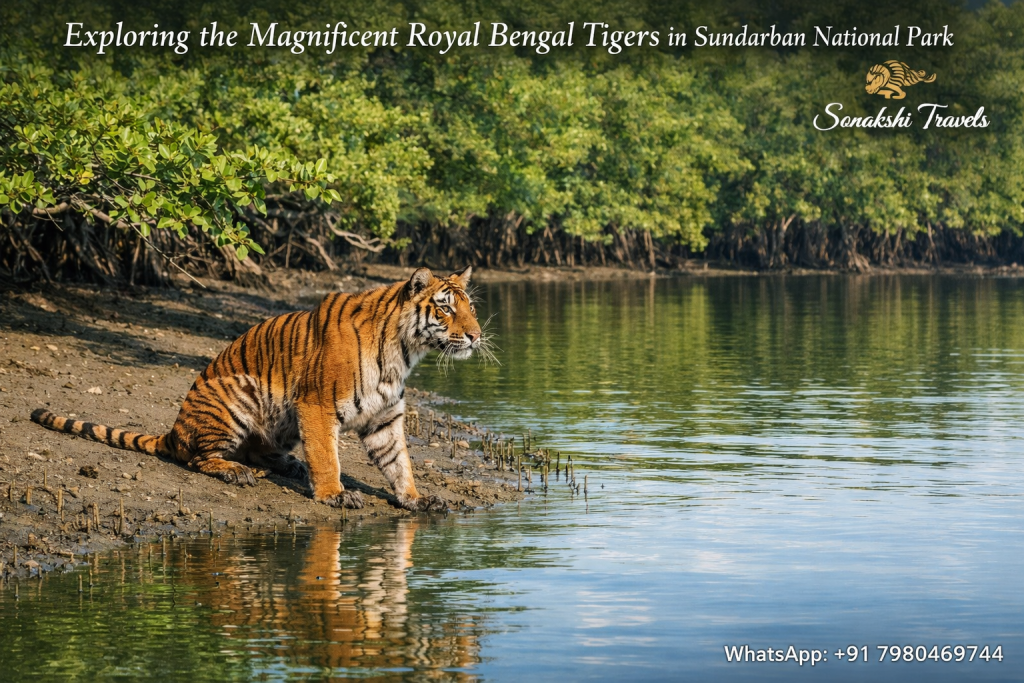
The Royal Bengal Tiger stands at the apex of India’s ecological imagination. Nowhere is its presence more complex, adaptive, or scientifically compelling than within the tidal mangrove wilderness of Sundarban National Park. As documented across Sundarban Travel, this protected delta is not simply a sanctuary where tigers survive; it is a dynamic estuarine system where the species has evolved behavioural, physiological, and spatial strategies to endure environmental extremes.
Exploring the Royal Bengal Tiger in Sundarban National Park requires more than admiration for a charismatic predator. It demands careful attention to how a large carnivore negotiates saline creeks, unstable mudflats, shifting islands, dense mangrove thickets, and fluctuating prey distribution. The tiger of this delta is not merely a forest animal living near water; it represents one of the most ecologically specialised tiger populations in the world.
The Ecological Setting of the Sundarban Tiger
Sundarban National Park forms part of the largest mangrove ecosystem on Earth, shaped by the confluence of the Ganges, Brahmaputra, and Meghna river systems. For travellers undertaking a structured Sundarban tour, the defining characteristic of this region becomes immediately apparent: land here is fluid rather than fixed. Islands erode and re-form, creeks alter course, and salinity levels influence vegetation patterns. For a territorial predator dependent on reliable hunting grounds, such instability creates constant adaptive pressure.
Unlike inland forests where topography remains relatively consistent, the delta landscape changes with each tidal cycle. Twice daily, large tracts of forest floor are submerged. Mudbanks disappear beneath brackish water and re-emerge hours later. Variations in salinity alter plant composition, which in turn shapes herbivore movement. The Royal Bengal Tiger must therefore recalibrate its territorial pathways, stalking routes, and resting zones in response to these environmental shifts.
Mangrove Vegetation and Habitat Structure
The dominant mangrove species—Heritiera fomes (Sundari), Avicennia, and Excoecaria—form dense root networks and narrow visibility corridors. These structural conditions significantly influence hunting techniques. In contrast to open grassland tigers that rely on extended visual pursuit, Sundarban tigers operate within compressed sightlines. Their approach is measured, silent, and dependent on precise spatial memory.
Pneumatophores, the breathing roots that protrude from tidal mud, create uneven and unstable ground. For a predator that may exceed 200 kilograms, maintaining balance while stalking prey across such terrain demands muscular efficiency and careful weight distribution. Field observations suggest that Sundarban tigers exhibit a distinctive gait suited to muddy substrates, minimising sinking while preserving stealth.
Adaptive Behaviour in a Tidal Environment
Behavioural flexibility is among the most studied characteristics of the Sundarban tiger population. These animals are powerful swimmers and frequently cross tidal channels that would deter many inland populations. Documented observations show individuals traversing significant stretches of open water between islands. This aquatic competence is essential for maintaining territorial continuity across a fragmented delta.
Territories in Sundarban National Park are often defined not by ridgelines or clearings, but by tidal creeks and shifting embankments. As islands shrink, expand, or alter shape, territorial boundaries change accordingly. Tigers must interpret these spatial adjustments and defend dynamic zones rather than static landscapes. Camera-trap data indicates that home ranges here are often more fluid than those in mainland reserves.
Hunting Strategies and Prey Dynamics
The primary prey base consists of spotted deer (Axis axis), wild boar, and smaller mammals adapted to mangrove conditions. However, prey density in tidal ecosystems is generally lower than in productive grasslands. As a result, Sundarban tigers expend greater energy per successful hunt. Ambush opportunities are frequently aligned with tidal timing, when exposed mudflats concentrate prey movement.
Studies suggest that these tigers adjust their activity cycles in response to tidal rhythms rather than adhering strictly to nocturnal or crepuscular patterns. Movement intensity often correlates with predictable prey behaviour during low tide. This temporal flexibility reflects a refined ecological intelligence shaped by environmental constraint.
Population Status and Conservation Realities
The Royal Bengal Tiger remains classified as Endangered under the IUCN Red List. Within the Sundarbans landscape shared by India and Bangladesh, population monitoring has improved through scientific methodologies including camera trapping, genetic sampling, and spatial modelling. For those exploring the region through a carefully structured Sundarban tour package, awareness of these conservation frameworks adds depth to the experience of the landscape.
Conservation challenges in the delta differ fundamentally from those in inland reserves. Beyond poaching, rising sea levels, increased salinity, and cyclonic disturbances directly influence habitat stability. Island submergence reduces available territory, intensifying competition among individuals. Protecting the tiger here therefore involves ecological management that addresses climate vulnerability as well as species security.
Human–Tiger Interface
Forest-dependent communities engage in fishing, honey collection, and wood gathering within buffer zones of the Sundarban region. Historical encounters between humans and tigers have shaped local perceptions and cultural narratives. Contemporary conservation frameworks integrate regulated access, compensation systems, and awareness initiatives to reduce conflict while preserving ecological balance.
Scholarly assessments of conflict patterns indicate that territorial defensiveness increases when natural prey availability declines or when tidal constraints limit movement corridors. Mitigation strategies therefore focus on maintaining prey populations and reducing unnecessary human intrusion into core habitats. Long-term survival depends on harmonising ecological integrity with socio-economic realities.
Physiological Resilience in a Saline Ecosystem
The saline character of the Sundarban environment imposes measurable stress on mammals. Tigers rely on freshwater sources formed by rainfall and upstream flows, yet salinity intrusion affects vegetation quality and prey distribution. Observations suggest behavioural selectivity in water consumption and adaptive metabolic responses that support survival under brackish conditions.
Analysis of scat and hair samples indicates dietary variability influenced by seasonal and hydrological shifts. This flexibility enables individuals to respond to changing ecological inputs without compromising territorial dominance. Such resilience underscores the tiger’s capacity to function within a habitat that is both physically demanding and biologically dynamic.
Scientific Monitoring and Research Methodologies
Monitoring tigers in mangrove forests presents logistical complexities. Dense vegetation restricts visibility, while tidal flooding limits the duration of ground surveys. Researchers deploy camera traps above high-tide lines and integrate GPS mapping with vegetation data to model distribution patterns. These approaches have refined understanding of movement corridors and habitat utilisation.
Genetic sampling contributes to insights regarding relatedness, dispersal, and overall population health. In a fragmented deltaic ecosystem, maintaining genetic diversity is critical. Connectivity between islands ensures breeding exchange and reduces inbreeding risk, strengthening long-term viability.
Transboundary Significance
The Sundarbans extend across India and Bangladesh, making tiger conservation inherently transboundary. Coordinated research initiatives enhance data accuracy and ecological planning. Shared strategies address habitat continuity across political boundaries, recognising that wildlife operates beyond administrative divisions.
Psychological Impact of Encountering a Sundarban Tiger
Encountering a Royal Bengal Tiger within its mangrove domain generates a distinct psychological response. Visibility is often partial and fleeting. A brief movement between tree trunks, a silent figure against a mudbank, or ripples along a creek surface intensify awareness of presence. For individuals participating in a carefully designed private Sundarban tour, such moments carry heightened meaning precisely because they are rare and unscripted.
This perceptual ambiguity deepens respect for the animal’s dominance. Unlike prolonged sightings in open habitats, here the tiger is sensed before it is fully seen. The landscape itself amplifies stealth and unpredictability, reinforcing the species’ role as apex predator within a concealed and intricate environment.
Ecological Role within the Mangrove Food Web
As the apex predator, the Royal Bengal Tiger regulates herbivore populations, preventing overgrazing of mangrove vegetation. In a fragile tidal system, unchecked deer numbers could disrupt regeneration of key plant species, weakening shoreline stability. The tiger’s predatory function therefore contributes indirectly to forest resilience and coastal integrity.
This trophic regulation sustains ecological equilibrium. Removal of the apex predator would trigger cascading effects throughout the food web, influencing prey abundance, vegetation density, and soil stability across the delta.
A Living Symbol of Ecological Endurance
The Royal Bengal Tiger of Sundarban National Park embodies adaptation under environmental extremes. It swims saline channels, hunts within tangled roots, and defends territory on land reshaped by tides. Its persistence reflects ecological ingenuity shaped by natural selection and supported by conservation science. For those who commit to immersive field observation through a longer 2 nights 3 days Sundarban Tour, understanding this endurance transforms the tiger from icon to ecological indicator.
To explore this species within Sundarban National Park is to recognise a predator refined by tidal forces and mangrove architecture. Its continued survival affirms the vitality of the delta itself. Safeguarding the Royal Bengal Tiger here is inseparable from preserving one of the world’s most intricate coastal ecosystems, where land and sea negotiate their boundaries each day.