Botanical Identity, Ecology, and Conservation Significance in Tropical Mangrove Landscapes
Finlaysonia obovata, locally known as Mamakola, is a lesser-known yet ecologically significant mangrove-associated climber belonging to the family Apocynaceae. Although it rarely attracts attention due to its non-timber nature and inconspicuous appearance, this plant plays an essential functional role within estuarine and mangrove ecosystems of South and Southeast Asia. Its presence is particularly notable in tidal forests such as the Sundarbans, where it contributes to habitat complexity, microclimate regulation, and biodiversity support.
This article presents a comprehensive, research-oriented overview of Finlaysonia obovata, focusing on its taxonomy, morphology, habitat preferences, ecological role, regional occurrence, and conservation relevance. Special emphasis is given to its association with the Sundarbans mangrove ecosystem, where environmental pressures are intensifying due to climate change and anthropogenic disturbances.
Taxonomy & Classification
Systematic Position
Finlaysonia obovata is classified under the Apocynaceae family, a large and diverse group comprising trees, shrubs, climbers, and herbs, many of which are characterized by milky latex and specialized floral structures. The genus Finlaysonia includes a small number of species adapted to coastal and riverine environments.
Kingdom: Plantae
Clade: Angiosperms
Clade: Eudicots
Order: Gentianales
Family: Apocynaceae
Subfamily: Apocynoideae
Genus:Finlaysonia
Species:Finlaysonia obovata
The species has undergone taxonomic revisions in historical literature, occasionally being placed under allied genera due to morphological similarities. However, modern botanical consensus recognizes Finlaysonia obovata as a distinct taxon based on floral morphology and growth habit.
Morphology & Field Identification
Growth Form and Stem Characteristics
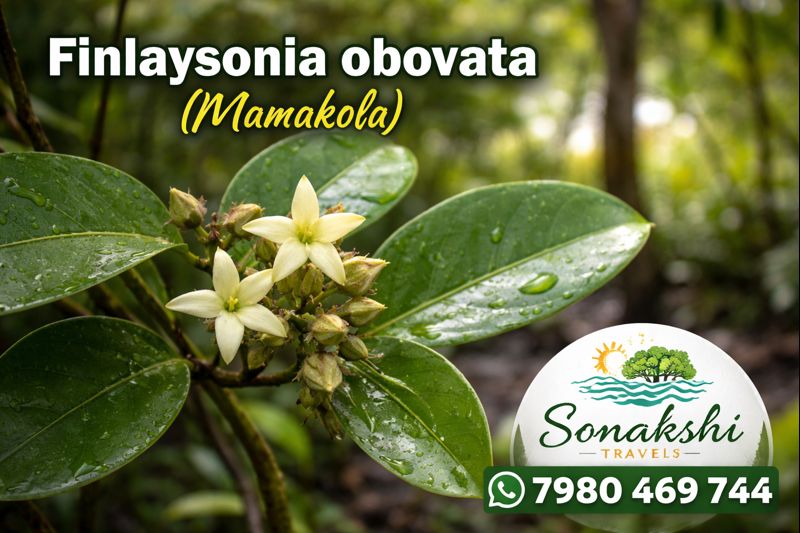
Finlaysonia obovata is a perennial woody climber or scandent shrub that typically uses surrounding vegetation for support. The stems are slender, flexible, and capable of twining or leaning over mangrove shrubs and small trees. Like many members of Apocynaceae, the plant exudes a milky latex when injured.
Leaves
The leaves are simple, opposite, and distinctly obovate in shape, a characteristic feature that aids field identification. Leaf blades are thick, leathery, and glabrous, with entire margins and a glossy surface. The leathery texture is an adaptive trait that minimizes water loss and provides resistance against saline spray.
Flowers and Reproductive Structures
The flowers are small to medium-sized, typically tubular, and arranged in axillary or terminal clusters. Corolla coloration ranges from pale yellowish to creamy white, occasionally tinged with green. The floral structure is specialized for insect pollination, particularly by small bees and flies that frequent mangrove margins.
Fruits are elongated follicles containing numerous seeds, often equipped with tufts of silky hairs that facilitate wind or water-assisted dispersal in tidal environments.
Habitat & Distribution
General Habitat Preference
Finlaysonia obovata is primarily associated with coastal and estuarine habitats. It favors semi-saline to moderately saline environments and is often found along tidal creeks, riverbanks, mangrove fringes, and brackish wetlands. The species shows a marked preference for areas that experience periodic tidal inundation without prolonged waterlogging.
Soil and Hydrological Conditions
The plant thrives in alluvial, silty-clay soils enriched with organic matter. Such substrates are typical of deltaic systems where sediment deposition is continuous. Its root system is adapted to fluctuating oxygen availability, allowing survival in hypoxic soils common to mangrove zones.
Global Range
The natural distribution of Finlaysonia obovata extends across parts of South Asia and Southeast Asia. Recorded occurrences include eastern India, Bangladesh, Myanmar, Thailand, and parts of the Malay Peninsula. Within this range, the species is typically localized rather than widespread, occurring in fragmented populations tied closely to suitable estuarine habitats.
Its patchy distribution reflects both its ecological specialization and the declining availability of intact coastal vegetation across the region.
Occurrence
In India, Finlaysonia obovata is most commonly documented from eastern coastal states, particularly West Bengal and Odisha. In West Bengal, its presence is closely linked to the lower Gangetic delta, where brackish-water ecosystems dominate the landscape.
The species is not typically abundant, and its populations are often overlooked due to its climbing habit and tendency to merge visually with surrounding vegetation.
Preferred Habitat in the Sundarbans Region
Microhabitat Selection
Within the Sundarbans, Finlaysonia obovata occupies transitional zones between dense mangrove forests and open tidal flats. It is frequently observed climbing on shrubs such as Acanthus and young mangrove trees along creek edges.
These microhabitats provide partial shade, protection from strong tidal currents, and access to pollinators, making them ideal for the species’ growth and reproduction.
Ecological Association
The plant coexists with a variety of mangrove and mangrove-associate species, contributing to the structural complexity of the forest edge. This complexity enhances habitat suitability for insects, small reptiles, and nesting birds.
For nature enthusiasts seeking an immersive understanding of mangrove flora, a professionally guided Sundarban Tour offers valuable opportunities to observe rare climbers like Mamakola in their natural setting.
Ecological Role
Biodiversity Support
Finlaysonia obovata plays a subtle yet meaningful role in supporting biodiversity. Its flowers provide nectar resources for pollinating insects, while its dense foliage offers shelter for invertebrates. By climbing over shrubs, it also creates layered vegetation structures that enhance microhabitat diversity.
Ecosystem Stability
The root system of the plant contributes to soil stabilization along creek banks, reducing erosion caused by tidal action. Such stabilization is crucial in mangrove ecosystems, where land loss is a persistent concern.
Habitat Alteration
The primary threats to Finlaysonia obovata arise from habitat alteration. Coastal development, embankment construction, aquaculture expansion, and pollution have significantly reduced suitable habitats. In the Sundarbans, increased salinity intrusion and cyclonic disturbances further exacerbate stress on mangrove-associated flora.
Although the species shows some tolerance to salinity fluctuations, extreme and prolonged changes can impair flowering, seed set, and long-term population viability.
Conservation Efforts
Indirect Protection Through Habitat Conservation
Finlaysonia obovata is not currently the focus of species-specific conservation programs. However, it benefits indirectly from the protection of mangrove forests and estuarine reserves. Conservation initiatives aimed at preserving mangrove integrity inherently safeguard associated climbers and understory plants.
Need for Botanical Documentation
Improved field surveys, herbarium documentation, and ecological studies are essential to better understand the species’ population status and ecological requirements. Such data are critical for incorporating lesser-known plants into broader conservation planning.
Exploring mangrove biodiversity responsibly becomes more meaningful through an organized Sundarban Tour, where ecological awareness and conservation values go hand in hand.
Did You Know?
Finlaysonia obovata belongs to the same family as several medicinally important plants, although its own pharmacological properties remain underexplored.
The obovate leaf shape is a key diagnostic feature that distinguishes it from other mangrove climbers.
The plant’s seeds are adapted for dispersal in tidal environments, allowing colonization of new creek margins.
Its presence often indicates relatively undisturbed mangrove fringe habitats.
External Reference
For general taxonomic background and global references, readers may consult the following source: