A Comprehensive Biological and Ecological Profile of a Coastal Shorebird
Taxonomy & Classification
The Kentish Plover (Charadrius alexandrinus) is a small shorebird belonging to the family Charadriidae, a group that includes plovers, lapwings, and dotterels. This family is widely distributed across coastal, inland wetland, and semi-arid landscapes. The genus Charadrius comprises numerous species adapted to open habitats where ground nesting and visual foraging strategies dominate. Taxonomically, the Kentish Plover has been the subject of extensive ornithological research due to its wide geographic range and notable regional variations. Molecular studies indicate that populations across Eurasia, Africa, and parts of Asia share a common evolutionary lineage, with subtle genetic differentiation reflecting long-term geographic isolation and habitat specialization.
Morphology & Field Identification
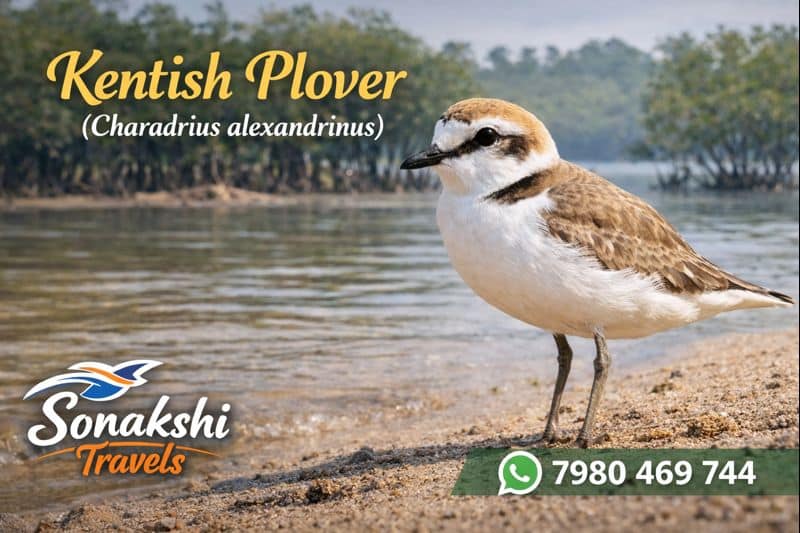
The Kentish Plover is a delicately built bird characterized by its compact body, slender legs, and proportionately short bill. In the field, it is best identified by its pale sandy-brown upperparts, clean white underparts, and contrasting facial markings. Its overall coloration blends seamlessly with sandy beaches, mudflats, and saline flats, making visual detection challenging when the bird remains motionless. The species exhibits seasonal plumage variation, with breeding individuals displaying more pronounced markings than non-breeding birds.
Male Features
During the breeding season, male Kentish Plovers exhibit distinct black markings on the sides of the breast and a black band extending from the bill through the eye to the ear coverts. A partial black collar is often visible on the upper chest, contrasting sharply with the white throat and underparts. The crown may show darker brown tones, enhancing the bird’s facial contrast. These features play a significant role in mate attraction and territorial displays during the breeding period.
Female Features
Females closely resemble males but generally possess duller and browner facial markings. The black areas present in males are replaced by dark brown or greyish tones in females. This subtle sexual dimorphism aids field identification when birds are observed closely during the breeding season. Outside the breeding period, both sexes appear more uniformly pale, making differentiation difficult without behavioral cues.
Size & Wingspan
The Kentish Plover is a small shorebird, measuring approximately 15–17 centimeters in length. Its wingspan ranges from 42 to 45 centimeters, allowing for agile and sustained flight over coastal environments. Adult body weight typically falls between 35 and 45 grams, reflecting its lightweight build and energy-efficient design for long-distance movement.
Flight Characteristics
In flight, the Kentish Plover displays rapid wingbeats interspersed with short glides. The flight is low and direct, often following the contours of the shoreline or mudflat. When disturbed, the bird rises swiftly, emitting soft calls before settling again at a short distance. During migration, individuals are capable of sustained nocturnal flight, covering considerable distances between stopover sites.
Habitat & Distribution
Global Range
The Kentish Plover has an extensive distribution spanning southern Europe, North Africa, the Middle East, Central Asia, South Asia, and parts of East Asia. It also occurs across coastal regions of Africa and extends into Southeast Asia. This broad range reflects the species’ adaptability to diverse coastal and inland saline habitats.
Preferred Habitat
The species favors open, sparsely vegetated habitats such as sandy beaches, tidal mudflats, salt pans, brackish lagoons, and saline lakes. Areas with minimal human disturbance and gently sloping substrates are particularly important for breeding and foraging. The absence of dense vegetation allows unobstructed views, aiding predator detection.
Diet & Feeding Ecology
Kentish Plovers are primarily insectivorous, feeding on a wide array of small invertebrates. Their diet includes insects, insect larvae, small crustaceans, worms, and mollusks. The species exhibits dietary flexibility, adjusting prey selection based on seasonal availability and habitat conditions.
Foraging Technique
Foraging typically involves a characteristic run-and-pause technique. The bird runs a short distance, stops abruptly to visually locate prey, and then pecks rapidly. This method is highly effective in open habitats where prey items are visible on or just below the surface. Foraging occurs throughout the day, with increased activity during low tide in coastal areas.
Breeding & Reproduction
Breeding seasons vary geographically but are generally timed to coincide with favorable climatic conditions and food availability. The Kentish Plover is known for its flexible mating system, which may include monogamy, sequential polyandry, or polygyny depending on environmental conditions.
Nesting Sites
Nests are simple scrapes in the ground, often lined with small pebbles, shells, or plant fragments. These nests are typically placed on open sandy or gravelly substrates, where their appearance closely matches the surrounding environment. Clutch size usually consists of three eggs, which are cryptically colored to blend with the substrate.
Unique Adaptations & Behavioral Ecology
Speed & Agility
The Kentish Plover exhibits remarkable agility on the ground. Its long legs and lightweight body enable rapid bursts of speed, allowing it to evade predators effectively. Quick directional changes and sudden stops are common defensive behaviors.
Camouflage and Nesting Strategy
Camouflage is a critical survival adaptation for this species. Adult plumage closely matches sandy and saline substrates, while eggs are exceptionally well camouflaged. When threatened, adults may perform distraction displays, feigning injury to draw predators away from the nest.
Social Behavior
Outside the breeding season, Kentish Plovers are generally gregarious, forming small flocks during migration and wintering periods. During breeding, however, individuals become highly territorial and defensive of nesting sites.
Occurrence & Seasonal Movement
The species is partially migratory. Populations breeding in temperate regions migrate southward during winter, while those in tropical and subtropical areas may remain resident or exhibit short-distance movements in response to water levels and food availability.
Preferred Habitat in the Sundarbans Region
Within the Sundarbans, the Kentish Plover is most commonly observed along open mudflats, sandy riverbanks, and saline coastal fringes. Areas with limited mangrove density and exposed substrates provide ideal conditions for foraging and resting, particularly during migratory stopovers.
Exploring the coastal birdlife of eastern India becomes truly rewarding with a guided Sundarban Tour, offering close encounters with diverse shorebirds in their natural habitats.
Ecological Role
The Kentish Plover plays an important ecological role by regulating populations of small invertebrates in coastal and saline ecosystems. Its presence is often considered an indicator of healthy, undisturbed shoreline environments.
Habitat Alteration
Coastal development, tourism pressure, pollution, and alteration of natural hydrology pose significant threats to suitable habitats. Nesting sites are particularly vulnerable to trampling and vehicular movement on beaches.
Conservation Efforts
Conservation initiatives focus on habitat protection, regulation of human activities in breeding areas, and long-term population monitoring. Protected coastal zones and awareness programs have proven effective in stabilizing local populations.
Did You Know?
The Kentish Plover is known for its complex breeding strategies, including cases where one parent may leave the brood early, allowing the remaining parent to continue chick rearing independently.
External Reference
For additional scientific information, consult the species account on Wikipedia.
Witness migratory shorebirds and pristine tidal landscapes through a carefully curated Sundarban Tour, designed for nature enthusiasts and wildlife observers.