Updated Date: 19 February 2026
Sundarban Sanctuary Tour: An Abode of Nature’s Beauty
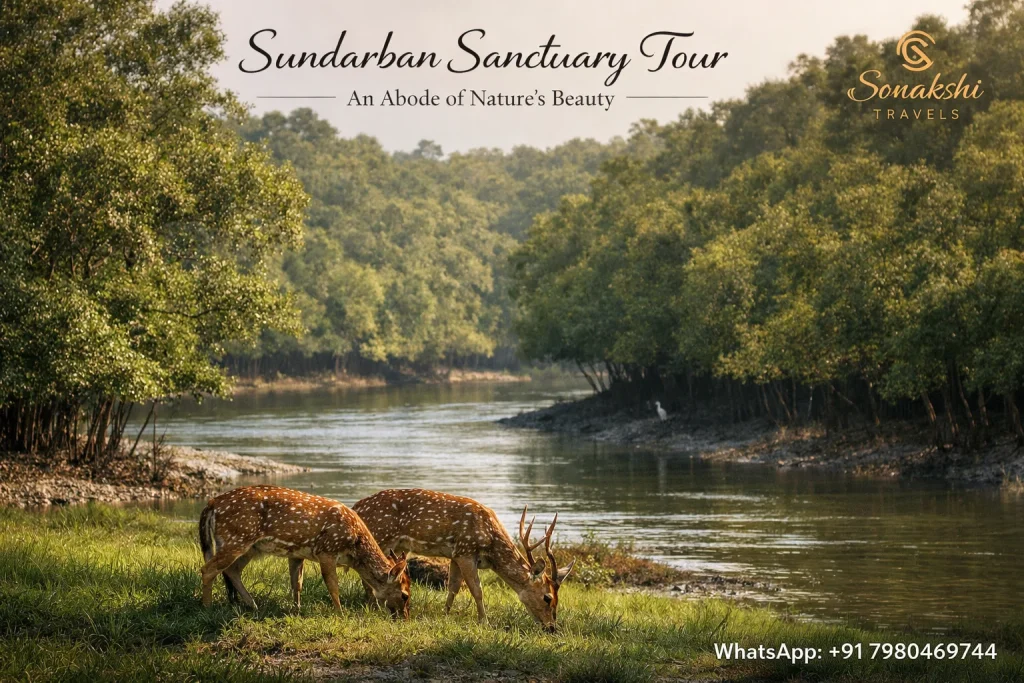
The Sundarban Sanctuary represents one of the most intricate and ecologically refined systems on Earth. Situated within a vast delta shaped by sediment-rich rivers and powerful tidal exchanges, this protected landscape functions as a living interface between land and sea. Any meaningful understanding of this environment begins with a broader study of Sundarban Travel, where the sanctuary emerges not as a conventional forest reserve but as a tidal ecosystem governed by salinity gradients, hydrological rhythms, and evolutionary adaptation. Here, water defines structure, movement, and survival.
A substantial portion of the mangrove forest extends into Bangladesh, while the Indian segment is administered as a designated wildlife sanctuary of global ecological importance. Its recognition as a heritage ecosystem reflects not only species richness but also its scientific relevance in coastal resilience studies. Mangrove vegetation, estuarine channels, and intertidal mudflats combine to sustain endangered fauna, including the Bengal tiger, saltwater crocodile, and a remarkable concentration of avian diversity.
The Ecological Architecture of the Sanctuary

The sanctuary is structured around a dynamic hydrological framework. Unlike inland forests defined by continuous terrain, this landscape is segmented by tidal rivers, narrow creeks, and shifting sediment banks. Water does not merely traverse the terrain; it reorganizes it. Twice-daily tidal fluctuations regulate soil salinity, nutrient circulation, and vegetative distribution. This recurring exchange creates ecological heterogeneity, allowing microhabitats to exist within tightly interconnected zones. Such structural complexity becomes evident during a carefully regulated guided exploration of the Sundarban region, where the fluid boundaries between land and water are clearly observed.
Mangrove species form the biological foundation of the sanctuary. These trees possess specialized adaptations including salt-filtering root membranes, aerial pneumatophores for respiration in oxygen-poor soils, and viviparous seed development that ensures propagation in unstable substrates. Their distribution reflects salinity tolerance, resulting in stratified vegetation belts across tidal gradients. This botanical architecture determines habitat suitability for numerous terrestrial and aquatic species.
The mangrove network performs vital environmental functions. Root systems trap suspended sediments, gradually stabilizing emerging landforms and minimizing erosion. Dense vegetation reduces tidal energy and mitigates storm impact, acting as a natural coastal buffer. Simultaneously, decomposing leaf litter enriches the estuarine substrate, supporting plankton growth and sustaining aquatic food chains. Through these processes, the sanctuary operates as a self-renewing estuarine system.
Wildlife Dynamics Within the Mangrove Matrix
The Bengal Tiger in a Tidal Landscape
The Bengal tiger population of the Sundarban Sanctuary represents a uniquely adapted apex predator community. Unlike tigers inhabiting dry deciduous forests, these individuals navigate saline creeks, swim across tidal channels, and hunt within fragmented island habitats. Their territorial ranges are influenced by tidal movement and prey distribution rather than static land boundaries. Detailed wildlife observation during an exclusive Sundarban private expedition often reveals how the species adapts to this aquatic terrain without compromising predatory efficiency.
Field studies indicate strong swimming proficiency and behavioural flexibility. The prey base, including chital deer and wild boar, varies according to habitat accessibility influenced by tidal inundation. Dense mangrove cover provides concealment, enabling ambush strategies suited to limited visibility conditions. This predator-prey balance reflects ecological equilibrium rather than dominance.
Reptilian and Aquatic Predators
The saltwater crocodile inhabits brackish estuaries and tidal channels within the sanctuary. As one of the largest living reptiles, it occupies the apex of aquatic food webs, regulating fish populations and contributing to ecological stability. Its survival signals the presence of a productive and balanced estuarine system.
Indian pythons and monitor lizards inhabit elevated mudbanks and vegetated corridors, relying on both terrestrial and aquatic prey. Their presence further illustrates the sanctuary’s interdependent habitat structure, where land-water transitions sustain diverse reptilian communities.
Avian Biodiversity and Migratory Significance
The sanctuary supports over 250 recorded bird species, including residents and migratory visitors. Rare sightings such as the masked finfoot and mangrove pitta underscore its global ornithological importance. Waders, raptors, and kingfishers occupy distinct feeding niches along tidal gradients. The density of avifauna often becomes particularly observable during a structured well-organized Sundarban travel program, where slow navigation through creeks enhances bird-watching precision.
Shallow waterways rich in crustaceans and small fish provide feeding grounds, while mangrove canopies offer nesting protection. Seasonal migration patterns connect the sanctuary to broader continental flyways, reinforcing its ecological significance beyond regional boundaries.
The Role of Mangroves in Coastal Protection and Livelihood Systems
Mangroves extend their ecological contribution beyond wildlife support. By trapping sediments and reinforcing shorelines, they maintain island stability within an environment shaped by tidal flux. Their structural density disperses wave energy, reducing the impact of storm surges on adjacent settlements.
Ecologically, submerged roots serve as nurseries for fish, shrimps, and crabs. Juvenile marine organisms find refuge in this complex root network, protected from predators. This breeding function supports fisheries that sustain communities near buffer zones. Conservation oversight ensures that resource use remains balanced, preserving regenerative cycles essential to both biodiversity and human livelihoods.
The equilibrium between ecological preservation and livelihood dependence requires structured regulation. Controlled access policies and monitored extraction practices maintain habitat integrity while recognizing socio-economic realities.
Experiencing the Sanctuary Through River Navigation
River navigation remains the principal mode of accessing the sanctuary. Movement through narrow tidal creeks allows close observation of mangrove density, mudbank formations, and subtle wildlife traces. The experience differs fundamentally from land-based reserves, as visibility depends on tidal height and vegetative thickness. A thoughtfully designed Sundarban luxury wildlife journey emphasizes silent progression and ecological attentiveness rather than pursuit.
Observers learn to interpret indirect signs such as disturbed sediments or alarm calls among birds. This interpretive engagement fosters deeper ecological awareness. Navigation also reveals geomorphological shifts—eroding banks, newly deposited silt beds, and redefined creek alignments—illustrating that the sanctuary is in continuous transformation.
For visitors seeking extended immersion in this tidal ecosystem, structured programs such as a 2 Nights 3 Days Sundarban tour experience provide adequate time to observe these gradual environmental processes without rushing ecological interpretation.
Regulated Entry and Conservation Governance
The sanctuary operates under strict regulatory oversight. Formal permission procedures are mandatory prior to entry, ensuring visitor numbers remain within ecological carrying capacity limits. Administrative monitoring preserves habitat security and safeguards breeding zones.
Conservation guidelines prohibit disruptive activities, including excessive noise and waste disposal within protected channels. These regulations are ecological necessities rather than procedural formalities. Management integrates forest officials, conservation biologists, and local stakeholders to implement adaptive strategies informed by ongoing population monitoring of tigers, crocodiles, and avian species.
Data-driven governance allows authorities to respond to environmental variability, reinforcing the sanctuary’s resilience. This structured oversight ensures that exploration remains compatible with long-term preservation goals.
Interconnected Ecosystem Processes
The sanctuary exemplifies ecological interdependence. Mangrove leaf litter decomposes into nutrient-rich detritus, sustaining plankton populations that feed fish and crustaceans. These species support reptiles and birds, while herbivores grazing along vegetated banks sustain carnivorous predators. Energy transfer across trophic levels maintains system equilibrium.
Salinity gradients determine vegetation distribution, which in turn influences faunal patterns. High-salinity zones host distinct mangrove varieties compared to comparatively fresher channels. Wildlife distribution mirrors these botanical shifts, reinforcing the sanctuary’s identity as a mosaic of interconnected habitats rather than a uniform forest block.
This layered complexity enhances resilience. Localized disturbances can be absorbed through adaptive processes in adjacent habitats. Such ecological flexibility explains the sanctuary’s capacity to endure hydrological variability over extended periods.
Human Presence and Cultural Interaction
Communities residing near the sanctuary maintain longstanding cultural relationships with the forest environment. Knowledge of tidal rhythms, seasonal fishing cycles, and estuarine navigation reflects adaptation to a landscape shaped by water. While direct extraction within core zones remains restricted, peripheral interactions influence a broader socio-ecological system.
Cultural narratives often portray the forest as both benefactor and force of nature, embodying respect for ecological unpredictability. This human dimension complements scientific understanding, illustrating how environmental systems shape identity and livelihood practices in coastal regions.
The Sanctuary as a Living Ecological Entity
The Sundarban Sanctuary represents a convergence of biological adaptation, tidal geomorphology, and structured conservation governance. From microscopic plankton to apex predators, each life form operates within a delicately balanced system defined by salinity and sediment flow. The persistence of the Bengal tiger within this saline terrain underscores evolutionary resilience, while avian migrations highlight its global ecological connectivity.
Engagement with this protected landscape reveals more than visual beauty; it exposes the intricacies of ecological processes that sustain coastal systems. Every creek and mangrove root contributes to a dynamic equilibrium shaped by water and regulated stewardship.
As an abode of nature’s beauty, the sanctuary stands as a testament to ecological adaptation and interdependence. Its preservation remains essential not only for wildlife conservation but for advancing scientific understanding of mangrove ecosystems and their role in global coastal sustainability.