Updated : 20 February 2026
Sundarban Tour Package: A Journey to the Land of the Giant Salamander
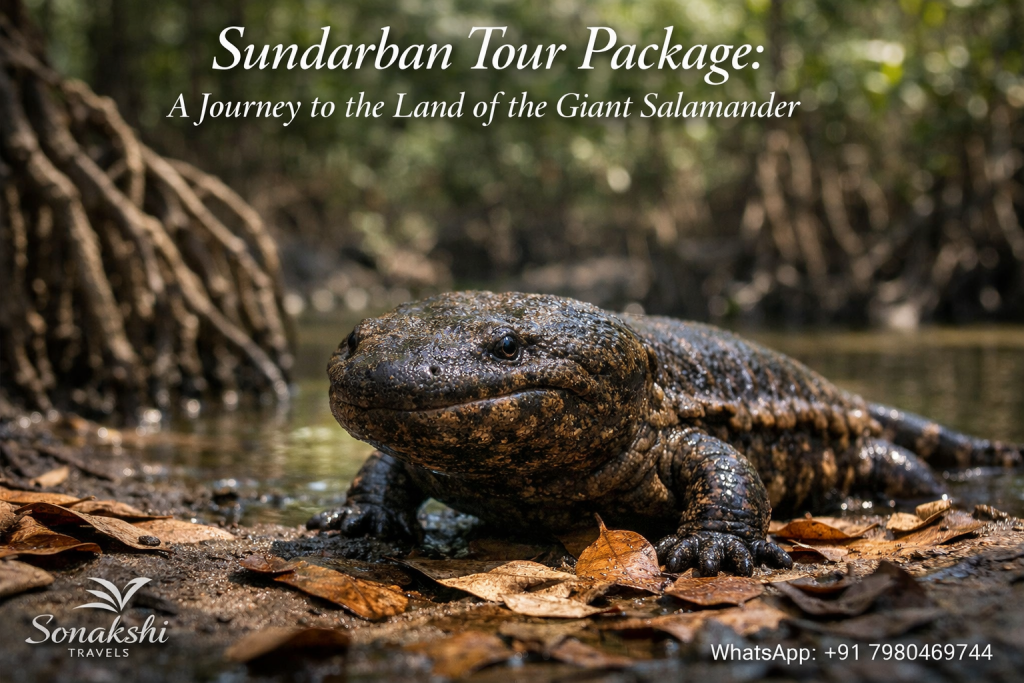
The mangrove delta known as the Sundarban represents one of the most ecologically complex wetland systems in the world. Within this interwoven network of tidal creeks, brackish water channels, mudflats, and submerged roots survives a range of highly specialized organisms. As documented across the broader ecological framework presented on Sundarban Travel, the region’s biodiversity extends far beyond its most visible wildlife icons. Among these lesser-known inhabitants, the giant salamander occupies a particularly intriguing ecological position. A carefully structured exploration allows travelers to engage with this elusive amphibian while observing the wider biological matrix that sustains it.
Unlike charismatic megafauna that dominate popular imagination, the giant salamander is rarely conspicuous. Its presence is subtle and dependent on water salinity gradients, sediment composition, prey availability, and tidal fluctuation. The journey, therefore, is not merely about sighting a rare amphibian. It is about understanding the environmental conditions that permit such a species to survive in a mangrove-dominated estuarine landscape. A well-designed Sundarban tour package frames the amphibian within this ecological context rather than reducing the experience to chance observation.

The Ecological Identity of the Giant Salamander in the Mangrove System
The amphibian commonly referred to as the “giant salamander” within local discourse belongs to a group of large-bodied, aquatic salamanders adapted to slow-moving or semi-stagnant waters. In the tidal channels of the delta, its survival depends on a delicate balance between freshwater influx and saline intrusion. Unlike inland river systems with relatively stable salinity, this environment shifts continuously. Twice-daily tides alter chemical composition, oxygen concentration, and nutrient distribution, directly influencing amphibian viability.
Adaptation to Brackish Conditions
Amphibians are generally sensitive to changes in salinity due to their permeable skin. The persistence of a giant salamander in an estuarine setting therefore signals remarkable physiological tolerance. Studies on estuarine amphibians suggest that osmoregulatory mechanisms enable them to maintain internal equilibrium despite fluctuating external salinity. Transitional waters—where freshwater streams merge with tidal creeks—often provide comparatively stable microconditions suitable for such species.
During a carefully guided Sundarban tour, exploration of these transitional zones becomes central to the interpretive experience. Visitors observe not only the amphibian’s habitat but also the hydrological interplay that shapes its distribution.
Role in the Aquatic Food Web
The giant salamander functions as a mid-level predator within the estuarine food web. Its diet typically consists of small fish, crustaceans, insect larvae, and occasionally other amphibians. By regulating these populations, it contributes to trophic stability. In mangrove systems where nutrient cycling is driven by decomposing leaf litter and plankton productivity, such predation helps maintain ecological balance.
During boat-based observation, trained naturalists interpret subtle environmental indicators—water turbidity, mangrove root density, prey movement—that collectively suggest amphibian presence. The journey evolves into an exercise in ecological literacy rather than passive sightseeing.
Mangrove Forest Exploration as Ecological Study
The boat safari component forms the structural core of the experience. Unlike terrestrial wildlife drives, movement occurs through narrow creeks bordered by mangrove roots that descend vertically into tidal water. These root systems create shaded, oxygen-moderated microhabitats that shelter juvenile fish and amphibians alike.
Root Architecture and Microhabitats
Mangrove pneumatophores and prop roots alter sediment composition and slow water velocity. Such conditions favor amphibians requiring concealed resting grounds and stable substrates. By navigating channels at controlled speeds, observers can detect surface disturbances or faint ripples that indicate aquatic life below.
The interpretive value lies in recognizing how vegetation architecture influences species distribution. The salamander’s presence cannot be separated from root density, sediment layering, and tidal rhythm. The forest is not passive scenery; it is an ecological architect.
Sensory Dimensions of the Boat Experience
Exploration through water reshapes perception. Sound transmission differs across tidal creeks; vibrations travel through hull and water column. Experienced guides read these sensory cues—disturbed sediment plumes, shifts in bird activity, or sudden fish movement—to assess potential amphibian zones.
For travelers seeking deeper engagement, a more personalized format such as a Sundarban private tour allows extended observation time in selected creeks, increasing interpretive depth without disrupting habitat integrity.
Wildlife Photography and Amphibian Documentation
The delta provides a demanding yet rewarding environment for wildlife photography. Photographing an aquatic amphibian requires technical precision, patience, and environmental awareness. Unlike large terrestrial mammals, salamanders often surface briefly and unpredictably.
Technical Considerations in Estuarine Conditions
Mangrove channels reflect light intensely during specific tidal phases. Photographers must account for glare, surface distortion, and variable visibility. Polarizing filters reduce reflection, while higher shutter speeds help capture movement during fleeting appearances.
In more refined formats such as a luxury-oriented Sundarban tour, smaller group size can facilitate quieter positioning of the vessel, improving photographic opportunities without ecological disturbance.
Ethical Photography Practices
Responsible documentation avoids stress and habitat interference. Amphibians are particularly sensitive to disturbance. Structured guidelines emphasize maintaining distance, minimizing noise, and refraining from altering the environment for clearer shots.
The objective remains observation rather than manipulation. Ethical discipline ensures that documentation contributes to awareness without compromising ecological stability.
Interpretive Role of the Local Guide
An experienced guide transforms wildlife viewing into informed ecological engagement. Knowledge of amphibian behavior, breeding cycles, and microhabitat preference requires sustained interaction with the landscape.
Behavioral Indicators
Giant salamanders often display nocturnal or crepuscular tendencies. Even in daylight, subtle signs—air bubbles near submerged logs, faint silt disturbances—may indicate presence. Guides trained in recognizing these cues enhance the probability of informed observation.
Their interpretation extends beyond immediate sightings, connecting amphibian survival to wetland conservation and hydrological balance.
Knowledge Transmission and Conservation Awareness
Amphibians globally face threats from pollution, habitat fragmentation, and climate-induced salinity shifts. Understanding these vulnerabilities within the mangrove context fosters ecological responsibility. Guided discussion situates the salamander within broader conservation discourse, reinforcing awareness of fragile estuarine systems.
Accommodation Within the Natural Setting
Lodging integrated into the surrounding landscape enables reflection on daily ecological observations. Proximity to tidal creeks maintains sensory continuity—shifting water levels, distant avian calls, saline air currents.
For travelers with limited schedules yet interest in focused biodiversity interpretation, shorter formats such as a 1 night 2 days Sundarban package can still provide meaningful immersion when structured around ecological priorities rather than superficial sightseeing.
Culinary Context and Local Knowledge Systems
Meals prepared locally form part of the experiential continuum. Culinary traditions reflect adaptation to estuarine conditions—fish and crustaceans shaped by brackish ecosystems, rice cultivated in saline-tolerant fields.
Discussion during shared meals often revisits themes introduced during creek exploration: salinity shifts, aquatic diversity, and ecological interdependence. Biological understanding becomes interwoven with lived experience.
The Giant Salamander as a Symbol of Hidden Biodiversity
Public narratives frequently associate the delta with apex predators. Yet ecosystems are sustained by intermediate species that regulate ecological balance. The giant salamander represents this concealed dimension of biodiversity.
Its elusive character challenges spectacle-driven expectations. Even without direct sighting, contextual understanding of habitat dynamics deepens appreciation for the complexity of estuarine life. The amphibian becomes a symbol of the subtle processes sustaining mangrove ecosystems.
Conclusion: Ecological Immersion Through Focused Exploration
A thoughtfully structured journey centered on the giant salamander represents more than wildlife viewing. It is an interpretive engagement with estuarine ecology, amphibian adaptation, and mangrove architecture. Through guided boat exploration, disciplined photography, ecological interpretation, and immersion within the tidal environment, visitors gain insight into the delicate interdependencies defining the delta.
The journey to the land of the giant salamander demands attentiveness and patience. In return, it offers a nuanced understanding of biodiversity beyond the obvious, revealing intricate layers that sustain life within the Sundarban mangrove landscape.