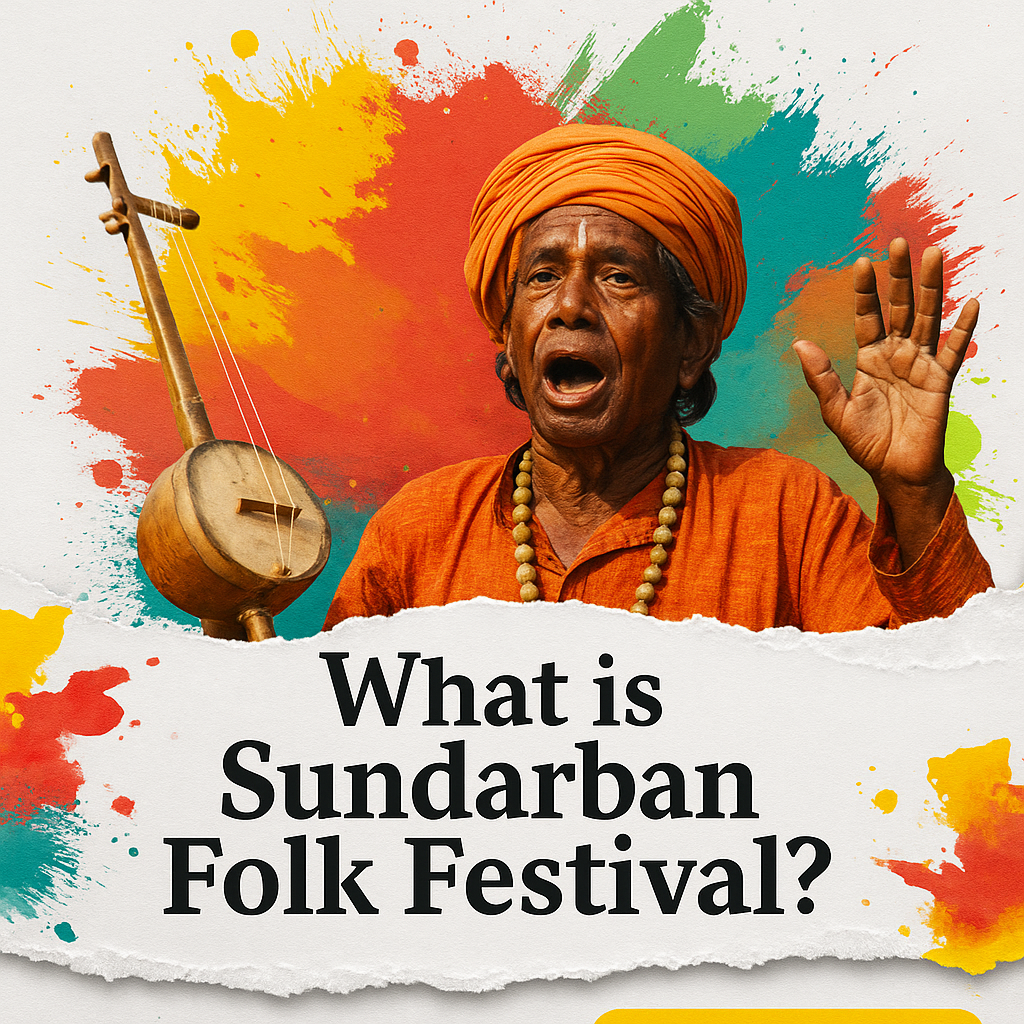
🪔 It began with the scent of incense and the beat of a single drum…
The first sound I heard wasn’t the cry of a kingfisher or the gentle slap of water on the boat’s hull.
It was the rhythmic beat of a dhak, rolling across the twilight river like a memory reawakened.
I was on my third evening in the Sundarbans, expecting silence and solitude. But instead, I found a village field bathed in fairy lights, women in red-bordered sarees singing in circles, and a man with kohl-lined eyes telling stories with his arms outstretched.
That was the night I stumbled into the Sundarban Folk Festival, and my idea of a cultural celebration changed forever.
🎭 The Festival You Can’t Find on a Map
🧭 Where GPS ends and folklore begins
The Sundarban Folk Festival isn’t held at a specific address.
It isn’t a ticketed event.
It doesn’t trend on social media.
Instead, it rises from the riverbanks — wherever stories, songs, and survival meet.
Held during the monsoon and winter seasons (often coinciding with Hilsa Festival or local harvest rituals), this festival is a living, breathing expression of the delta’s people — boatmen, farmers, singers, mystics.
It’s more communion than event.
More ancestral echo than advertisement.
Sundarban Baul songs, folk traditions of Bengal, Sundarban cultural celebration
💌 A Postcard to Myself: Found in a Patch of Firelight
“Dear Self,”
Today, you stopped recording and started listening. You stood barefoot in wet grass while a blind singer sang of gods who hide in forests. You tasted puffed rice sweetened with jaggery while children painted tigers on the ground. You didn’t just attend a festival. You became part of one.”
Remember that.
🎤 Voices of the Mangrove – Sounds that Stitch Time
🎵 Baul and Bhatiyali – Songs That Float Like Boats
One of the first performers I met was Nimai Da, a Baul singer with dreadlocked hair, wearing saffron and spinning a one-string ektara like it held the universe.
“We sing not of gods in sky, but gods in men,” he told me, plucking a note that felt like honey poured over thunder.
Every folk festival in Sundarban features Baul, Bhatiyali, and Jhumur performances — musical forms shaped by the tides, fields, and faith of Bengal.
🎶 You’ll hear lyrics like: “Amar moner manush ache re, shey rekechhe amare bashi”
(There lives someone in my soul, playing me like a flute.)
🔥 Bonfire Jatra – Drama Under the Stars
Later that night, a folk theatre troupe performed an open-air Jatra drama — loud, expressive, mythical.
Gods argued under strobe lights.
Demons danced on bamboo stilts.
The audience gasped, cheered, and sometimes cried.
I sat beside a grandmother with her grandson in her lap. When Gazi Pir was invoked on stage, she clutched his hand and whispered, “Ei amader rakhwala.”
(This is our protector.)
🪔 Theatrical forms likeGazi Katha, Behula-Lakhinder, and Manasa Mangal are common themes — stories rooted deep in local fears, floods, and faith.
👣 Feet in Mud, Eyes on Stars – My Walk Through the Festival
🌾 Crafts, Colors, and Conversations
The next morning, I walked through the festival grounds:
Clay idols of Bonbibi, hand-painted with reverence
Woven mats, bamboo flutes, shell bangles
Children selling tiger masks made of paper and rice paste
I bought one. Wore it.
A group of schoolgirls laughed and called me “Bondhur Bagh Mama” (Uncle Tiger Friend).
And just like that, I wasn’t an outsider anymore.
🐅 Folk Meets Forest – Rituals Beyond Performance
In the corners of the festival, you’ll find rituals few tourists notice:
A mud pot filled with rice and sindoor, guarded by an old woman in white
A floating diya (lamp) offered to the Matla River
A prayer whispered to Dakshin Rai for protection from tigers
These are not for the stage.
These are for the soul.
🙏 Dakshin Rai and Bonbibi are the twin protectors of the forest and its people — invoked not in temples, but through story, song, and shrine.
🧓 Through the Eyes of a Grandmother – Miniature Tales
🪢 Introducing Shantirani Thakur
Wearing a faded white saree and coral bangles, she watched every performance from the same seat.
I joined her one afternoon during a puppet show about a fisherman lost at sea.
She told me:
“Aamar ekta chele chhilo, gela boney. Bonbibi-ke diya eto din ashirbad chai. Ei utsobey tomar moto loker asha-i ashirbad.” (I had a son who went missing in the jungle. I’ve been praying to Bonbibi for years. This festival, and people like you coming to it — is itself a blessing.)
That night, she gave me a string amulet and said,
“Raksha korbey.”
(It’ll protect you.)
I still wear it.
📓 What I Took Away — My Festival Journal in Scribbles
📌 Moments etched in ink:
The smell of burnt coconut husk before a performance
The taste of bhapa pithe wrapped in sal leaves
A goat wandering on stage mid-play, and the audience cheering it like a guest star
A poet reciting: “Ei nodi noy tomar amar, ei to nijer desh” (This river isn’t yours or mine, it is home to all)
🧾 Practical Guide: How to Experience the Sundarban Folk Festival
🧳 When & Where to Go
Season: Post-monsoon & winter (Aug–Feb)
Places: Villages near Gosaba, Dayapur, Satjelia, or during Hilsa Festival