Why Royal Bengal Tiger Sightings Should Never Define the Success of a Sundarban Tour

A tiger reserve exists to protect habitat and the natural system that allows wildlife to survive. Mangroves, prey species, tidal channels, mudflats, water zones, nesting areas, and protected forest all form part of that system.
This is why a visitor should not think of the forest as a stage on which a tiger must appear. The tiger is part of a much larger ecological story. Even without a direct sighting, the fact that such a large predator can live in a difficult, water-shaped mangrove environment is itself one of the most interesting things about the destination.
Why Tiger Sightings Are Naturally Difficult in the Sundarbans
Tiger viewing in the Sundarbans is very different from tiger viewing in many central Indian reserves. In some dry forests and grassland areas, visitors travel by jeep on fixed tracks. Open ground, waterholes, forest roads, and dry vegetation can sometimes create longer lines of sight. The Sundarbans works differently. Most wildlife tourism happens from a boat moving along rivers and creeks. The forest edge can be thick, muddy, uneven, and covered by mangrove roots.
A tiger may be present inside the forest without being visible from the water. It may move behind vegetation, rest away from the riverbank, cross a creek before a tourist boat arrives, or remain inside areas where visitors are not allowed to enter. A brief view can also disappear within seconds because the forest edge gives animals many places to remain hidden.
The Sundarbans National Park is part of a complex mangrove and tidal environment, and that physical setting explains why patience matters. Low visibility does not mean that the forest lacks wildlife. It simply means that the landscape gives wild animals more cover and gives visitors fewer direct viewing angles.
A Tiger Can Be Close and Still Remain Unseen
This is one of the most important ideas for first-time visitors to understand. Wildlife sightings depend on more than the number of animals in an area. They also depend on habitat, animal movement, timing, distance, light, tide, weather, noise, and simple chance. A tiger may use the same forest zone as your boat without ever stepping into a clear line of sight.
That is not a failure of the forest, guide, boat, or tour plan. It is one of the clearest signs that the animal is living freely in a large natural habitat.
A Sundarban Safari Is About Reading the Landscape
One of the best parts of a good Sundarban safari is learning to notice small signs rather than waiting only for a large animal. An experienced guide may pay attention to deer behaviour, bird alarm calls, movement near a muddy bank, fresh marks, disturbed vegetation, or sudden activity along a creek. None of these signs guarantees a tiger, but they make the forest more interesting because visitors start watching it as a connected system.
The river itself also becomes part of the wildlife experience. You may move from a broad channel into a narrower creek and notice how the forest changes. At low tide, muddy banks and mangrove roots can become more visible. At higher water, the same bank may be partly covered. Birds may feed in exposed areas, reptiles may use warm banks, and mammals may appear near the water for short periods.
This is why understanding how tides shape a Sundarban tour is so useful. Tides affect the look of the landscape, the height of the water, the visibility of banks, the use of smaller channels, and the rhythm of daily boat movement. A tiger is only one part of this constantly changing scene.

Wildlife That Can Make the Day Meaningful Without a Tiger
Visitors who watch only for orange-and-black stripes may miss many of the animals that make the Sundarbans special. Spotted deer are important prey animals and are often among the mammals travellers most hope to see. Wild boar and rhesus macaques also form part of the forest community. Estuarine crocodiles may be seen near water, while water monitor lizards can appear along muddy edges. The region is also known for rich birdlife, including kingfishers, raptors, herons, egrets, and many other river and forest birds.
Dolphin sightings are another possible highlight, although they should also never be promised. A quick movement in the river, a fin breaking the surface, or a short series of surfacing moments can become one of the strongest memories of the day. The same is true for a large crocodile resting near a bank or a bright kingfisher diving near the boat.
Good Sundarban Tourism should encourage this wider way of watching wildlife. When travellers understand the food chain, water system, mangrove habitat, and animal behaviour, even a quiet hour on the river can become meaningful.
The Mangrove Forest Is Part of the Main Attraction
The Sundarbans is not simply a tiger reserve with water around it. The mangrove ecosystem is the reason the destination looks, moves, and feels so different. Trees and shrubs grow in a zone shaped by salt, mud, tides, river flow, and changing land. Exposed roots, soft banks, creeks, islands, and wide estuaries create a landscape that many travellers from North America or Europe have never experienced before.
Travellers who arrive expecting only a tiger hunt may spend hours feeling that “nothing is happening.” Travellers who arrive ready to observe the forest often notice that something is changing all the time.
Tides Can Change What You See and When You See It
Tidal movement is one reason two safari days can feel completely different even on a similar route. At one time, a muddy bank may be open and easy to scan. Hours later, water may cover much of that area. Narrow channels may look different, boat movement may change, and wildlife may use the edge in a different way.
This means there is no perfect timetable that can force a tiger sighting. A guide and boat crew can choose sensible routes within permitted areas, watch conditions, and use local knowledge. They cannot control when a wild tiger comes to an exposed bank.
For travellers who are used to fixed sightseeing schedules, this can require a change of mindset. The Sundarbans rewards flexibility. Instead of asking, “At what time will we see the tiger?” it is better to ask, “What does this tide make easier to observe now?” That question leads to a richer experience and gives the guide room to explain the landscape rather than defend an impossible promise.
Boat-Based Wildlife Watching Changes the Meaning of a Safari
The boat is not only transport. It is your viewing platform for much of the day. Comfort, shade, seating, safe movement, a usable toilet, drinking water, meal arrangements, and the behaviour of the crew all affect how well you can enjoy long hours on the river.
A private boat can be useful for quiet observation, photography, family comfort, and more time with the guide. However, even a private boat cannot leave permitted routes or chase wildlife simply to satisfy a sighting target.
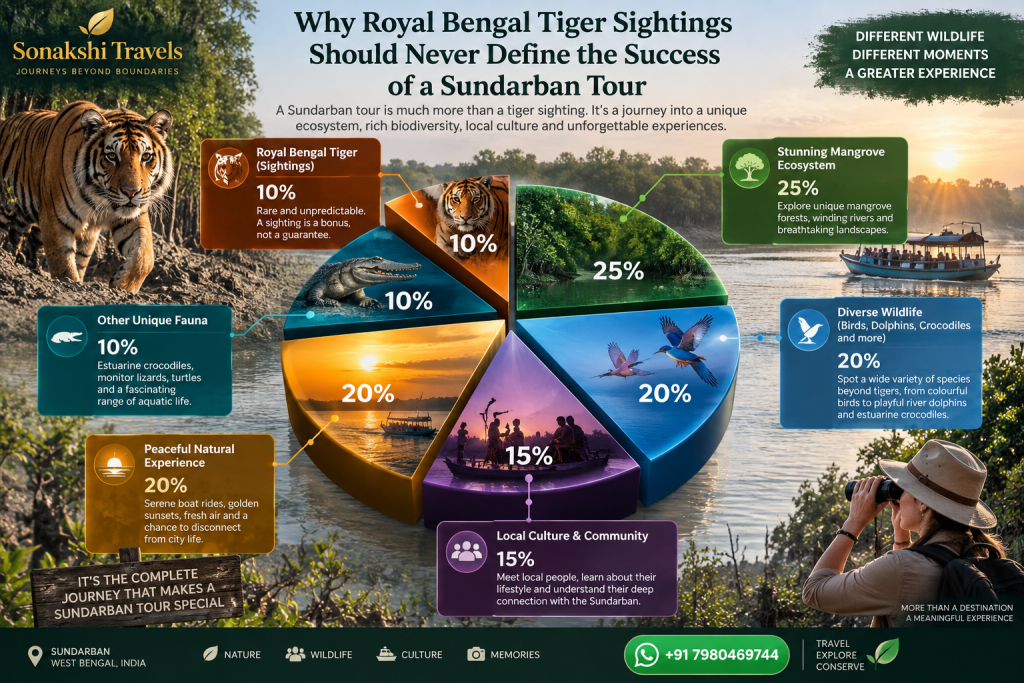
A well-managed Sundarban Travel plan should therefore be judged by the full day: quality of the boat, time in the forest, knowledge of the guide, food and water arrangements, route planning, safety, and the freedom to observe nature without unnecessary rush. A tiger sighting is a wonderful extra, not the only sign of quality.
Why a One-Day Tiger Mission Can Create the Wrong Expectation
Travellers sometimes try to fit the Sundarbans into a very short India itinerary. A one-day visit can still be interesting, but it gives less time to understand the area. Road transfer from Kolkata, boat boarding, river travel, permits, meals, and return timing all use part of the day. The more the visit is compressed, the easier it is to feel pressure for one dramatic sighting to “justify” the trip.
A longer stay gives the experience more space. Different times of day, changing tides, more river hours, quieter moments, and more time with a guide can help travellers understand the forest. The article on how many days are useful for a meaningful Sundarban tour explains why duration should be chosen around actual forest time rather than only hotel nights.
There is no fixed number of days that guarantees a tiger. Staying longer can increase the amount of time available for wildlife watching, but nature still decides what appears. The value of extra time is that it improves the depth of the journey, not that it buys a guaranteed sighting.
The Journey from Kolkata Is Part of the Experience
For many overseas visitors, the trip begins in Kolkata and then changes from road travel to river travel. That transition is part of understanding the delta. The guide to the road-and-river journey from Kolkata to the Sundarbans explains how visitors move from the city into rural Bengal, reach a river gateway, transfer to a boat, and continue through the waterways.
Responsible Guides Should Never Promise a Tiger
A strong wildlife operator should be confident about services that can be controlled and careful about things that cannot. It is reasonable to confirm a vehicle type, private or shared boat, meal plan, accommodation category, guide service, pickup point, and planned safari time. It is not reasonable to guarantee a wild tiger sighting.
Promises such as “100% tiger” or “definite tiger sighting” should be treated with caution. Wild animals do not follow tour schedules. A guide may know good areas, understand recent movement, read signs, and make sensible route choices, but no ethical guide controls the tiger.
This point protects both the visitor and the forest. When operators are judged only by tiger sightings, there can be pressure to rush, crowd, chase reports, or treat wildlife as a product. Responsible tourism should put legal routes, safe boat movement, animal welfare, and visitor understanding ahead of a dramatic photograph.
What USA and French Travellers Should Ask Before Booking
International travellers often compare packages online before arriving in India. The cheapest offer may look attractive, but price alone does not show how much real forest time, private service, or support is included. Before booking, ask clear questions about the daily schedule, boat type, guide, meals, accommodation, transport from Kolkata, luggage handling, permits, safety equipment, and return timing.
The guide on what foreign travellers should know before booking a Sundarban tour is useful for understanding these practical details. Visitors can also compare a broader Sundarban tour overview and travel options to see how road transfers, boat travel, resort stays, and safari time are commonly combined.
- Ask how many hours are planned on the boat. Hotel nights alone do not tell you how much wildlife time you receive.
- Ask whether the boat is private or shared. This can affect noise, space, photography, and daily flexibility.
- Ask what the guide will explain besides tigers. A good guide should help you understand birds, mangroves, tides, reptiles, mammals, and local conditions.
- Ask what happens if weather or forest rules change the route. A good plan should allow practical changes.
- Do not pay extra for a tiger guarantee. Pay for better planning, service, safety, comfort, and knowledgeable guiding instead.
A Better Way to Measure the Success of Your Sundarban Tour
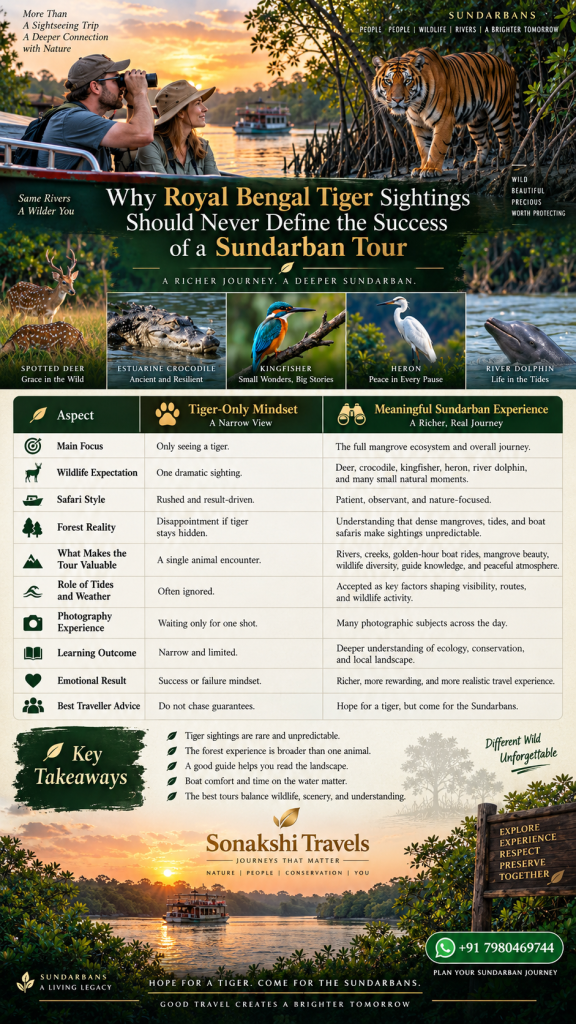
Instead of judging the trip by one animal, use a wider scorecard. Ask whether the day gave you enough time in the landscape. Was the boat comfortable enough for several hours of watching? Did the guide help you understand what you were seeing? Did you observe wildlife without disturbing it? Did the route show different kinds of waterways and mangrove edges? Did you have time to slow down rather than move from one named point to another?
Also ask whether the trip changed your understanding of the Sundarbans. Before the visit, you may have imagined only a tiger in a mangrove forest. After a good tour, you should understand more: why tides matter, why boats replace safari jeeps, why visibility changes, why wildlife can remain hidden, why local people depend on waterways, and why conservation must protect an entire ecosystem.
That kind of learning is a more reliable measure of success because it does not depend on a few seconds of chance.
What Counts as a Strong Day in the Sundarbans?
A strong day may include a quiet sunrise on the river, spotted deer feeding near a forest edge, a crocodile on a mudbank, several kingfisher species, a distant dolphin surfacing, fresh wildlife signs, a useful talk with the guide, and a slow journey through a narrow creek. On another day, the wildlife list may be shorter but the light, tide, silence, and mangrove scenery may be unforgettable.
And sometimes the tiger does appear. If it does, enjoy the moment without letting it erase everything else you have seen. The sighting becomes more meaningful when you understand the habitat around the animal.
How Sonakshi Travels Can Set More Realistic Expectations
For a private Sundarban Tour from Kolkata, Sonakshi Travels can make the journey more meaningful by explaining the nature of the destination before the guest arrives. The most useful promise is not “we will show you a tiger.” The useful promise is a well-organised experience built around private transport where booked, suitable boat arrangements, meals, local support, planned forest time, and clear communication.
For American and French travellers, a short pre-tour briefing about tides, boat-based viewing, wildlife uncertainty, climate, clothing, and daily timing can prevent unrealistic expectations.
Clear expectations also make a tiger sighting more exciting. When guests know it is never guaranteed, an unexpected view feels like a genuine wild encounter rather than a service they believed they had purchased.
Let the Forest, Not One Sighting, Define the Journey
The Royal Bengal Tiger will always remain one of the strongest reasons people dream about the Sundarbans. It deserves that attention. But the animal is powerful partly because it belongs to a wild system that cannot be scheduled for tourists. Dense mangroves, tidal rivers, hidden creeks, prey animals, birds, reptiles, dolphins, changing light, and local life all form the setting that makes the tiger possible.
A successful private Sundarban Tour should therefore be measured by the quality of the whole experience: good planning, enough time on the water, responsible guiding, comfortable and safe travel, careful wildlife watching, and a better understanding of the mangrove world. If a tiger appears, it can become the highlight of the journey. If it does not, the Sundarbans still has many ways to reward a traveller who knows how to look.
The best expectation to carry into the forest is simple: hope for a tiger, but come for the Sundarbans.