Sundarban Tour Wildlife Watching: Understanding Patience, Probability and Habitat
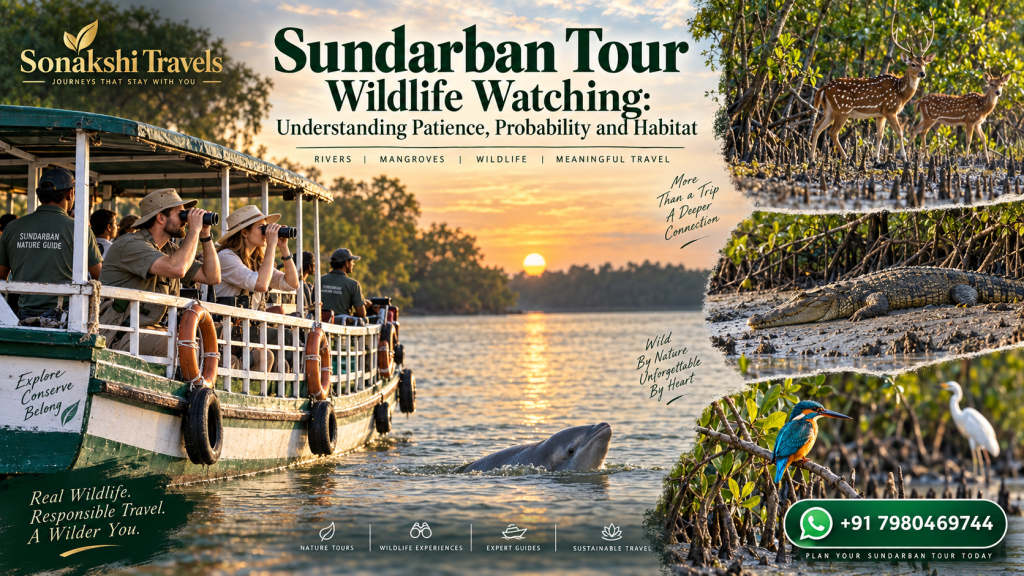
Wildlife watching in the Sundarban is not like entering a zoo, driving across an open grassland, or following a fixed route where animals are expected to appear at known points. A Sundarban Tour takes place inside a living tidal mangrove system where rivers, creeks, mudbanks, forest cover, weather, water level, animal movement, and simple chance all affect what visitors may see. For travellers coming from the USA, France, or other long-distance destinations, understanding this before arrival can make the experience far more rewarding.
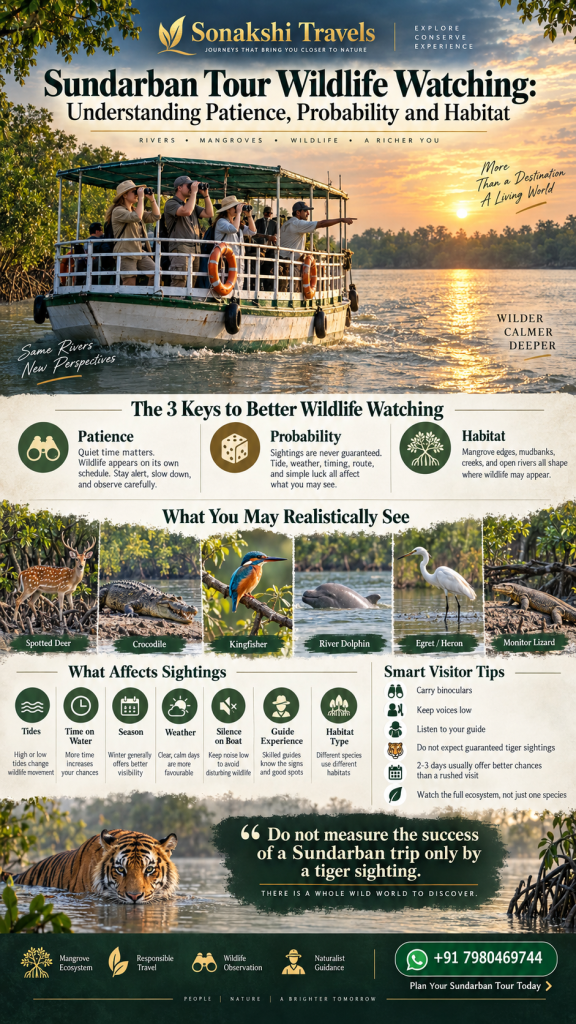
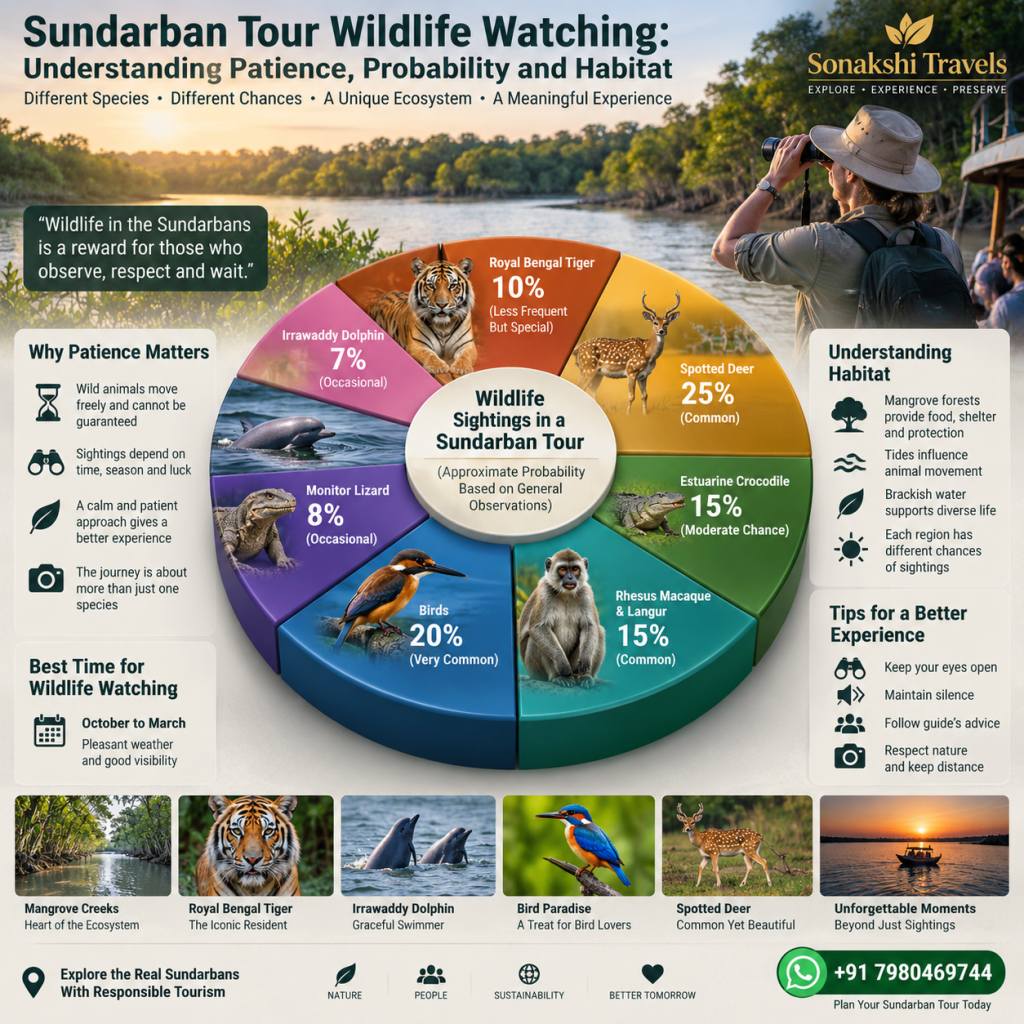
The most useful way to think about Sundarban wildlife watching is through three ideas: patience, probability, and habitat. Patience gives wildlife time to appear. Probability reminds us that no wild animal can be scheduled. Habitat teaches us where and why different species may be seen. Together, these ideas help visitors enjoy the forest as an ecosystem rather than judge the trip only by one dramatic sighting.
Wildlife Watching Here Is About Reading a Landscape
The Sundarban is a maze of tidal rivers, narrow creeks, mangrove islands, exposed mud, estuarine water, and dense vegetation. The UNESCO profile of Sundarbans National Park explains that the area is part of a major mangrove ecosystem shaped by tides and that it supports tigers, aquatic mammals, birds, reptiles, and many other forms of life. This matters to visitors because the animals are spread across several kinds of habitat rather than concentrated in one open viewing area.
From a safari boat, you mainly observe the edges of this large natural system. You may scan a muddy bank for deer tracks, watch roots for a resting monitor lizard, listen for bird calls, check open water for dolphins, or study a quiet bend where animals might come near the river. Sometimes several sightings happen within a short period. At other times, the forest appears still. Both situations are normal.
This is why experienced wildlife watching is active even when nothing dramatic is happening. The visitor is not simply waiting for a tiger. The guide, boat crew, and attentive travellers are reading movement, sound, habitat, light, tide, tracks, and behaviour. A good Sundarban Travel plan gives enough time for this slower form of observation instead of rushing from one named point to another.
Patience Is Not Empty Waiting
Many first-time visitors understand patience as sitting quietly until an animal appears. In the Sundarban, it is more useful to see patience as a wildlife-watching skill. Animals do not move for tourists. They feed, rest, hide, cross channels, search for food, protect territory, respond to tide and temperature, and avoid disturbance according to their own needs.
A quiet stretch of river may therefore become interesting without warning. A kingfisher may leave a low branch and dive. A spotted deer may step out briefly before returning to cover. A crocodile may be visible on an exposed bank and later disappear under rising water. A dolphin may surface far enough away that only a few people notice the first movement. If the boat is noisy, the group is distracted, or everyone is looking in only one direction, small moments can easily be missed.
Patience also changes the quality of attention. After some time on the river, travellers begin noticing roots, bird movement, tracks, mudbanks, water changes, and calls that were easy to miss at first. The environment becomes more readable with time.
Probability: Why No Sighting Can Be Promised
Wildlife tourism often creates a problem of expectation. Travellers may see beautiful photographs online and assume that the same species will appear during their own visit. But a photograph shows one successful moment, not all the hours of searching before or after it.
Probability in wildlife watching is simple: the longer and more carefully you observe suitable habitat, the more opportunities you create, but no responsible operator can promise a specific wild animal. The chance of seeing a species depends on many changing factors, including where the animal is, whether it is moving, how dense the cover is, how far the boat is from the bank, the direction of light, the water level, the time of day, and whether the animal is visible at all.
This is especially important with the Royal Bengal tiger. The tiger is the most famous animal associated with the region, yet the Sundarban is dense mangrove country cut by water. A tiger may be present in the wider forest without being visible from a tourism route. The article on why a tiger sighting should not define the success of a Sundarban tour explains this expectation problem in greater detail.
A good wildlife trip therefore does not treat a tiger as a product included in the package. It creates conditions for careful observation while accepting the independence of wild animals. This is not a weakness of the destination. It is one of the clearest signs that the visitor is entering a real protected ecosystem.
Habitat Often Tells You What to Look For
Instead of asking only, “What animal will we see?”, ask, “What habitat are we passing through, and what may use it?” Different parts of the Sundarban offer different wildlife clues.
Mudbanks and Exposed River Edges
When water falls, exposed banks can reveal roots, tracks, crabs, wading birds, and reptiles. An animal crossing open mud may be easier to notice than one behind leaves. Low water is not automatically better; it simply changes what is visible.
Mangrove Cover and Creek Edges
Dense vegetation offers food, shade, and cover, but it also makes viewing difficult. Deer or wild boar may stand close to the water and remain partly hidden. Birds may be heard before they are seen, so binoculars and slow scanning help.
Open Rivers and Estuarine Water
Open water creates a different type of observation. Travellers may watch for dolphins, water birds, currents, and movement between islands. Wildlife can appear at a distance, so look beyond the nearest bank instead of staring at one small patch.
For background on the protected landscape, the Sundarbans National Park overview gives a useful general introduction to the park, its mangrove setting, and its wildlife.
Tides Change Both Habitat and Visibility
Tides are one of the biggest reasons why the same river may look different a few hours later. Higher water can cover mudbanks and reach farther into mangrove edges. Lower water can expose roots, mud, small channels, and feeding areas. These changes can influence where birds stand, where reptiles rest, how animals approach the water, and which details are visible from a boat.
The important point is that high tide is not simply “good” and low tide is not simply “bad,” or the other way around. Each phase reveals a different version of the landscape. The detailed guide on how tides shape a Sundarban tour day explains how changing water levels can affect navigation, boarding, creek access, mudbank exposure, and wildlife observation.
This is one reason rigid safari expectations do not work well here. A route that looks ideal on a map may be less useful at a particular water level. Local guides and boat crews need room to respond to tide, permissions, route conditions, and safety. Flexibility is therefore part of good planning, not a sign that planning has failed.
Why More Time Usually Creates Better Wildlife Opportunities
A short trip can still be enjoyable, but wildlife probability is closely linked to opportunity. More useful hours on the water mean more changes of light, more sections of habitat, more tide stages, and more chances for something unexpected to happen. This does not guarantee a rare sighting. It simply gives nature more time to work.
For international travellers, this point is important because travel from Kolkata also takes time. The journey includes a road stage and then a river stage. A one-day visit may introduce the mangrove landscape, but a multi-day programme usually creates more room for real observation. The guide to choosing enough days for a meaningful Sundarban tour explains why the first and last days cannot always be treated as full forest days.
A well-designed Sundarban Tourism itinerary should therefore be judged by usable forest time, not simply by the number of nights printed in a package. Ask how many hours are likely to be spent on the boat, how the main safari day is planned, and whether the schedule allows quiet observation rather than continuous transfers.
The Road and River Journey Also Shapes the Safari
Visitors from the USA or France may arrive after a long flight and expect the forest to begin soon after leaving Kolkata. In practice, the approach includes road travel and then a change to boat transport. Understanding the road-and-river journey from Kolkata to the Sundarban helps travellers plan their energy, luggage, boarding, and first safari hours more realistically.
Travellers comparing programme styles can also review this overview of Sundarban tour packages and boat-based travel to see how short and multi-day trips are commonly structured. The key is to compare actual safari time, private or shared boat use, guide support, transfer arrangements, and daily pace rather than choosing only by price.
What You May Realistically Watch for During a Sundarban Tour
The best wildlife mindset is broad. Depending on season, route, tide, weather, and luck, visitors may watch for spotted deer, wild boar, rhesus macaques, monitor lizards, crocodiles, river dolphins, and many kinds of birds. Birdlife often provides regular activity, while mammals and reptiles may need slower scanning. Crocodiles can blend into mud, deer can remain partly hidden, and dolphins are visible only when they surface. Learning to notice shape, movement, contrast, and sound is often more useful than searching for a perfect view.
The Difference Between Seeing Wildlife and Understanding Wildlife
A list of species is easy to collect; understanding what you see is more valuable. A good guide can explain why an animal uses a mudbank, why birds gather in one area, how mangrove roots work, and why tide changes matter. Even a short deer or bird sighting becomes more meaningful when the habitat and behaviour are explained.
This is also why Sonakshi Travels should present wildlife viewing as part of a complete forest experience rather than a race to collect sightings. A private Sundarban Tour from Kolkata can give a small group more control over noise, photography, meal timing, observation stops, and questions for the guide, although all movement must still follow local rules and route conditions.
How to Improve Your Own Chances Without Disturbing Wildlife
Visitors cannot control where wild animals go, but they can improve the quality of observation. The goal is not to force sightings. It is to become a better observer.
- Keep voices low: Quiet groups hear more natural sounds and are less distracted.
- Use binoculars: Many animals and birds are easier to identify at a distance than with the naked eye.
- Scan slowly: Look at open mud, root lines, branches, water surfaces, and gaps in vegetation instead of sweeping past them quickly.
- Listen to the guide: Local guides often notice movement, calls, tracks, and habitat clues before first-time visitors do.
- Keep the camera ready but do not watch only through it: A sudden sighting may last only a few seconds.
- Wear practical colours and clothing: Comfortable, simple clothing helps you sit for long periods without constant adjustment.
- Protect yourself from sun and insects: A hat, sunscreen, water, and suitable insect protection can help you stay focused.
- Avoid feeding or calling wildlife: Observation should not change natural behaviour.
For long-haul visitors, it is also wise to keep the first morning realistic. Jet lag, heat, humidity, and early starts can reduce concentration. Rest, hydration, and a comfortable boat matter because wildlife watching often involves several hours of sitting, scanning, and waiting.
Photography Changes the Way Probability Feels
Photography can make wildlife probability look easier than it is because people usually see only the successful image, not the quiet time around it. A tiger crossing, dolphin surfacing, or close bird portrait may represent a very brief moment.
Bring camera equipment that is easy to handle safely on a moving boat. A telephoto lens helps with distant wildlife, while a wider lens is useful for rivers and mangrove landscapes. Protect gear from spray and humidity, and do not let the search for a photograph make you miss the experience itself.
Common Wildlife-Watching Mistakes
Treating the Tiger as the Only Measure of Success
A tiger sighting can be extraordinary, but its absence does not mean the forest was empty. The full ecosystem is the real subject of the journey.
Expecting Constant Action
Long quiet periods are normal. Treating silence as part of observation helps visitors notice smaller details instead of feeling that the safari has failed.
Ignoring Habitat or Chasing a Checklist
Mangrove roots, mudbanks, water depth, shade, channels, tide, permissions, and guide skill often matter more than a long list of named stops. Better pacing can be more rewarding than rushing through many points.
Responsible Expectations Make the Tour Better
Responsible wildlife tourism begins with accepting limits. Protected forests are managed for conservation first, not for guaranteed tourist entertainment. Routes may change. Access may depend on permission. Weather can affect plans. Tide can alter navigation. Animals can remain hidden.
These limits protect the quality of the environment that visitors have come to see. They also keep expectations realistic. A responsible operator should explain what is possible, what is uncertain, and what may change. It should never create pressure on a guide or boat crew to chase wildlife, break rules, move too close, or disturb animals for a photograph.
Visitors can support this approach by following instructions, keeping litter on the boat until it can be disposed of properly, avoiding loud music in wildlife areas, respecting local communities, and treating every animal sighting as a privilege rather than an entitlement.
How USA and French Travellers Can Plan More Wisely
Long-distance travellers should treat the Sundarban as a distinct nature experience rather than squeeze it into an overpacked Kolkata schedule. Leave enough time for road transfer, boat boarding, a full safari day where possible, and a safe return buffer before flights or trains.
Before booking, ask whether the boat is private or shared, how much forest time is planned, whether an English-speaking guide is included, who manages permits, and how route changes are handled. Bring binoculars, sun protection, water, medicine, a small day bag, and practical footwear. Comfort matters because wildlife watching can mean many hours of quiet attention.
The Real Reward Is Understanding How the Forest Works
The deeper value of a Sundarban journey appears when travellers stop asking only, “Did we see a tiger?” and begin asking, “What did the habitat show us today?” A change in tide, a group of deer at the edge, a crocodile resting on mud, a dolphin surfacing in a river, a kingfisher hunting from a branch, or even fresh tracks can all reveal how the mangrove system works.
That change in mindset does not reduce excitement. It increases it. Rare sightings remain thrilling, but they are no longer the only source of satisfaction. The whole day becomes meaningful because visitors are watching a living system rather than waiting for one animal to perform.
Patience, Probability and Habitat Define Better Wildlife Watching
A successful Sundarban Tour should create good opportunities for wildlife observation without pretending that nature can be controlled. Patience helps travellers stay alert. Probability keeps expectations realistic. Habitat explains why animals may appear in one place and remain hidden in another. Tides, route conditions, forest rules, guide skill, time on the water, and simple luck all play a part.
For visitors from the USA, France, and other international markets, this understanding can completely change the quality of the journey. Instead of measuring the tour by one photograph or one species, you begin to notice the relationships between river, mud, mangrove, birds, reptiles, mammals, tide, and human life around the delta. That is the more accurate way to experience Sundarban wildlife: not as a guaranteed show, but as patient observation inside one of the world’s great mangrove landscapes.