Sundarban Tour Birdwatching for International Nature Travellers

Birdwatching changes the way a traveller sees the Sundarbans. Instead of waiting only for a tiger or another large animal, you begin to watch the whole river edge. A kingfisher on a low branch, a heron standing on exposed mud, a Brahminy kite above the water, a group of waders moving with the tide, or a sudden call from deep inside the mangroves can become the main event of the day. For visitors from the USA, France, and other long-distance markets, a Sundarban Tour can therefore work very well as a slow nature journey built around observation rather than a race for one famous sighting.
This is especially important because birdwatching in the Sundarbans is very different from birding in a city park, open grassland, or fixed wetland hide. The landscape is made of tidal rivers, creeks, mudbanks, mangrove islands, brackish water, forest edges, and changing water levels. Birds use each part in a different way. Some sit openly on branches. Some feed on mud when the tide falls. Some fly across wide rivers. Others remain partly hidden inside leaves and roots. The best experience comes from learning how habitat, tide, season, light, patience, and boat movement work together.
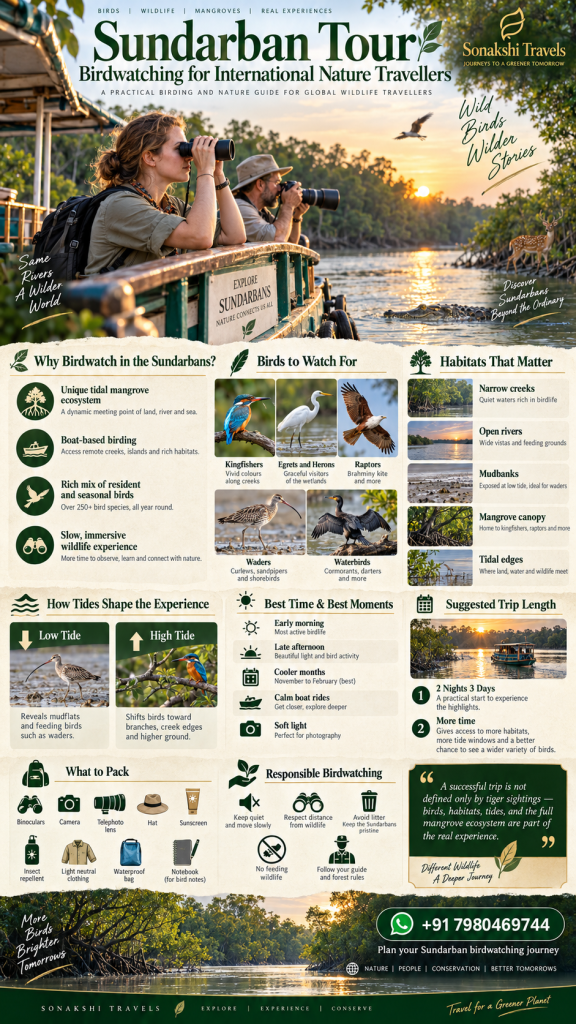
Why the Sundarbans Appeals to International Birdwatchers
The first attraction is variety. The wider Sundarbans supports a rich mix of waterbirds, raptors, kingfishers, waders, forest birds, and seasonal visitors. This variety comes from the meeting of land, river, estuary, mudflat, and mangrove habitat. A visitor may spend part of the morning scanning open water and then enter a narrow creek where the birding style changes completely.
The second attraction is setting. Many birdwatching destinations are reached by road and explored on foot. In the Sundarbans, much of the forest experience happens from a boat. That means the traveller watches the landscape slowly pass by while the guide scans branches, banks, exposed roots, mud, and open river. The boat becomes both a moving viewing platform and a place to sit quietly for long periods.
The third attraction is uncertainty. Birdwatchers who enjoy natural behaviour often value this. There is no fixed stage where a bird must appear. The day depends on water level, weather, route, season, available habitat, and chance. This makes the experience less predictable but often more satisfying for serious nature travellers. The wider idea is explained in this guide to wildlife watching through patience, probability, and habitat.
The Mangrove Landscape Is the Main Birdwatching Guide
A useful way to birdwatch in the Sundarbans is to stop thinking only in terms of a species list. Start with habitat. Ask what kind of river edge you are passing and what kind of bird may use it.
Mangrove Branches and Creek Edges
Low branches above narrow creeks are good places to scan for kingfishers and other birds that watch the water from a perch. The bird may remain still for several minutes and then move very quickly. Binoculars are useful because a small bird can be easy to miss against dark leaves. A guide may notice the shape or colour first, but travellers should also learn to scan likely perches rather than look randomly.
Mudbanks and Exposed Ground
When water levels fall, mudbanks can become feeding areas for waders and other water-edge birds. Small birds may walk quickly across the mud, stop, feed, and move again. Larger herons and egrets may stand more openly. These exposed areas are also useful for learning the difference between birdwatching and simple sightseeing: a bank that looks empty at first may reveal several birds after a slow scan.
Open Rivers and Wider Water
Wider rivers encourage a different style of watching. Look higher as well as lower. Raptors may circle above the channels, while terns or other waterbirds may cross the open space. The distance can be greater, so binoculars matter more. Strong sunlight on water can also make viewing harder, which is one reason early and later parts of the day may feel easier on the eyes.
For wider background on the protected mangrove landscape, the Sundarbans National Park overview gives a useful general introduction. Travellers who want an official conservation source can also read the UNESCO World Heritage profile for Sundarbans National Park, which explains the importance of the mangrove ecosystem and its wildlife.

Bird Groups International Travellers May Learn to Watch For
A birdwatching trip is easier to enjoy when you think in groups rather than trying to remember a long list of names before arrival. A good guide can help you move from broad groups to more exact identification.
Kingfishers
Kingfishers are among the most rewarding birds to look for in the mangrove creeks because their colours, calls, and fishing behaviour can be very clear when conditions are right. Different species vary in size, colour, bill shape, and preferred perch. Some may sit low near the water, while others are easier to notice when they fly across a channel. For photographers, the main challenge is not always finding the bird but reacting before it leaves the perch.
Herons, Egrets, Cormorants and Darters
These birds often help beginners understand the wetland side of the Sundarbans. They may be seen standing near water, flying between feeding areas, drying wings, or moving along exposed edges. Their larger size can make them easier to notice than small forest birds. Even so, distance, light, and background can make identification difficult, so colour alone should not be the only clue.
Raptors
Brahminy kites and other birds of prey can add drama to a quiet river journey. Raptors may sit on tall branches, cross the river, or circle above open water. A common mistake is to keep the binoculars pointed only toward the forest edge. Looking at the sky every few minutes can produce some of the most memorable bird moments of the day.
Waders and Seasonal Visitors
Winter can bring extra interest because migratory birds join the resident birdlife. Mudflats and shallow edges become especially useful places to scan. Small waders can be difficult for beginners because several species may look similar at a distance. This is where an experienced guide, patient viewing, and a field guide or birding app become valuable. Rather than trying to identify every bird at once, note size, leg length, bill shape, feeding style, and where the bird is standing.
Tides Can Change the Birdwatching Scene Within Hours
Tides are one of the most important parts of a Sundarban birdwatching day. The same stretch of river can look very different at different water levels. At lower water, more mud, roots, and shallow edges may become visible. At higher water, some feeding space disappears, and birds may shift to branches, higher banks, or other areas. There is no single tide that is always best for all birds.
This matters because international visitors sometimes expect a fixed safari timetable. In a tidal forest, a good plan needs some flexibility. The guide and boat crew may make decisions based on water level, safe navigation, route permissions, and where useful habitat is available. A detailed explanation of how tides shape each day of a Sundarban tour is useful before arrival because it helps travellers understand why the river itself influences the schedule.
For birdwatchers, the practical lesson is simple: do not judge the day too early. A quiet stretch at high water may look much more active later when mud appears. A branch used by a kingfisher in the morning may be empty in the afternoon. The forest is not a fixed viewing area. It is a moving system.
Why Winter Often Suits Bird-Focused Nature Travel
International travellers often ask for the best season. There is no month that can promise particular birds, but the cooler part of the year is widely preferred for bird-focused travel because resident species may be joined by migrants and daytime conditions are often more comfortable for long hours on the boat. This is especially useful for travellers who want to sit outside with binoculars or camera equipment for much of the day.
A Birdwatching Tour Should Not Be Measured by Tiger Sightings
The Royal Bengal tiger is closely linked with the Sundarbans, and many first-time visitors naturally hope to see one. But a birdwatching trip becomes much richer when the tiger is treated as a possible bonus rather than the only measure of success. Dense mangrove cover, wide water channels, and limited viewing angles mean that large mammals can remain hidden even when they are present in the wider landscape.
Birds, by contrast, can give the visitor many smaller moments through the day. A hunting kingfisher, a raptor on a high branch, a heron taking off from a mudbank, or a group of waders feeding together can tell you a great deal about the habitat. The article on why tiger sightings should not define a successful Sundarban journey explains why this wider view of wildlife makes more sense in a real forest.
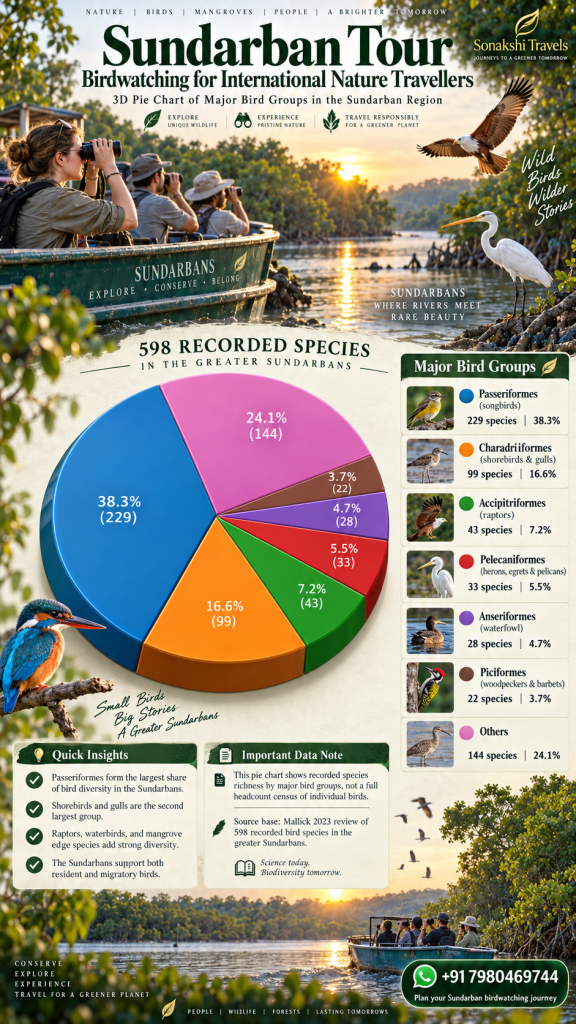
How Many Days Make Sense for Birdwatching?
A one-day visit can introduce the river landscape, but it gives limited time to work with changing light, different tide stages, and several habitat types. For international nature travellers who have already flown a long distance to India, a multi-day plan usually creates a more relaxed birdwatching experience. More time does not guarantee rare birds. It simply gives you more observation windows.
Two nights and three days can be a practical starting point for many visitors, especially when one full day can be used mainly for forest travel. Travellers with stronger birding or photography goals may prefer more time. The important number is not only the nights in the package but the useful hours actually spent on the water. The guide on how many days are needed for a meaningful Sundarban tour explains this difference in more detail.
A well-planned Sundarban Travel programme should therefore show the transfer time, boat time, main safari hours, meal breaks, and overnight plan clearly. This helps birdwatchers compare itineraries based on real nature time rather than package length alone.
Private Boat or Shared Boat for Serious Birdwatching?
Both styles can work, but they create different experiences. A shared boat is usually more social and may be more budget-friendly. A private boat gives a small group more control over pace, noise, camera space, and the time spent watching a bird or habitat area, subject to forest rules and route conditions. Travellers comparing formats can review this overview of Sundarban tour options and boat-based travel and then ask what part of the programme is private and how the daily boat plan is handled.
What to Pack for Birdwatching from a Boat
You do not need heavy equipment to enjoy the birds, but a few practical items make a large difference.
- Binoculars: A comfortable pair is more useful than very high power that becomes difficult to hold steady on a moving boat.
- Camera: A telephoto lens helps with distant birds. A wider lens is useful for mangrove scenery, river views, and travel photographs.
- Weather protection: Carry a light cover for camera gear and a dry bag or simple waterproof pouch for smaller items.
- Sun protection: A hat, sunscreen, sunglasses, and water are useful for long hours outdoors.
- Insect protection: Carry a suitable repellent and clothing that gives good coverage when needed.
- Light clothing: Choose comfortable, breathable clothes in simple colours rather than bright or reflective outfits.
- Small notebook or app: Recording what you saw, where you saw it, and the habitat can make the trip more useful later.
International travellers should keep important medication, passport copies, batteries, memory cards, and essential personal items in a small day bag rather than inside large luggage that may be stored away during transfer. A lens cloth is also useful because river air, humidity, and spray can affect optics.
Photography from a Moving Boat Needs a Different Approach
For photographers, a private Sundarban Tourism plan may be useful when it allows more careful pacing and fewer distractions, but all stops and movements still need to follow local forest rules. No photograph is worth pushing the boat too close to wildlife or asking the crew to ignore safe practice.
How to Work with Your Guide
A good birdwatching guide does more than name species. The guide should help travellers understand where to look, which calls matter, how habitat changes, and why a bird may favour one part of the river. International visitors should feel comfortable asking for simple English explanations if technical bird terms become confusing.
Responsible Birdwatching Protects the Experience
Birdwatching should not change the natural behaviour of the birds. Keep voices low, avoid loud music, do not throw food, and do not pressure the boat crew to move too close. If a bird looks disturbed, the best response is usually to give it more space. Nesting areas deserve special care because repeated disturbance can affect breeding behaviour.
Playback of bird calls should also be treated carefully. Repeated artificial calls can cause birds to respond, move, or become stressed. A nature trip is more meaningful when the visitor observes what the bird chooses to do on its own. The same rule applies to photography: a natural distant record is better than a close image created by disturbance.
Practical Planning for Travellers from the USA and France
Long-haul travellers should allow enough time around the Sundarban journey. International flights, jet lag, Kolkata traffic, road transfer, boat boarding, and early starts can make a tightly packed plan tiring. Avoid scheduling an important international departure too close to the planned return from the delta. A reasonable time buffer can protect the trip from becoming rushed.
For travellers beginning in Kolkata, a Sundarban Tour from Kolkata should be planned as both a land and river journey. Keep the first day realistic, especially after a long flight. If birdwatching is a main goal, it is usually better to arrive in Kolkata with enough rest rather than land after an overnight flight and immediately expect a full day of careful observation.
Common Birdwatching Mistakes First-Time Visitors Can Avoid
Looking Only for Rare Species
Common birds are often the best teachers. Watching how a heron feeds, how a kingfisher changes perch, or how a kite uses air above the river can build observation skill. Rare species are exciting, but they should not make ordinary behaviour feel unimportant.
What Makes a Bird-Focused Sundarban Journey Meaningful
The strongest birdwatching experience is not simply the one with the longest checklist. It is the one that helps the traveller understand why the birds are there. A kingfisher is linked to water and small prey. A wader is linked to exposed feeding ground. A raptor is linked to open air, tall perches, and food below. A heron is linked to shallow water and patient feeding. Once these links become clear, the whole landscape starts to make sense.
This is where the Sundarbans can be especially rewarding for international nature travellers. The birds are not separated from the forest. They are part of a tidal system that includes mangrove roots, fish, crabs, mud, freshwater flow, salt water, weather, rivers, and human life around the delta. Birdwatching becomes a way to read that system one small sign at a time.
Let Birdlife Become the Story of Your Sundarban Tour
A bird-focused Sundarban journey works best when travellers bring patience, curiosity, and realistic expectations. The most rewarding moments may be dramatic, such as a raptor crossing a wide river, or very small, such as noticing a wader feeding on fresh mud as the tide falls. Both matter because both show how the mangrove landscape works.
For visitors from the USA, France, and other international markets, the main planning goal should be enough time, a comfortable boat, suitable guide support, simple equipment, and a schedule that respects tides and forest conditions. Do not measure the trip only by rare species or a tiger sighting. A well-planned Sundarban Tour can be successful because it teaches you to slow down, watch carefully, and understand the living connection between birds, water, mangroves, and the changing river.