Updated: March 8, 2026
A Journey to the Hilsa Fish Festival Sundarban
— Where Food, Folklore, and Festivity Unite
When Rain Meets Tradition, a Festival is Born
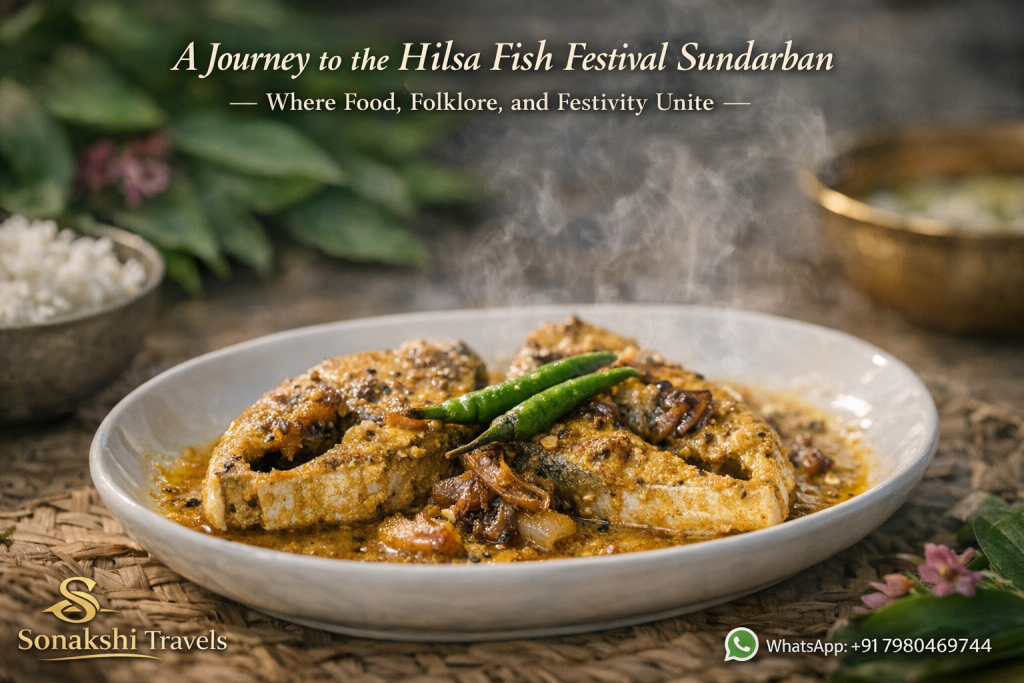
In Bengal, the arrival of monsoon carries meanings that extend far beyond rain. The clouds gather over the delta, rivers swell with life, and kitchens begin to prepare for a seasonal ritual that has shaped regional food culture for generations. At the center of that ritual stands the Hilsa fish, or Ilish, long regarded as the “King of Fish.” This living food tradition is also part of the wider cultural landscape explored across Sundarban travel narratives, where cuisine, ecology, and memory often meet.
Among Bengalis, Hilsa is not merely a prized fish served at the table. It represents continuity between family memory and regional identity. Conversations about the first Hilsa of the season still carry emotion in homes, marketplaces, and riverside settlements. Recipes pass from one generation to the next with care, and every household preserves its own belief about the finest way to cook it.
The Hilsa fish festival in the Sundarbans grew out of that deep relationship between food and culture. It is not simply a themed meal or a seasonal gathering arranged for visitors. It is a layered celebration where culinary craft, local livelihood, folk expression, and monsoon atmosphere come together in one shared experience.
For that reason, the festival feels less like an event one attends and more like a cultural setting one enters. Meals, songs, stories, and river life work together to reveal why Hilsa holds such a powerful place in Bengali imagination.
The Cultural Meaning of Hilsa in Bengal
A Fish That Became a Cultural Symbol
Hilsa occupies a rare place in Bengali life because it is both seasonal and symbolic. Unlike ordinary fish that remain available through most of the year, Hilsa carries with it the drama of return. Its movement from the sea into the river system has long shaped the expectations of fishing communities across the Bengal delta.
This migration gave the fish a special emotional position in public life. The first catches of the season were never seen as routine market arrivals. They marked a turning point in the monsoon cycle and often signaled abundance, household celebration, and culinary anticipation.
Over time, Hilsa moved beyond the status of a favored food and became part of ceremony, literature, and domestic ritual. It appears in festive meals, family exchanges, and cultural memory with unusual force. That is why a festival built around Hilsa does not feel narrow or limited. It opens onto a much wider field of meaning.
Within that broader setting, the festival can also be understood as a distinctive expression of a river-centered cultural tour through the Sundarbans, where food is inseparable from place, livelihood, and seasonal rhythm.
The Emotional Memory of Taste
One of the most striking features of Hilsa is the way it awakens personal memory. Many Bengalis do not describe the fish only in terms of flavor. They describe it through people, seasons, and moments: a grandmother’s kitchen, a rainy afternoon, a family lunch, the sound of oil heating before mustard paste is added to the pan.
Writers on food culture often explain this through the idea of taste memory. Smell and flavor are closely tied to emotional recall, which is why traditional foods can revive scenes from the distant past more quickly than words can.
At the festival, this is not an abstract idea. It becomes visible around the dining table. Visitors tasting traditional Hilsa preparations often respond with a level of feeling that exceeds ordinary appreciation of good food. The aroma of mustard oil, steamed rice, and fresh fish creates a sensory language that is deeply familiar to many and newly revealing to others.
Setting Off: From Urban Clamor to River Calm
The Journey Begins
The emotional logic of the festival begins before the first meal is served. Leaving Kolkata for the river region creates a gradual transition in mood. The city gives way to open stretches of rural Bengal, and the mind begins to slow with the landscape.
What makes this shift important is not distance alone, but atmosphere. The movement away from noise and speed prepares the visitor for a festival rooted in listening, tasting, and observing. The Hilsa celebration depends as much on setting as on cuisine.
In that sense, the journey becomes part of the event itself. The road through fields and settlements creates a threshold between two rhythms of life: the urban clock and the slower, more seasonal rhythm of the river country.
Boarding the Boat of Stories
Once travelers step onto the boat, the festival takes on its true form. The river becomes both route and stage. Wooden decks, open water, and the distant line of mangroves create a setting in which food and storytelling feel naturally connected.
Boats in this context are not passive carriers. They are shared social spaces where people sit together for meals, watch the light change on the water, listen to music, and exchange reflections. The movement of the vessel through tidal water adds a quiet continuity to the experience.
That is why the Hilsa festival differs from a conventional food event. It unfolds in motion. The river itself becomes part of the celebration, giving meals and performances a setting that feels inseparable from the story being told.
For travelers who value privacy and an intimate cultural atmosphere, this floating setting often resembles the quiet refinement associated with a more exclusive Sundarban private tour, where the pace allows closer attention to food, conversation, and place.
The Culinary Heart of the Festival
The First Hilsa Meal
The culinary center of the festival usually begins with Shorshe Ilish, Hilsa prepared in mustard paste. This dish is famous not because it is complicated, but because it expresses Bengali food philosophy with remarkable clarity. A few ingredients are used with precision so that the fish remains at the center.
Fresh mustard, green chili, turmeric, and mustard oil create a sharp, earthy profile that supports rather than hides the natural richness of Hilsa. The method depends on balance. If the seasoning is too heavy, the fish loses its character. If too light, the preparation feels incomplete.
Served with hot rice, the dish becomes more than a meal. It becomes an edible summary of regional taste: bold, aromatic, restrained in form, and deeply tied to household tradition.
For many visitors, the first serving of Shorshe Ilish marks the moment when the festival’s cultural purpose becomes fully understandable. What seemed at first like a food celebration reveals itself as an expression of memory and belonging.
A Diversity of Hilsa Dishes
Another strength of the festival lies in the range of Hilsa preparations presented during the experience. The fish is not confined to one celebrated recipe. Instead, visitors encounter a sequence of dishes that reveal how flexible and sophisticated Hilsa cooking can be in Bengali cuisine.
Fried Hilsa highlights texture and pure flavor. Mustard-based versions emphasize sharpness and heat. Yogurt preparations soften the profile and create a smoother finish. Rice-based combinations allow the oils and aroma of the fish to spread through the grain, producing a more layered meal.
This variety gives the festival intellectual depth as well as sensory pleasure. It shows that Hilsa is not treated as a luxury ingredient alone. It is part of a long culinary tradition that has encouraged experimentation within a very clear regional identity.
That culinary richness also helps explain why festival-centered food experiences continue to attract attention from those studying the evolution of the modern Sundarban holiday experience, where cuisine increasingly functions as a central part of destination meaning rather than a secondary attraction.
Music, Folklore, and Evening Gatherings
Folk Songs of the River
As evening approaches, the mood of the festival changes. The emphasis shifts from dining to performance, yet food remains present in the background through tea, shared snacks, and the memory of the day’s meals. Folk music begins to shape the gathering with a quieter emotional force.
Traditional forms such as baul and bhatiyali are especially meaningful in this setting. Baul songs bring inward reflection, philosophical longing, and spiritual openness. Bhatiyali carries the sound of river movement and has long been associated with boatmen and waterside life.
When these musical traditions are performed near the water, they do more than entertain. They deepen the interpretive frame of the festival. Visitors begin to understand that Hilsa belongs to a world of labor, river travel, oral tradition, and emotional expression.
Storytelling Traditions
Alongside music, conversation becomes one of the most important cultural elements of the evening. Local fishermen, cooks, and residents often share stories connected to Hilsa seasons, household customs, and remembered years of abundance or difficulty.
Such storytelling has value because it keeps practical and emotional knowledge together. A story about fishing may also be a story about uncertainty, family survival, or changing river conditions. A story about a recipe may also carry a memory of migration, marriage, or maternal teaching.
Through these spoken narratives, Hilsa emerges not as an isolated food item but as part of a living system of work, family, and river memory.
Village Encounters and Living Culinary Traditions
Cooking Knowledge Passed Through Generations
Some of the most meaningful moments of the festival take place in direct contact with local cooking traditions. In village settings, visitors can observe methods that developed not in formal culinary schools but in domestic kitchens shaped by need, season, and inherited skill.
A classic example is Ilish Paturi, in which the fish is coated in mustard and spice, wrapped in banana leaf, and cooked slowly so that fragrance and moisture remain locked inside. The method is elegant, but its origin is practical. It uses local materials, preserves flavor, and reflects an older style of careful household cooking.
Watching such preparations gives the festival unusual depth. It becomes clear that Hilsa cuisine rests not on restaurant presentation alone, but on everyday intelligence built over many generations of river life.
The Community Dimension of the Festival
For local communities, the festival is not only a cultural display but a social collaboration. Residents contribute through cooking, hosting, performing, guiding, and sharing local knowledge. Their role is central, not decorative.
This matters because it prevents the event from feeling detached from the people whose traditions sustain it. The festival gains authenticity from participation at the community level, and that participation gives visitors a more grounded understanding of Hilsa’s place in local life.
At the same time, the event demonstrates how carefully designed seasonal travel can support meaningful local engagement. In recent years, this has become one reason why curated events such as the Sundarban Hilsa Festival 2026 celebration have drawn interest from travelers who want culture and cuisine to remain connected to real communities rather than detached performance spaces.
The Hilsa Thali — Culinary Finale
A Meal That Tells a Story
The concluding Hilsa thali often serves as the most complete culinary statement of the festival. A thali brings several preparations together on one plate, but in this context it does more than offer abundance. It arranges taste in a meaningful order.
Fried Hilsa introduces clarity and directness. Mustard-based dishes add intensity and regional character. Yogurt-based preparations soften and round the palate. Rice preparations carry aroma and absorb the richness of the fish in a different form. Sweet elements at the end restore balance and completeness.
The result is not excess for its own sake. It is structure. Each item helps define the next, allowing the diner to understand Hilsa through contrast as well as repetition.
This is one reason the Hilsa thali stands as the culinary finale of the festival. It gathers the story of the event into one meal and allows food to function almost like narrative composition.
Where Food Tells Stories
What the Hilsa fish festival ultimately reveals is that food can carry cultural meaning with unusual strength. Hilsa connects river ecology, household memory, craft knowledge, local music, and seasonal celebration in a way few other foods can.
The rivers that bring Hilsa into Bengal have shaped labor, appetite, and imagination for generations. Recipes survived because families kept making them. Songs survived because communities kept singing them. Stories survived because people continued to attach meaning to the season of return.
When visitors enter the festival, they do not simply consume a menu. They briefly enter that larger continuum. The value of the experience lies in this immersion: the sense that taste, sound, and place are all part of one cultural language.
That is why the festival deserves to be understood with seriousness. It is not only enjoyable. It is revealing. It shows how a regional food can hold together an entire emotional world of rain, rivers, memory, and shared meals.
Book Your Hilsa Story
For those who wish to experience Hilsa not only as cuisine but as culture, the festival offers a rare opportunity to encounter food in its full social and emotional setting.
What remains with most visitors is not one single dish, but the total atmosphere: the scent of mustard in the air, songs moving across the river after dusk, and the feeling that an old Bengali seasonal tradition is still alive in lived form.
Travel with trust, taste, and tradition — travel with Sonakshi Travels.
📲 WhatsApp: +91 7980469744