At the far eastern edge of India, where the vast plains of the Ganga–Brahmaputra delta dissolve into a labyrinth of rivers, creeks, and tidal forests, lies a landscape unlike any other on Earth. A Sundarban Tour is not merely a journey into a forest; it is an immersive exploration of a living boundary where land and water constantly reshape each other. Here, soil is born and washed away in the same breath, trees rise from saline mud, and human life adapts to rhythms dictated by tides rather than clocks. This is a region where geography, ecology, culture, and survival are inseparably intertwined.
To explore the Sundarbans is to witness the fragile balance between terrestrial and aquatic worlds. Every creek tells a story of sediment and salinity, every mangrove root reveals centuries of adaptation, and every village reflects human resilience against natural extremes. From the very first moment of entering the delta by boat, travelers sense that they are crossing into a domain governed by water—where rivers are roads, forests are guardians, and tides are the true rulers.
Understanding the Geography of the Sundarbans: Where Continents Meet the Sea
The Sundarbans form the largest deltaic mangrove ecosystem on the planet, created by the continuous deposition of silt carried by the Ganga, Brahmaputra, and Meghna rivers. Over thousands of years, these mighty rivers have sculpted an intricate mosaic of islands separated by tidal channels, estuaries, and mudflats. Unlike stable terrestrial landscapes, the Sundarbans remain in a constant state of flux. Islands appear, expand, erode, and sometimes vanish entirely under the pressure of tides and cyclonic storms.
This geographical dynamism is precisely what makes a Sundarban Tour so compelling. Travelers do not move through a static environment; they navigate a living delta where freshwater from rivers meets saline water from the Bay of Bengal. This continuous interaction creates gradients of salinity, soil texture, and vegetation, resulting in extraordinary ecological diversity within a relatively compact region.
The Role of Tides in Shaping the Landscape
Tides are the defining force of the Sundarbans. Twice each day, seawater surges inland through creeks and rivers, flooding forest floors and retreating hours later to reveal muddy banks etched with animal tracks. These tidal cycles regulate nutrient flow, influence plant distribution, and determine the availability of prey for aquatic and terrestrial species alike. For visitors, observing tidal rhythms during a Sundarban Tour provides a deeper appreciation of how life here synchronizes with lunar cycles rather than seasonal calendars.
Mangrove Forests: Nature’s Engineering Marvel
Mangroves are the ecological backbone of the Sundarbans. These salt-tolerant trees possess remarkable adaptations that allow them to survive in waterlogged, oxygen-poor soils. Stilt roots, pneumatophores, and buttressed trunks stabilize sediment while facilitating gas exchange. By trapping silt, mangroves gradually convert shallow waters into land, even as tides threaten to reclaim it.
A Sundarban Tour offers firsthand insight into how mangrove forests function as natural coastal defenses. During cyclones and storm surges, dense mangrove belts dissipate wave energy, reducing the impact on inland settlements. This protective function has drawn global scientific attention, positioning the Sundarbans as a critical natural barrier against climate-induced coastal hazards.
Dominant Mangrove Species and Their Ecological Roles
Different mangrove species occupy specific zones based on salinity and tidal exposure. The iconic sundari tree, from which the region derives its name, thrives in moderately saline conditions, while species such as gewa and goran dominate higher-salinity zones. Each species contributes uniquely to habitat complexity, supporting insects, crustaceans, fish, birds, and mammals in a finely balanced food web.
Wildlife at the Water’s Edge: Adaptation and Survival
The Sundarbans are globally renowned for their wildlife, particularly the Bengal tiger, which has adapted to a semi-aquatic existence. Unlike its forest-dwelling counterparts elsewhere, the Sundarban tiger frequently swims across wide channels, navigates muddy terrain, and hunts in mangrove thickets. This extraordinary adaptability symbolizes the broader theme of life in the delta—survival through constant adjustment.
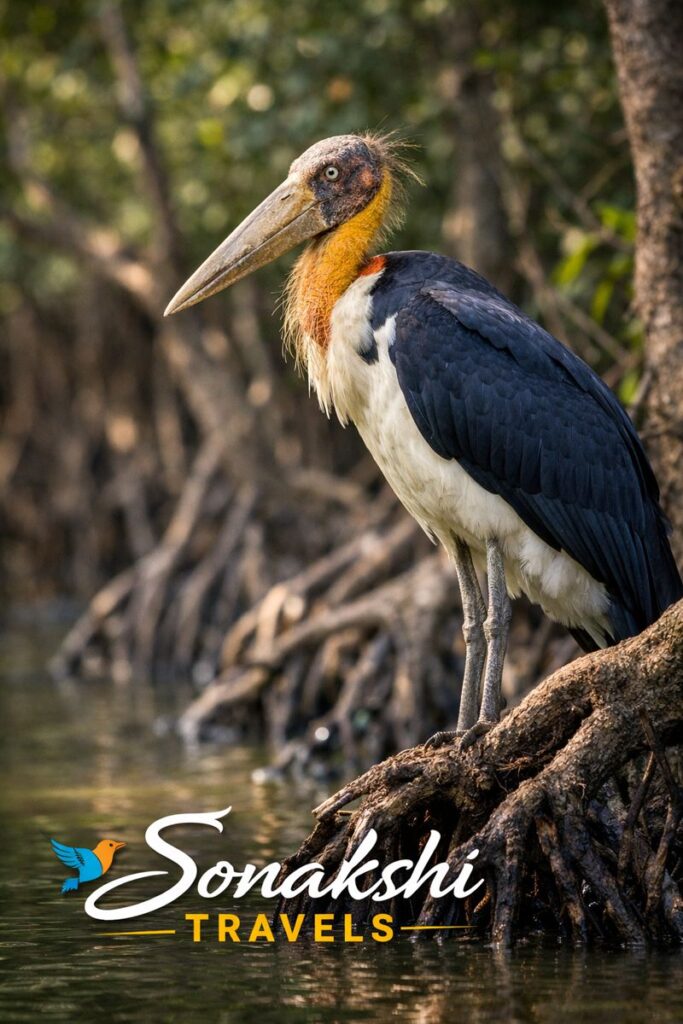
Beyond tigers, the region supports estuarine crocodiles, spotted deer, wild boar, fishing cats, otters, and an astonishing diversity of birdlife. Aquatic species, including mudskippers and various crustaceans, demonstrate equally remarkable adaptations, bridging the gap between land and water.
Avifauna of the Delta
Birdwatching is an integral component of any Sundarban Tour. The intertidal mudflats and creeks attract resident and migratory birds alike, including herons, egrets, kingfishers, and raptors. Seasonal migrations further enrich avian diversity, making the Sundarbans an important node in global migratory pathways.
Human Settlements: Life Between Rivers and Forests
Human habitation in the Sundarbans reflects centuries of coexistence with an unpredictable environment. Villages are often located on embankments, shielding agricultural land from tidal flooding. Livelihoods revolve around fishing, honey collection, crab harvesting, and small-scale farming, all of which depend on careful negotiation with natural forces.
During a Sundarban Tour, interactions with local communities reveal profound indigenous knowledge systems. From understanding tidal patterns to interpreting animal behavior, residents possess insights that formal scientific frameworks increasingly seek to document and preserve.
Cultural Beliefs and Environmental Ethics
Local culture is deeply infused with ecological awareness. Folk traditions, rituals, and deities often embody respect for forest and river spirits, reinforcing conservation ethics through spiritual narratives. Such belief systems have historically regulated resource use, fostering a form of community-led environmental stewardship.
Climate Change and the Fragile Balance of Land and Water
The Sundarbans stand on the frontline of climate change. Rising sea levels, increased cyclone intensity, and changing salinity patterns threaten both ecosystems and human settlements. Scientific studies indicate that even modest sea-level rise could submerge significant portions of low-lying islands, intensifying displacement and biodiversity loss.
These challenges underscore the importance of responsible tourism. A well-designed Sundarban Tour can contribute to conservation by generating awareness, supporting local economies, and promoting sustainable practices aligned with long-term ecological resilience.
Conservation Frameworks and Global Recognition
The Sundarbans are protected under multiple national and international frameworks. As a UNESCO World Heritage Site and a designated biosphere reserve, the region benefits from coordinated conservation strategies. Official information on conservation initiatives and environmental monitoring can be accessed through authoritative government portals such as
https://www.indiabiodiversity.org/, which document biodiversity and policy-driven conservation efforts across India.
Scientific Significance of the Sundarbans Ecosystem
From an academic perspective, the Sundarbans serve as a natural laboratory for studying estuarine ecology, sediment dynamics, and climate adaptation. Researchers analyze mangrove responses to salinity stress, wildlife movement patterns across fragmented habitats, and the socio-economic impacts of environmental change on deltaic populations.
For informed travelers, understanding this scientific context enriches the experience of a Sundarban Tour. The forest is no longer viewed solely as a scenic destination but as a critical system whose health influences regional and global environmental stability.
Global Context and Comparative Importance
Comparable mangrove systems exist in Southeast Asia, Africa, and South America, yet few match the scale and biodiversity of the Sundarbans. Detailed background information on the region’s global standing is available through comprehensive resources such as
Wikipedia’s Sundarbans entry, which outlines historical, ecological, and geopolitical dimensions of the delta.
Navigating the Delta: The Experience of a Boat-Based Journey
Boat travel is fundamental to exploring the Sundarbans. As vessels glide through narrow creeks and expansive rivers, travelers observe subtle transitions in vegetation, water color, and wildlife activity. Silence often dominates these journeys, broken only by the call of birds or the splash of a surfacing fish.
This mode of exploration reinforces the central theme of land–water convergence. The forest cannot be accessed by roads; it reveals itself only to those willing to move with the water. A thoughtfully planned Sundarban Tour ensures that such navigation respects ecological sensitivities while maximizing observational opportunities.
Seasonal Variations and Their Impact on Travel
Seasonality profoundly influences the Sundarbans. Monsoon months bring swollen rivers and heightened biological activity, while winter offers clearer skies and optimal wildlife visibility. Each season highlights different aspects of the land–water relationship, making timing a crucial consideration for travelers seeking specific experiences.
Sustainable Tourism: Preserving the Delta for the Future
As visitor interest in the Sundarbans grows, sustainable tourism practices become increasingly vital. Limiting waste, minimizing noise pollution, respecting wildlife distances, and supporting local enterprises are essential components of responsible travel. Tourism models that prioritize environmental education and community participation help ensure that economic benefits do not come at the expense of ecological integrity.
Engaging with a well-structured Sundarban Tour allows travelers to contribute positively to conservation outcomes while gaining meaningful insights into one of the world’s most delicate ecosystems.
Education Through Experience
Experiential learning remains one of the most effective tools for environmental awareness. Observing erosion along riverbanks, witnessing mangrove regeneration, and understanding human–wildlife interactions firsthand foster a deeper appreciation for conservation challenges than abstract data alone.
Why the Sundarbans Represent the Ultimate Land–Water Interface
Few places on Earth illustrate the merging of land and water as vividly as the Sundarbans. Here, boundaries are fluid, adaptation is constant, and survival depends on balance rather than dominance. The delta challenges conventional notions of permanence, reminding visitors that landscapes, like societies, are shaped by continuous interaction with natural forces.
To embark on a Sundarban Tour is to step into this dynamic interface—to witness how forests rise from tides, how animals traverse rivers as pathways, and how communities persist at the edge of change. It is an experience that transcends sightseeing, offering profound lessons in resilience, coexistence, and respect for nature’s complexity.
A Journey into Nature’s Living Boundary
Exploring where land and water merge on a breathtaking Sundarban Tour is both an intellectual and emotional journey. It invites travelers to reconsider humanity’s relationship with nature, to observe ecosystems not as static resources but as living systems shaped by perpetual motion. The Sundarbans stand as a testament to nature’s ingenuity and vulnerability, urging thoughtful engagement rather than passive admiration.
In an era of accelerating environmental change, the Sundarbans offer invaluable insights into adaptation, interdependence, and sustainability. For those seeking more than a destination—for those seeking understanding—the Sundarbans remain one of the most compelling places on Earth, where land and water meet in an endless, awe-inspiring dialogue.