Updated: March 10, 2026
Step into the Stillness Where Rivers Pray —Sundarban Tour is Devotion
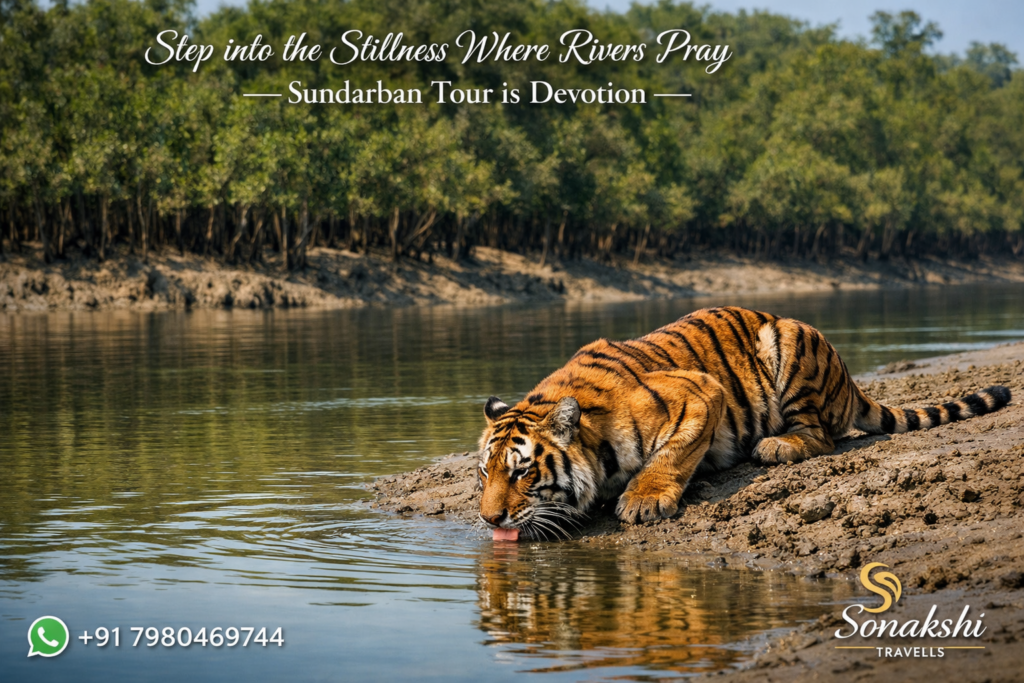
There are journeys that entertain, journeys that inform, and journeys that briefly impress before fading into memory. Then there are journeys that quiet the mind so completely that the traveler begins to notice deeper patterns within the world. The Sundarbans belongs to this rarer kind of experience. In this immense tidal forest, movement is never hurried, sound is never wasted, and silence is never empty. A Sundarban tour becomes meaningful not because it overwhelms the senses, but because it refines them. It slows perception until the eye begins to read the patience of water, the discipline of trees, and the calm intelligence of a landscape shaped by tide and time.
The title of devotion suits this landscape because the Sundarbans does not merely appear beautiful. It behaves with the solemnity of ritual. Rivers arrive and withdraw like repeated prayer. Mudbanks emerge, disappear, and return with a certainty older than human calendars. Mangrove roots stand not as decorative forms, but as signs of endurance and adaptation. Every element here seems to act according to an ancient order. A traveler entering this region may initially see only water, forest, and distance. But slowly, with attention, those surfaces begin to reveal a world governed by rhythm, restraint, and profound ecological intelligence. That is why a true Sundarban tourism experience often feels less like sightseeing and more like participation in a living ceremony of land and tide.
Silence in the Delta Is Not Emptiness
Many people imagine silence as the absence of events, but the Sundarbans teaches a more accurate definition. Silence here is full of motion. It contains the faint pull of current against the boat, the subtle tapping of branch against branch, the distant break of water along a muddy edge, and the unseen work of crabs, fish, birds, and roots beneath the visible surface. The stillness is therefore active, not passive. It does not remove life; it concentrates it. Within such an environment, the traveler becomes aware that noise often obscures reality, while quiet allows the world to disclose its finer structure.
Researchers who study wetlands often emphasize that estuarine environments are among the most dynamic ecological systems on earth. The Sundarbans illustrates this principle with unusual clarity. Salinity, sediment movement, tidal force, and vegetative adaptation are in constant relation. Yet this enormous ecological labor unfolds without spectacle. The delta does not dramatize itself. It works through accumulation, repetition, and balance. In that sense, a Sundarban eco tourism journey, when approached with seriousness and patience, offers more than scenic pleasure. It gives direct contact with a functioning landscape whose discipline can be observed in almost every visible form.
Silence also changes human behavior. In crowded urban life, attention is fragmented by interruption. In the Sundarbans, the opposite happens. The mind begins to gather itself. One starts listening for differences rather than seeking constant stimulation. The widening of a ripple, the sudden pause of a bird, the angle of a branch leaning over a creek—these details begin to matter. The traveler becomes less concerned with consuming the environment and more concerned with understanding it. That inward shift is one reason why a thoughtful Sundarban travel experience can feel so emotionally deep. It reorders perception.
The Rivers Move Like Prayer
No image captures the devotional quality of the Sundarbans more powerfully than the movement of its rivers. They do not rush in a straight, aggressive line. They bend, widen, narrow, return, divide, and reunite. Their motion feels deliberate. Each current appears to negotiate with mud, root, and shore rather than conquer them. This is not the drama of mountain torrents or crashing surf. It is a quieter authority, one shaped by persistence. The water seems to speak in repetition, and that repetition resembles prayer: not because it is theatrical, but because it is faithful.
Within such spaces, boats do more than transport the visitor. They become instruments of observation. A slow passage through a creek or wider channel changes the scale at which the mind works. One stops thinking in terms of destinations and begins thinking in terms of transitions. The curve of the river matters. The reflective quality of the surface matters. The shift from open channel to enclosed waterway matters. This is why a meaningful Sundarban nature tour depends so heavily on pace. The landscape is legible only to the patient observer.
The devotional quality of river movement is also ecological. Tides sustain nutrient exchange, shape habitat boundaries, influence breeding grounds, and determine the changing accessibility of channels and banks. What appears calm is often highly organized. What appears repetitive is often essential to survival. Seen in this light, the river is not a backdrop for tourism. It is the central actor in the drama of the delta. Any serious Sundarban exploration tour should therefore be understood as an encounter with systems rather than scenery alone. The river is both pathway and principle.
Mangroves Teach the Discipline of Survival
The mangrove forest does not inspire admiration merely because it looks unusual. It commands respect because it represents adaptation in one of its most elegant forms. These trees live where land and water remain in constant negotiation. Their roots rise, branch, grip, and breathe in ways that reveal a deep intelligence of structure. To stand before such forms is to see survival made visible. Nothing is excessive. Nothing is decorative for its own sake. Everything serves endurance.
For the attentive traveler, this creates a moral as well as visual impression. The mangrove does not resist its environment by denial. It survives through adjustment without surrender. It responds to salinity, unstable soil, and changing tide through form. That is why a Sundarban travel guide that focuses only on attractions misses the deeper significance of the place. The real lesson of the forest lies not simply in what is seen, but in how it lives. The Sundarbans is an archive of ecological resilience written in root, bark, and sediment.
Even the visual rhythm of mangrove belts contributes to the atmosphere of devotion. Lines of roots along the banks resemble script. Shadowed foliage creates chambers of secrecy. Openings between trees feel like thresholds rather than gaps. When the boat moves beside these living walls, the traveler is often struck by a sense of presence that exceeds ordinary scenic appreciation. The forest does not behave like a passive object waiting to be observed. It carries its own order, and that order asks for humility in return.
The Psychology of Slowness in a Tidal Forest
Modern life often rewards acceleration. We move quickly, decide quickly, photograph quickly, and forget quickly. The Sundarbans quietly opposes this habit. Here, speed can become a barrier to understanding. The slower one watches, the more the region reveals its structure. The forest does not yield meaning all at once. It unfolds through intervals. A channel that looked empty begins to show layered movement. A silent bank begins to display tracks, textures, and signs of recent activity. A distant line of foliage begins to separate into species, height variations, and microhabitats.
This change in observational tempo has psychological consequences. The mind, no longer compelled to race ahead, starts dwelling more fully in the present moment. One becomes less restless. Sensory experience deepens. Reflection becomes easier. This is one reason many travelers remember a Sundarban personalized travel package or a more private encounter with the delta as unusually intimate. When there is space for observation without interruption, the landscape enters consciousness more deeply. It is not simply visited; it is absorbed.
Slowness also restores proportion. The human figure feels smaller in the Sundarbans, but not in a humiliating way. Rather, one begins to sense participation in a larger ecological order. The river, the tide, the mudflat, the root system, the birds overhead, the changing light across water—all of these processes continue without reference to individual urgency. That realization can be calming. It reminds the visitor that not all significance depends on human speed, noise, or control.
Wildlife Presence Is Often Felt Before It Is Seen
The Sundarbans is often described through its wildlife, yet the deepest truth of the forest is that animal presence is not always a matter of direct spectacle. Very often it is sensed through atmosphere, pattern, and interruption. A sudden stillness in a stretch of water, a cluster of birds shifting direction, movement near reeds, or the tension of attention among those observing the bank—these can carry as much intensity as a clear sighting. The forest teaches that presence is broader than visibility.
That is why a serious Sundarban wildlife safari is not merely a search for dramatic encounters. It is an education in signs. One begins to notice the logic of habitat edges, the value of quiet, the meaning of tracks or disturbed mud, and the relation between water movement and animal behavior. In research terms, such environments demand indirect reading because much of life here avoids obvious display. For the traveler, this creates a special form of alertness. The forest is not inactive simply because it is not loudly revealing itself.
There is also an ethical lesson here. Wildlife in the Sundarbans does not exist to satisfy expectation. It exists according to its own survival patterns. Respect grows when the observer understands this. A mature Sundarban private wildlife safari or contemplative forest journey therefore depends on restraint. The aim is not to dominate the scene with human desire, but to witness traces of a world that remains independent. That independence is part of the region’s dignity.
Devotion Lives in Repetition, Not Spectacle
Much of what gives the Sundarbans its spiritual quality comes from repetition. Tide follows tide. Water continues its patient exchange with shore. Leaves move, settle, and move again. Reflections break and return. The same channel may appear altered from one hour to the next, yet its transformation is part of an enduring cycle. This pattern resembles devotion because devotion, in its deepest sense, is not sudden excitement. It is sustained attention given again and again.
When travelers speak of being changed by the delta, they are often responding to this repeated order. One does not need grand drama to feel the power of the place. The repetition itself becomes transformative. It cleanses distraction. It restores seriousness. It reminds the mind that what is repeated with integrity can become profound. In that sense, a private Sundarban eco tour or even a carefully observed shared journey may offer something rare in contemporary travel: not novelty alone, but disciplined renewal of perception.
This is also why the Sundarbans resists superficial language. Words such as “beautiful” or “peaceful” are not wrong, but they are incomplete. The region is beautiful, yes, but its beauty is structured by tension between fragility and resilience. It is peaceful, yes, but its peace is created through endless ecological negotiation. Devotion is a more accurate word because it contains patience, order, repetition, humility, and depth. The landscape seems to practice all of these continuously.
Why Private Space Deepens Perception
There are times when solitude or reduced noise becomes essential to understanding a place. The Sundarbans is one of them. A more intimate journey allows silence to remain intact, and when silence remains intact, details emerge more clearly. The ear hears smaller sounds. The eye lingers longer. Thought becomes less fragmented. This is why many travelers seeking emotional or reflective depth are drawn toward a Sundarban private tour rather than a louder or more crowded format.
Private space does not make the landscape more authentic; the landscape is already authentic. What it changes is the quality of reception. A quieter deck, a more deliberate pace, and uninterrupted views across the water can help the traveler enter the region’s rhythm more completely. For some, a Sundarban luxury private tour becomes meaningful not because of extravagance, but because it preserves stillness and gives time for deeper engagement. Comfort, in this case, supports attention rather than distracting from it.
The same principle applies to the river journey itself. A calm and focused passage can turn even simple observation into something lasting. Water against the hull, distant tree line, the measured unfolding of channels—these elements gain emotional force when experienced without constant interruption. That is why a luxury Sundarban cruise is best understood, at its highest level, as a carefully held space for witnessing the delta with dignity and concentration.
The Landscape Encourages Inner Reordering
One of the most remarkable effects of the Sundarbans is that it does not merely offer external scenery. It rearranges internal emphasis. Concerns that seemed urgent elsewhere begin to lose intensity. Attention shifts from productivity to presence, from noise to listening, from accumulation to awareness. This is not mysticism in a vague sense. It is a psychological response to an environment whose rhythms differ sharply from urban pressure and digital interruption.
In reflective travel writing, places are often praised for helping people “disconnect.” The Sundarbans does something more precise. It reconnects the observer to forms of order that human life frequently ignores: cyclical time, habitat dependence, patient motion, and the meaning of boundaries that are never entirely fixed. A serious Sundarban luxury travel experience, or any deeply attentive passage through this delta, can therefore feel restorative because it returns perception to first principles. Water moves. Roots hold. Life adapts. Silence speaks. The mind responds.
For couples, families, or solitary observers, the form may vary, but the inward effect often remains similar. Whether one enters through a Sundarban couple private tour, a Sundarban family private tour, or a contemplative solo passage, the place invites humility. It does not reward possession. It rewards presence. The forest cannot be taken away in any material sense. It can only be received through attention and remembered through altered understanding.
To Enter the Sundarbans Is to Learn Reverence
In the end, the deepest truth of this title remains simple. The rivers appear to pray because they move with constancy. The forest feels devotional because it survives through discipline. The silence carries weight because it is filled with living process. A journey here becomes more than movement through a destination. It becomes a study in reverence. The traveler learns that stillness is not weakness, that softness can hold immense power, and that repetition can shape meaning more deeply than spectacle.
This is why the Sundarbans remains unforgettable for serious observers. It does not flatter the visitor with easy drama. It asks for patience, and then rewards that patience with depth. A Sundarban tour experienced in this spirit is not simply a break from routine. It is a meeting with a tidal world whose every gesture—river bend, mangrove root, reflective surface, hidden creature, and measured silence—seems to say that life endures not by rushing, but by remaining faithful to its order.
To step into this stillness is therefore to enter a place where observation becomes respect. The visitor begins with curiosity, continues with attention, and leaves with reverence. That is the special dignity of the delta. It does not ask to be conquered, decoded, or consumed. It asks to be listened to. And when one truly listens, the lesson becomes clear: in the Sundarbans, devotion is not an idea added by the traveler. It is already present in the way the rivers move, the forest stands, and the entire landscape continues its prayerful work in silence.