Updated: March 10, 2026
Every horizon bends towards calm—Sundarban Tour is where peace resides
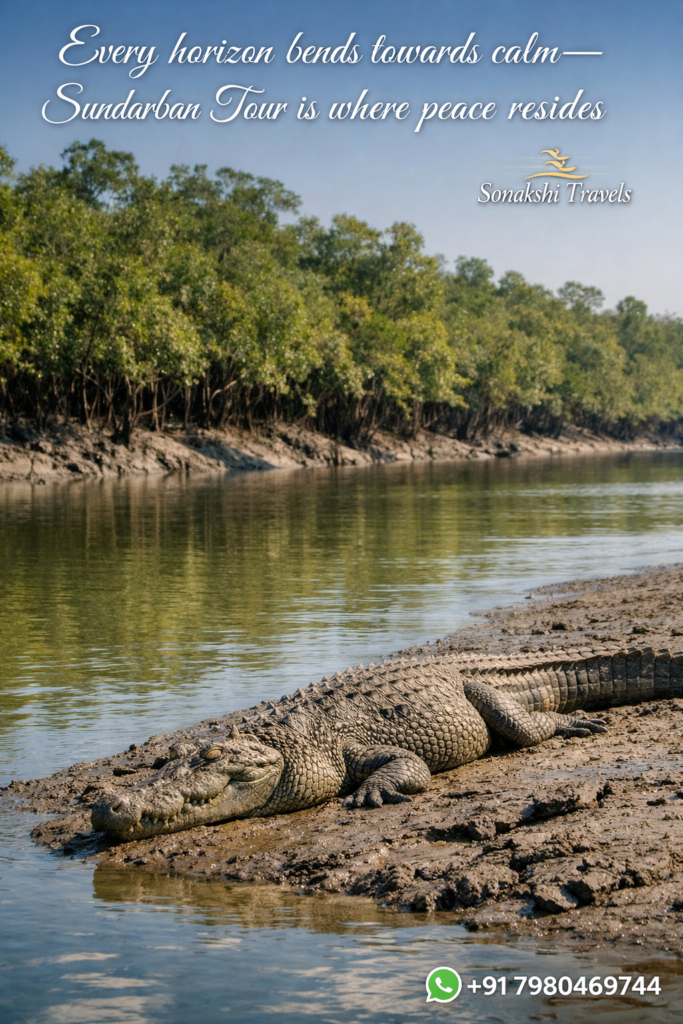
There are landscapes that impress the eye, and there are landscapes that quiet the mind. The Sundarbans belongs to the second kind. Its beauty does not depend on height, drama, or spectacle alone. Instead, it works through rhythm. Water widens, narrows, and turns without haste. Mudbanks appear and disappear with tidal patience. Mangrove roots rise from the earth like thoughts made visible. In such a place, peace is not presented as an abstract idea. It becomes physical. It sits in the still intervals between bird calls, in the softened movement of a boat crossing a wide river, and in the way the horizon never closes upon the traveler. Every outward view seems to lean gently toward rest, which is why a Sundarban tour is so often remembered not merely as a journey through a forest, but as an encounter with calm itself.
The title of peace is not given lightly to any landscape. Peace, in its deeper form, is not simply the absence of noise. It is the presence of order, proportion, and a certain inner balance between motion and stillness. The Sundarbans creates this balance in unusual ways. Nothing here is entirely fixed, yet nothing feels chaotic. The tide moves, channels shift, shadows lengthen, and the light changes across the water, but these movements occur within a large natural intelligence that the visitor can sense even without naming it. This is why the region often exceeds the expectations of ordinary travel writing. A true Sundarban tourism experience is not defined only by what one sees. It is defined by what one begins to feel: a reduction in mental pressure, a widening of attention, and a return to slower, steadier forms of awareness.
The Meaning of a Horizon in the Sundarbans
In many places, the horizon is a line of distance. In the Sundarbans, it is a line of release. The eye travels outward across open river water and meets neither the congestion of the city nor the visual interruption of steep built forms. Instead, the gaze continues. It moves across pale reflections, low forest edges, and an expansive sky that appears larger because the land remains so level. This visual openness has a direct psychological effect. Research in environmental psychology has long suggested that broad, uncluttered natural views help reduce cognitive fatigue by allowing the brain to rest from constant forced attention. The Sundarbans offers this kind of relief again and again. The traveler does not have to work to receive the place. The scene arranges itself gently.
That is one reason the calm of this region feels earned rather than decorative. Peace here is not created through artificial quietness. It rises from scale. The vastness of tidal space makes personal anxieties feel smaller without making the individual feel erased. The traveler remains present, but no longer central. This shift matters. Much of modern life conditions people to remain trapped within their own urgency. In the Sundarbans, the horizon quietly corrects that habit. It suggests a larger continuity beyond private pressure. A well-observed Sundarban travel guide may describe channels, forests, and riverbanks, but the deeper truth is that the horizon itself becomes part of the experience of healing.
Why Silence Feels Different Here
Silence in the Sundarbans is never empty. It is layered with subtle signals. One hears water touching the hull, a distant wingbeat, the brief crackle of mangrove leaves in a moving breeze, and the occasional call of a bird rising through the open air. Yet these sounds do not disturb stillness. They complete it. The silence of the Sundarbans is active but not aggressive. It contains life without becoming crowded by it. This distinction is important, because human beings do not always rest well in total emptiness. What soothes the mind is often patterned sound: sound that is soft, spaced, and meaningful. The region provides exactly this balance.
Such acoustics have a powerful effect on attention. In urban environments, sound often fragments thought. In the river world of the Sundarbans, sound gathers it. The mind stops leaping from one stimulus to the next. Instead, it begins to settle into sequence. Hear the water. Watch the bank. Notice the distant branch. Return to the open sky. This rhythm gradually lowers internal noise. A Sundarban eco tourism landscape does more than preserve biodiversity. It preserves the rare human opportunity to listen without being overwhelmed. That listening is not a minor pleasure. It is one of the central ways peace is felt in the region.
The Tidal Rhythm and the Human Mind
The Sundarbans is shaped by tide, and tide is one of the great teachers of calm. Unlike sudden mechanical motion, tidal movement is gradual, cyclical, and patient. Water rises without panic and withdraws without finality. It returns, changes the edge of the land, then moves again. To spend time in a place governed by such repetition is to re-enter a more ancient measure of time. The human nervous system, so often strained by speed, responds deeply to recurring natural patterns. This is one reason rivers, waves, rainfall, and wind have long been associated with mental rest. Repetition without monotony helps the mind loosen its grip.
In the Sundarbans, the visitor begins to sense that peace is not the freezing of life but its balanced flow. Mangrove trunks stand firm, yet the waters around them continue to move. Mudbanks alter, yet the greater system remains coherent. Calm here does not mean absence of change. It means change without violence. That makes the atmosphere unusually restorative. Even when one joins a curated Sundarban tour package, the most lasting memory is often not of any single sight, but of entering this tidal intelligence where all movement appears measured and all transitions seem natural.
Mangrove Geometry and the Feeling of Protection
The mangrove forest has a visual language unlike that of mountain woods or open grassland. Its roots rise, curve, grip, and breathe. Its branches do not rush upward in search of height alone. They spread, interlace, and occupy the edge between land and water with quiet authority. This structure gives the forest a rare emotional character. It feels both open and sheltered. The traveler can see channels widening under broad sky, yet also observe dense mangrove margins that suggest enclosure, refuge, and endurance. This combination is essential to the calm of the place.
Psychologically, peace often depends on a balance between prospect and refuge. One feels safest when able to see outward while remaining held by some form of protection. The Sundarbans offers this balance repeatedly. Wide water provides prospect. Forest edge provides refuge. The eye moves across openness, then returns to textured shelter. This alternation creates comfort at a deep level. It may help explain why the region can feel so emotionally stabilizing even to first-time visitors. The landscape seems to understand an old human need: to belong to a world that is spacious without being exposed, and hidden without being closed.
That is why a reflective Sundarban private tour often becomes more than a premium or exclusive outing. In a quieter setting, with fewer interruptions and a more measured pace, the traveler can absorb these relationships with greater clarity. The peace of the Sundarbans is subtle. It rewards attention. Private experience, when shaped thoughtfully, simply makes that attention easier to sustain.
Light, Distance, and Emotional Softness
Light in the Sundarbans does not merely illuminate. It mediates emotion. Because the region is defined by water surfaces, silted edges, pale skies, and low horizons, light is constantly reflected, diffused, and softened. It rarely remains harsh for long. It breaks across tidal channels, settles on leaves, and turns distant forest lines into tonal bands rather than hard boundaries. The result is visual gentleness. Sharpness gives way to gradation. This has aesthetic value, but it also has psychological consequence. Soft light reduces the sense of confrontation between observer and landscape. The world feels less resistant, more continuous.
Many memorable natural places are overwhelming. They astonish through cliff faces, storm energy, or dramatic elevation. The Sundarbans works differently. It restores through softness. Its power lies in reduced force, not increased intensity. This is why visitors often describe the region in terms of release, exhalation, or inward quiet. Even the distance between objects seems calming. Trees are rarely stacked in an oppressive wall. Instead, water opens space between one form and another. Such spacing gives perception room to breathe. A carefully designed Sundarban luxury tour becomes meaningful not because luxury replaces nature, but because comfort allows the traveler to notice these refinements without distraction.
Peace as a Form of Attention
One of the most valuable lessons of the Sundarbans is that peace is not passive. It is a disciplined softness of attention. The traveler soon realizes that the region does not yield itself fully to hurried seeing. Details matter: the shape of reflected branches in dark water, the slight color shift between exposed mud and submerged bank, the different ways birds occupy silence, the near-invisible textures along a tidal margin. To receive the place well, one must learn to look slowly. That slower gaze is itself a form of peace.
This is where the Sundarbans differs from tourism built around constant event. It invites depth over accumulation. The traveler remembers not a crowded sequence of attractions, but a finer texture of perception. The stillness becomes instructive. One learns that calm is not found by escaping the world altogether, but by entering it with greater steadiness. In this sense, the region has a philosophical quality. It changes not only mood, but method. It teaches a more patient way of seeing.
For this reason, even a formally arranged Sundarban luxury tour package can carry genuine inner value when the experience is shaped around observation rather than noise. The essential peace of the place remains the main event. Everything else should serve that encounter, not compete with it.
The Emotional Intelligence of Water
Water is central to the emotional atmosphere of the Sundarbans. It does not function merely as scenery or route. It is the medium through which the landscape thinks, moves, and reveals itself. The river channels create pause by widening visual space. They create suspense by bending out of view. They create reflection by doubling sky and forest. They create humility by reminding the traveler that fixed ground is never the only foundation here. This fluid geography changes the way one feels inside the body. The rigid stance of everyday life begins to soften.
Scientists studying restorative environments often note that water features tend to improve subjective feelings of calm, fascination, and mental renewal. In the Sundarbans, these effects are amplified because water is not isolated into decorative elements. It is everywhere. It shapes the route, the soundscape, the light, and the very logic of the land. To move through such an environment is to enter a continuous field of gentle adjustment. The traveler becomes less rigid in response. Thought loosens. Breathing deepens. Perspective widens.
This is also why a luxury Sundarban cruise, when understood properly, is not only about comfort on water. It is about giving oneself time within water’s influence. The river does important emotional work. It carries the body, yes, but it also carries away pressure by replacing compression with flow.
Calm Without Emptiness
Some peaceful places can feel too distant from life, as though rest were purchased at the cost of vitality. The Sundarbans avoids that problem. It is full of life, yet never crowded by display. Birds cross open channels with precision. Crabs mark the mud with fine temporary patterns. Leaves shift with wind. The forest edges hold hidden motion that is sensed more often than seen. The result is a living quiet rather than a dead stillness. This matters deeply. Human beings rest best where life continues in balanced measure. We do not want the world silenced; we want it harmonized.
The peace of the Sundarbans therefore feels trustworthy. It does not depend on fantasy. It arises from ecological reality. This is one of the most compelling aspects of the region and one reason thoughtful Sundarban tour packages from Kolkata continue to resonate with travelers who seek more than a checklist. The place offers not entertainment alone, but a believable experience of harmony between movement, sound, distance, and living presence.
Why the Memory of the Place Lasts
Many destinations fade because they are consumed too quickly. They are remembered as images but not retained as states of mind. The Sundarbans lingers differently. It remains as atmosphere. Long after the journey ends, travelers often recall not only what they saw, but how their mind behaved there. They remember thinking more slowly. They remember looking farther. They remember the strange kindness of open water, the modest authority of mangrove edges, and the softness of a horizon that never seemed to threaten closure. This is the sign of a truly restorative landscape: it continues to act upon memory after physical departure.
Part of this durability comes from coherence. The peace of the Sundarbans is not produced by one isolated feature. It is built through many elements working together—light, tide, sound, distance, ecological texture, and the non-aggressive scale of the land. Because the calm is systemic, it enters memory as a whole condition rather than a single image. The traveler does not merely remember a river or a forest. The traveler remembers being rebalanced.
Where Peace Resides
To say that every horizon bends toward calm in the Sundarbans is not poetic excess. It is a precise observation of how the place behaves upon perception. The region is composed in such a way that outward viewing becomes inward easing. Water opens the eye. Mangroves steady the scene. Silence gathers thought rather than breaking it. Tidal rhythm teaches patience. Light softens edges. Life remains present without becoming loud. The whole environment leads the traveler toward a quieter internal state.
That is why the deepest value of the Sundarbans cannot be reduced to category alone. Whether one arrives through a classic Sundarban tour, a thoughtfully arranged Sundarban luxury private tour, or a reflective river journey shaped for stillness, the essential gift remains the same. Peace here is not ornamental. It resides in the structure of the landscape itself. It lives in the bend of the river, in the breathing roots of the mangroves, in the measured hush between one sound and the next, and in the horizon that never presses inward but always seems to open. In an age defined by acceleration, this is no small gift. It is one of the rarest forms of travel: a journey in which the world does not demand more from the mind, but finally allows it to rest.