Updated Date: 24 February 2026
🌿 Venture Solo, Return Whole: The Role of Guides in a Sundarban Private Tour Package
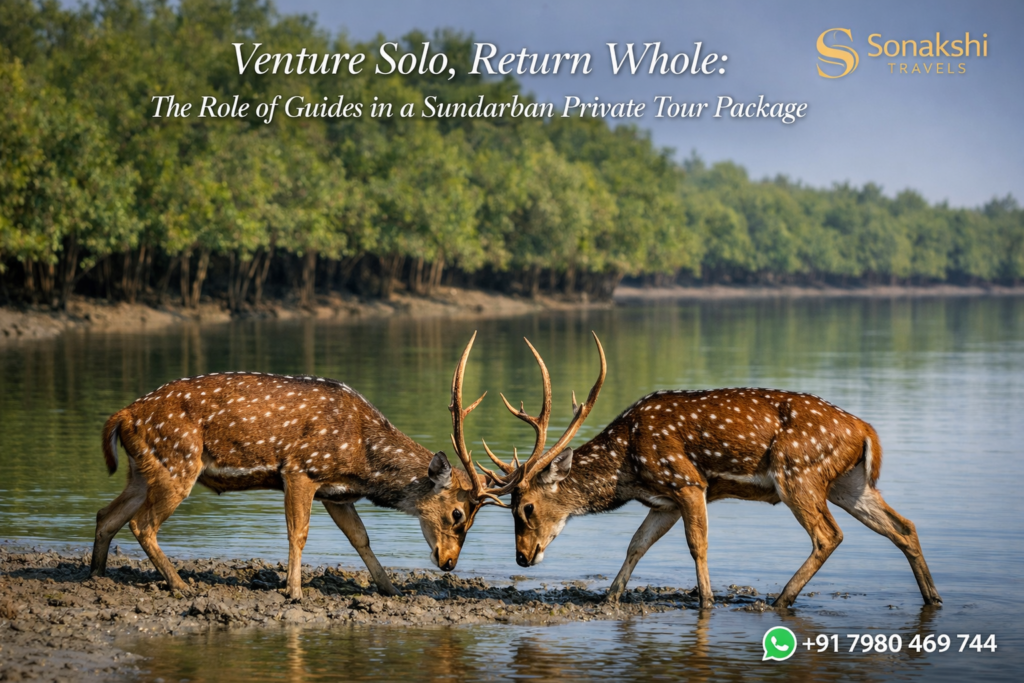
For a solo traveler, entering the Sundarbans is not simply a step into “nature”; it is entry into a living delta system governed by tides, sound cues, and protective regulation. The real question is not whether one can arrive alone, but whether one should move through this landscape without trained expertise. Within the broader knowledge base available at SundarbanTravel.com, the central principle remains consistent: in a terrain shaped by shifting channels and controlled forest access, guided support is structural rather than ornamental.
A Sundarban private tour designed for solo guests places professional guiding at the center of the experience. It is not added as a courtesy; it is embedded because the environment demands interpretation, vigilance, and procedural clarity. In practice, the guide becomes an ecological interpreter, a regulatory navigator, a safety professional, and a cultural mediator—roles that merge into a single, continuous layer of support for independent travelers.
Why Solo Travel in the Sundarbans Requires Structured Guidance
Unlike destinations defined by fixed trails and static terrestrial maps, the Sundarbans operate through tidal flux. Channels widen or compress with lunar-driven water movement; mudbanks surface and dissolve; navigable corridors are not merely geographic realities but regulated pathways. For a solo traveler, that fluidity can shift a calm experience into avoidable uncertainty unless the journey is anchored by local expertise.
Within the operational design of a field-based Sundarban tour experience, guides are trained to read tidal charts, recognize safe anchoring conditions, and maintain alignment with forest department instructions. This structure matters more for solo guests because there is no group buffer—no shared decision-making, no collective reassurance, and fewer margins for navigational or procedural errors.
Operational Complexity of a Mangrove Ecosystem
The Sundarbans form the world’s largest mangrove delta ecosystem, defined by intertidal forests, saline water channels, and sedimentary banks that behave like living geography. The terrain is not “untouched” in a romantic sense; it is ecologically delicate and legally managed. Boat movement follows permission-based routes, landing access is controlled, and wildlife proximity protocols must be observed with consistency rather than improvisation.
A solo traveler cannot realistically negotiate these layers alone. Forest entry permissions, timing windows for movement, restricted zones, and compliance practices require coordinated handling. In a private tour structure, the guide carries responsibility for documentation, on-ground coordination, and correct interpretation of rules—ensuring solitude never becomes non-compliance, and exploration never becomes ecological disturbance.
Safety Protocols: The Non-Negotiable Dimension
Safety in the Sundarbans is not an abstract reassurance; it is a set of behaviors shaped by environment and regulation. The region is habitat to apex predators, estuarine crocodiles, and other wildlife adapted to amphibious terrain. While direct encounters are uncommon and movement is controlled, risk management remains essential because the delta itself is unpredictable in smaller, operational ways—slippery embankments, fast-changing water levels, and limited infrastructure in remote stretches.
Wildlife Awareness and Risk Mitigation
Certified local guides are trained to interpret wildlife behavior cues rather than chase sightings. They recognize alarm calls that signal predator presence, understand how tides influence animal movement, and maintain distance-based observation norms. For solo travelers, this expertise converts uncertainty into a steady awareness—one that protects the visitor and avoids stressing the ecosystem.
They also implement practical safety disciplines: controlled deck movement during boat safaris, structured conduct during village walks, and constant communication with crew members about location, visibility, and timing. In a private arrangement, this attention is not diluted. The guide’s responsibility is concentrated, and the traveler receives the full benefit of that vigilance.
Emergency Preparedness
Professional guides associated with structured private tours typically undergo basic emergency response training and learn region-specific escalation procedures. They remain familiar with safe exit points, nearest medical access routes, and communication protocols in low-network zones. For solo travelers—who cannot rely on fellow guests in moments of confusion—this preparedness is not a “feature”; it is the foundation of responsible travel in a remote delta environment.
Interpretation: Transforming Observation into Understanding
Without interpretation, mangrove landscapes can appear visually repetitive. Creeks resemble one another, calls merge into ambient sound, and small changes in tide or bird activity may feel insignificant. The presence of a skilled guide shifts the experience from passive viewing to informed engagement—where details become meaningful and silence becomes readable.
Ecological Literacy
Guides explain the functional logic of mangrove adaptation: aerial roots that stabilize sediment, salt-management mechanisms that enable survival in brackish water, and the micro-relationships between mudflats, crustaceans, and bird feeding cycles. They contextualize what a traveler sees—why a certain bird perches at low tide, why dolphins surface in specific channels, or how honey collectors interpret forest cues for safe movement.
For a solo traveler seeking depth rather than spectacle, this interpretive layer is indispensable. The journey becomes a field-based learning experience, where observation builds understanding rather than remaining a series of disconnected scenes.
Cultural Mediation
The Sundarbans are inhabited landscapes. Fishing communities, crab collectors, and honey gatherers sustain livelihoods shaped by tidal rhythms. Their language, shared memory, and ritual practices are not tourist add-ons; they are part of how life is organized in a complex ecology. A guide facilitates respectful interaction, translating not only words but context—helping a solo traveler understand what is appropriate to ask, observe, or photograph.
For guests arriving from outside the region, this mediation protects both sides. It enables real connection without intrusion, and it ensures that cultural exchange remains ethical rather than extractive.
The Psychological Dimension of Guided Solo Travel
Traveling alone into a remote ecological zone often sharpens awareness. Silence amplifies internal dialogue, unfamiliar terrain heightens attention, and the absence of social distraction can be both restorative and demanding. In that psychological space, structured guiding creates steadiness—allowing solitude to remain intentional rather than stressful.
Balancing Solitude and Security
A private guide does not need to dominate the experience to make it safer. Their value lies in being present without being intrusive: available when the traveler seeks explanation, and quietly vigilant when the traveler seeks silence. This balance matters particularly in a boat-dependent landscape where timing, route selection, and protocol are not always visible to the guest.
When the guide carries the operational load—route logic, time windows, regulated conduct—the solo traveler gains cognitive space. Attention can shift toward listening, observing, and reflecting rather than managing uncertainty.
Confidence for First-Time Solo Explorers
Research on solo travel behavior consistently highlights perceived safety as a decisive factor in destination choice, especially in remote or wilderness-adjacent environments. In the Sundarbans, perceived safety is strongly linked to the presence of local expertise that can interpret terrain, manage compliance, and respond calmly to small disruptions. This is why a private tour structure can make the region accessible to travelers who are independent by nature but unwilling to take unnecessary risks.
For those selecting a premium private format, the guiding element is often paired with higher operational consistency—clear timing discipline, dedicated support, and coordinated field execution. In practice, that combination aligns closely with what many travelers mean when they look for a private guided Sundarbans tour experience rather than a generic itinerary.
Customized Attention in a Private Format
In group environments, interpretation is distributed and pacing is negotiated among multiple interests. Questions compete for time, and silence becomes difficult to preserve. In a private arrangement, the guide’s attention aligns entirely with one traveler’s intent—allowing the journey to remain focused, precise, and psychologically comfortable.
Focused Thematic Exploration
If a traveler’s interest leans toward bird behavior, ecological adaptation, or riverine livelihoods, the guide can deepen discussion in that direction without compromising others’ expectations. Dialogue evolves naturally and can become more rigorous—closer to field interpretation than general commentary. This intellectual flexibility is one of the defining strengths of guided private travel for solo guests.
Adaptive Pacing
Solo travelers vary in tempo. Some prefer long stretches of stillness; others want structured conversation and continuous learning. Private guiding makes pacing elastic. The guide observes attention patterns, fatigue, curiosity, and comfort, then subtly modulates engagement—protecting both the traveler’s experience and the operational rhythm required by a tide-driven environment.
Ethical Responsibility and Conservation Awareness
The Sundarbans are not merely “visited”; they are protected. Guided travel supports conservation by ensuring visitors behave in ways that align with ecological protection standards. For solo travelers, who may not have prior exposure to protected-area norms, the guide becomes a practical educator in responsible field conduct.
Minimizing Ecological Impact
Trained guides discourage disruptive behaviors such as noise amplification, unsafe wildlife proximity, or casual waste practices. They reinforce low-impact travel principles and provide grounded explanations of ecological stressors—habitat erosion, salinity shifts, and climate-linked vulnerability—without turning the journey into a lecture. The goal is not to moralize, but to create informed visitors who understand how small behaviors shape fragile systems.
For independent travelers, this knowledge changes the relationship with place. The journey becomes participatory: guided not only through space, but through responsibility.
Are Guides Available for Solo Travelers?
Yes. Within a professionally structured Sundarban private tour, guides are not reserved for groups. Solo travelers receive dedicated guiding support, often with more continuity than larger parties because attention is not divided among multiple guests. The guide remains assigned for core activities—forest movement, boat safaris, and community interaction—maintaining a consistent interpretive thread across the journey.
In established private tour frameworks, guide inclusion is operationally integrated. It typically includes verification of local credentials, language capability, and ongoing coordination with crew and accommodation partners. In practical terms, this integration is what allows solo travelers to remain “solo” in the emotional sense—without being alone in the logistical and safety sense.
Guided Solitude as a Thoughtful Choice
Solo travel into the Sundarbans is a deliberate act. It signals curiosity, independence, and a preference for depth over crowd experience. Yet autonomy does not require isolation from expertise. In environments defined by ecological sensitivity and operational complexity, trained guidance strengthens independence by reducing avoidable uncertainty.
A well-structured private tour ensures that solo travelers are supported by professionals who safeguard safety, interpret ecology, and mediate cultural interaction with respect. The guide is not a companion imposed upon solitude, but a quiet anchor that keeps solitude safe, meaningful, and legally compliant.
In the tidal hush of the mangroves—where routes shift, rules matter, and silence carries weight—structured guidance allows the solo traveler to move with confidence: observing deeply, understanding precisely, and returning with clarity rather than loose impressions.