Updated: March 16, 2026
What transportation options are available during a Sundarban Luxury Tour?
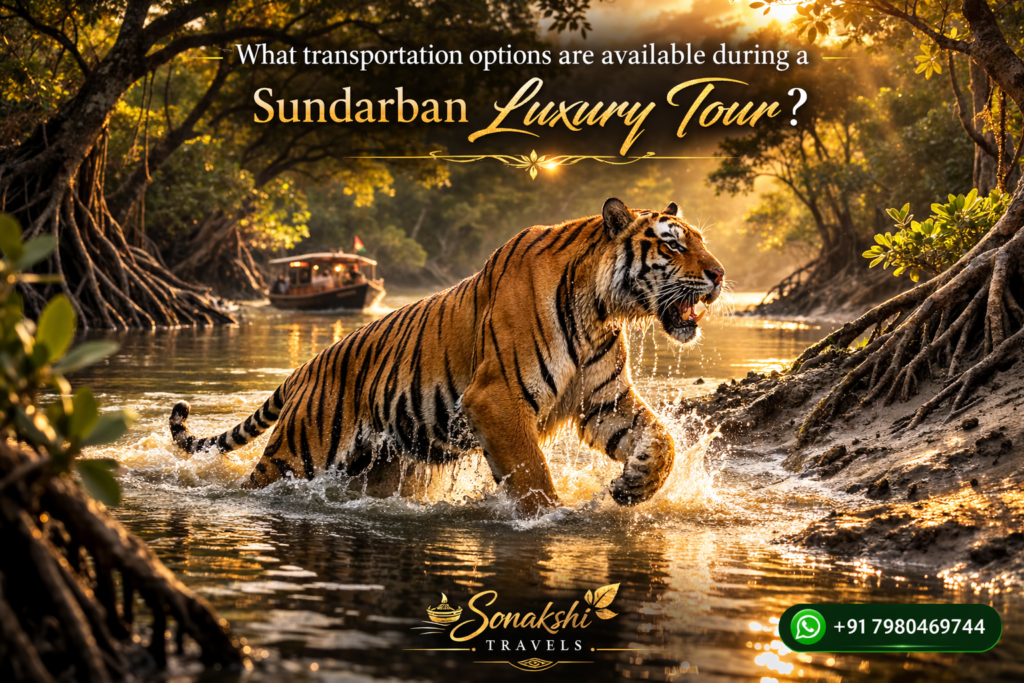
Transportation in the delta is never a minor logistical detail. It shapes the entire quality of perception. In most destinations, one may think of transport as a practical bridge between attractions. In the Sundarbans, that assumption fails. Movement is part of the experience itself. The route is not separate from the destination, because the landscape reveals itself through channels, tidal turns, mudbanks, silent creeks, shifting light, and long stretches of waterborne observation. For that reason, the transportation options available during a Sundarban luxury tour must be understood not only by category, but also by function, comfort, ecological suitability, and interpretive value.
A refined journey through this mangrove region usually combines more than one mode of transport, yet each mode has a distinct purpose. One form supports access and continuity, another supports observation, another supports privacy, and another supports the slow discipline of seeing. A luxury arrangement is not luxurious merely because it is comfortable. It becomes meaningful when transport is chosen with intelligence, when the pace matches the environment, and when the traveller is not rushed through a living tidal system that requires patience. That is why serious planners of Sundarban private tour experiences place unusual care on the design of transport.
The layered nature of movement in the delta
The first point to understand is that transport during a luxury journey in the Sundarbans is layered rather than singular. There is usually a land segment, then a river segment, and sometimes a more intimate secondary river movement within the broader cruise structure. These are not interchangeable. Roads can carry the traveller only to the threshold of the delta. Beyond that threshold, water becomes the principal surface of movement. This fact changes the psychology of travel. One does not merely pass through space; one enters a tidal rhythm in which direction, speed, silence, and visibility all matter.
Because of this, luxury in the Sundarbans depends on smooth transitions between these layers. A poorly coordinated transfer can break the mood of the journey. A well-arranged one preserves continuity. The guest should feel that the experience unfolds without friction, without crowding, and without the fatigue that comes from disorderly interchange. This is why many carefully designed forms of Sundarban travel place heavy emphasis on transfer quality, boarding ease, seating comfort, and the calm sequencing of movement from road to jetty to boat.
Private air-conditioned car transfer as the first transportation layer
Within a luxury context, the most common land-based transport option is a private air-conditioned car. Its significance lies not in extravagance, but in control. Shared road transport may be workable for ordinary mass travel, yet it often introduces waiting, noise, route deviation, and unnecessary fatigue. A private vehicle preserves quietness at the very beginning of the journey. That matters more than it may appear. The Sundarbans reward steady attention, and the tone of that attention is often set from the first stage of movement.
The vehicle used in a luxury arrangement is generally selected for ride quality, cabin comfort, and predictable timing. This first segment supports rest, conversation, orientation, and psychological preparation. It is also important because the transition from the urban density of Kolkata to the riverine threshold of the delta is not merely geographical. It is perceptual. Good transport allows that shift to happen gradually. In that sense, the land transfer is not just a utility. It becomes the opening corridor of the larger Sundarban luxury travel experience.
For families, older travellers, couples seeking privacy, and guests who prefer a more composed arrival, this private land segment remains one of the most valuable transportation options available. It reduces strain before the water journey begins. In better organized premium arrangements, luggage handling is integrated into this layer as well, so that the traveller does not experience repeated disruption at handover points.
The transfer launch or boarding boat
Once the road section ends, a second transport layer appears: the transfer launch or boarding boat. This is the practical bridge between the mainland approach point and the main river-going vessel or lodge-side jetty. In less thoughtful operations, this phase can feel abrupt or crowded. In a true luxury structure, it is treated as a carefully managed passage. Boarding stability, staff assistance, step safety, luggage transfer, and seating arrangement are all part of transport quality.
What makes this phase important is that it marks the moment when the journey stops behaving like ordinary terrestrial travel. Water changes everything. Sound disperses differently. Wind becomes a direct part of the sensory field. The horizon opens. Vegetation appears in a more lateral and continuous way. Even when the transfer boat is short-range, it introduces the elemental reality of the delta. In that sense, this modest transport layer performs a symbolic function as well as a practical one.
During a Sundarban private boat tour, this transfer phase is often more controlled because the handover is dedicated to one party rather than many mixed passengers. Privacy begins to deepen here. The traveller is not merely moved; the traveller is settled into a quieter observational mode.
The main river cruiser as the central transportation option
The central transportation option in a luxury delta journey is the main river vessel. This may be described in different ways—cruise boat, safari vessel, premium launch, or floating viewing platform—but its core role is the same. It is not only a carrier. It is the primary environment through which the landscape is encountered. In practical terms, it serves as the dominant transport system throughout the journey. In experiential terms, it acts as the moving threshold between traveller and wilderness.
This is where distinctions in quality become most visible. A properly designed premium vessel offers stable seating, shade, open viewing areas, clean washroom access, careful staff support, and a deck arrangement that supports long periods of silent observation. Since the Sundarbans are best read slowly, the vessel must permit stillness as well as motion. Too much engine harshness, crowding, or chaotic circulation on deck can reduce the experience severely.
That is why the main boat in a luxury setting is usually chosen for balance rather than spectacle. It should be sufficiently comfortable without becoming visually inappropriate to the environment. It should allow the traveller to watch banks, birds, roots, ripples, current patterns, and sudden animal movement without distraction. This form of transport is therefore not separate from interpretation. It is the very platform on which interpretation becomes possible during a luxury Sundarban cruise.
Why boat design matters in luxury travel
Not every boat offers the same quality of seeing. Hull stability, deck height, roof coverage, railing openness, engine vibration, seating layout, and circulation space all influence how the mangrove world is perceived. A boat that is technically functional may still be poor in interpretive terms if it forces the body into discomfort or prevents quiet observation. In a luxury context, transport should support attentiveness rather than test endurance.
Experts in river-based travel often note that comfort in ecological destinations is not only about softness. It is about endurance without strain. A guest who can remain settled for hours is more likely to notice subtle forms of life: the posture of a fishing bird, the sudden break of water at a creek mouth, the tonal shift of mudflats in receding tide, or the faint movement in shoreline foliage. Boat design therefore determines not only physical ease, but ecological readability.
This is why the best operators use a dedicated Sundarban private luxury boat or similarly high-standard vessel where deck structure and viewing logic have been carefully considered. The emphasis is not merely on appearance. It is on the discipline of unobstructed, patient witnessing.
Private boat movement and the value of exclusivity
Among the most important transport options in a luxury arrangement is exclusive boat use. Shared launches can carry many passengers effectively, but they often alter the emotional character of the journey. Conversations overlap. Movement becomes collectively dictated. The timing of pauses, meals, photography, and silence is no longer personal. In contrast, an exclusive vessel restores control over pace and atmosphere. This is one of the reasons travellers often prefer a Sundarban private tour package when the goal is calm immersion rather than simple movement.
Exclusive movement on water changes the entire tone of the day. It allows the guide’s explanations to be heard clearly. It allows children and older guests to settle without pressure from strangers. It allows couples to experience the river with privacy. It allows photographers to wait through longer quiet intervals. It also reduces the sense of being processed through a route. This matters deeply in the Sundarbans, because the landscape does not reveal its character through speed. It reveals itself through intervals, pauses, and subtle continuities.
For this reason, transport in a luxury setting is often judged not by distance covered, but by quality of occupancy. The difference between being carried and being hosted becomes visible here.
Small support craft and intimate creek access
In some carefully managed situations, a luxury arrangement may also include limited use of smaller support craft for localized movement. These are not replacements for the main river vessel. They serve narrower purposes where conditions, permissions, and safety considerations allow more intimate navigation. Their value lies in scale. A smaller craft can produce a different sensory relationship with the water. The traveller sits closer to the surface, hears finer details, and feels turns and current more directly.
However, this option must be understood with restraint. In the Sundarbans, smaller is not automatically better. The right craft depends on channel conditions, safety, and ecological appropriateness. Luxury does not mean intrusion into every narrow water path. It means good judgment. When a smaller vessel is used intelligently, it supports delicacy of approach rather than novelty for its own sake.
This principle is especially relevant to a private Sundarban river cruise structure, where the operator may combine a larger host vessel with more intimate movement only when it improves perception without compromising stability or environmental respect.
Comfort transport versus observational transport
One of the most useful distinctions in understanding Sundarban transportation is the difference between comfort transport and observational transport. The private car belongs mainly to the first category. It carries the traveller efficiently and smoothly. The main boat, by contrast, belongs to both categories at once. It must provide physical ease, but it must also function as an observational instrument. This dual role makes river transport uniquely important in the delta.
A boat that is too enclosed may protect from heat but reduce visual contact. A boat that is too exposed may enhance viewing but create fatigue. A good luxury arrangement finds equilibrium between these pressures. That is why the most successful premium journeys are not designed around decorative luxury alone. They are designed around perceptual efficiency. How well can a human being remain comfortable enough to notice the environment without losing contact with it? That is the essential transport question in a Sundarban luxury boat safari.
The role of silence in choosing transport
Silence is not an ornament in the Sundarbans. It is one of the conditions through which the place becomes legible. Transport that constantly produces disturbance weakens that legibility. Noise from engines, chaotic passenger behavior, harsh music, or disorderly loading does more than create inconvenience. It interrupts ecological attention. Luxury transport should therefore be evaluated partly by acoustic quality.
This does not mean absolute silence is possible. Boats must move, engines must function, and working waterways are living systems. Yet there is a meaningful difference between managed sound and careless sound. Better boats reduce harsh vibration. Better crews communicate calmly. Better private arrangements remove unnecessary noise from crowding. This quieter field of movement is one of the strongest reasons travellers choose a Sundarban luxury private tour instead of a generic, high-density group outing.
When sound is controlled, smaller environmental details become more available. The crack of a distant branch, the wingbeat of a large bird, the subtle slap of tidal water on a wooden hull, and even the changing texture of wind through mangrove edges become part of the journey. Transport then ceases to be a barrier and becomes a listening platform.
Psychological differences between road and river movement
The road vehicle and the river vessel do not simply move the body through different surfaces. They shape the mind differently. Road transport tends to be directional and goal-oriented. It encourages arrival thinking. River transport in the Sundarbans does something else. It stretches attention sideways. Instead of focusing on a single destination point, the traveller begins to observe edges, banks, light conditions, channel widenings, bird movement, floating vegetation, and the quiet drama of transitional space.
This psychological change is central to understanding transportation options in a luxury tour. The best arrangements do not force the river phase to imitate the road phase. They allow it to remain slow, interpretive, and atmospheric. That is why the boat is the true center of a luxury Sundarban safari mindset, even when the journey begins in a private car. The car supports access. The boat supports encounter.
Transportation options for different guest needs
Although the main categories remain similar, transport selection may still vary according to the guest profile. Families often benefit from private car transfer and exclusive deck space because predictability matters. Elderly travellers benefit from easier boarding, stable seating, and minimized transfer stress. Couples often prefer quieter occupancy and uninterrupted window-to-river continuity. Serious photographers value deck angles, low-clutter viewing lines, and the ability to wait. In each case, the transportation option is not changed purely for status. It is adjusted for perceptual and bodily needs.
This is one reason tailored premium arrangements continue to attract travellers who want more than standard movement. A transport plan that respects human variation is part of the deeper intelligence of a Sundarban customized private tour, even though the visible categories of vehicle and boat may appear similar from outside.
Why the best luxury transport feels effortless
When transport is correctly designed, the guest notices the landscape more than the system. This is a sign of success. Seamless movement does not draw attention to itself through confusion, delay, imbalance, or discomfort. It creates a condition in which the mangrove world can become primary. Staff coordination, boarding support, boat readiness, luggage flow, meal timing on board, and restful seating all work quietly in the background.
This apparent effortlessness is in fact the product of planning. River travel in the Sundarbans is complex because the environment is fluid. Water level, current behavior, embarkation conditions, and navigational rhythm all require experience. Luxury transport therefore means managed fluidity. The traveller should feel neither hurried nor neglected. The system should feel composed, humane, and proportionate to the delicacy of the place.
What transportation truly means in a luxury Sundarban journey
To ask what transportation options are available during a luxury journey in the Sundarbans is to ask more than whether one rides by car or boat. The truer answer is that transport in this landscape is an interpretive structure. A private air-conditioned car usually forms the first controlled layer. A transfer launch or boarding boat bridges access to the river environment. A premium main vessel becomes the central mode of movement and observation. In some situations, smaller support craft may add intimacy where appropriate. Yet the hierarchy matters: comfort, privacy, stability, silence, and perceptual access must remain above spectacle.
For that reason, the finest premium experiences do not treat transport as a secondary service added around the journey. They treat it as the very medium through which the delta can be understood. A serious Sundarban luxury tour package is therefore distinguished by how intelligently it choreographs movement. The traveller is not simply delivered from one point to another. The traveller is carried through a living environment in a way that preserves attention, dignity, quietness, and depth of encounter. That is the real meaning of transportation in a Sundarban luxury setting.