Designing the Ideal Sundarban Private Tour: Privacy, Wildlife, Seasonality, Cuisine, and the Meaning of Luxury in the Mangrove Delta
A journey into the Sundarban cannot be approached in the same way one plans an ordinary holiday. This is not a destination that reveals itself through speed, crowded sightseeing, or a checklist of attractions completed in quick succession. The delta asks for a different kind of attention. Its rivers shift with the tide, its forests hold back their meaning until the traveler learns to observe more patiently, and its atmosphere changes from one hour to the next through light, silence, water movement, and subtle signs of life. Because of this, the idea of a Sundarban private tour has become increasingly meaningful for travelers who want more than a routine excursion.
A private journey through the mangrove landscape is not simply a premium upgrade added to a standard itinerary. It is a different way of entering the region. Privacy allows the pace to become more deliberate. Comfort makes long hours on the water more restorative rather than tiring. Flexible planning makes the experience more personal, whether the traveler values birdwatching, silence, photography, food, or a slower immersion in the ecological and cultural mood of the delta. In this sense, a well-planned Sundarban luxury tour is less about display and more about refinement in access, atmosphere, and interpretation.
The strongest journeys are usually the ones that bring together several important dimensions at once: the right season, a thoughtfully customized route, meaningful encounters with wildlife, the pleasure of regional food, and the guidance of an operator who understands that comfort must support the landscape rather than compete with it. When all of these elements work together, the tour becomes more than transport through waterways. It becomes an experience of rhythm, texture, and place.
The Real Appeal of a Private and Luxury Experience in the Sundarban
Luxury in the Sundarban should be understood with care. It does not resemble the vocabulary of metropolitan hotels or resort-heavy destinations where luxury is measured mainly in excess, decoration, or spectacle. In the delta, refinement is expressed through quieter and more practical forms. It may appear in the quality of a boat, the privacy of movement, the spacing of the itinerary, the attentiveness of service, the knowledge of naturalist guidance, or the way the day is arranged so that the forest can be experienced without haste. A strong Sundarban luxury private tour is therefore defined by thoughtfulness rather than theatricality.
This is why many travelers are drawn toward a private format. Group departures often move according to a collective rhythm. They must balance many preferences at once, and that can reduce the intimacy of observation. In contrast, a private journey creates room for a more individualized experience. A family with children may prefer a gentler schedule with more breaks and more time for interpretation. A couple may value a quieter, more secluded atmosphere with elegant meals and uninterrupted river views. Wildlife enthusiasts may want longer hours in promising channels, while cultural travelers may prefer a stronger emphasis on village interaction, local cuisine, and the reflective mood of the landscape itself.
The value of privacy becomes especially clear in a place where the environment is not loud in an obvious way. The Sundarban is full of detail, but much of it is subtle. Bird calls arrive from hidden branches. Mudbanks record passing life in marks rather than in dramatic appearances. A creek that seems empty at first may slowly reveal egrets, kingfishers, fishing movement, or reptilian stillness when watched properly. Private touring supports this mode of travel because it allows silence, patience, and observation to remain intact.
For travelers who want to understand what kind of fauna may define such a journey, the broader ecological atmosphere is central to the appeal of a premium itinerary, and that is why interest naturally grows around the question of what wildlife can be expected on a Sundarban luxury tour. Wildlife is not an isolated add-on to the experience. It shapes the emotional tone of the tour itself.
Wildlife Is Not a Guarantee, but It Is the Soul of the Journey
One of the most important ideas a traveler must understand before entering the delta is that wildlife in the Sundarban does not behave like a staged attraction. The forest is not designed for certainty. It is designed for encounter, possibility, and evidence. That distinction matters. A meaningful journey is not built on exaggerated promises. It is built on respect for habitat, timing, trained observation, and a willingness to appreciate not only dramatic sightings but also the atmosphere that makes those sightings possible.
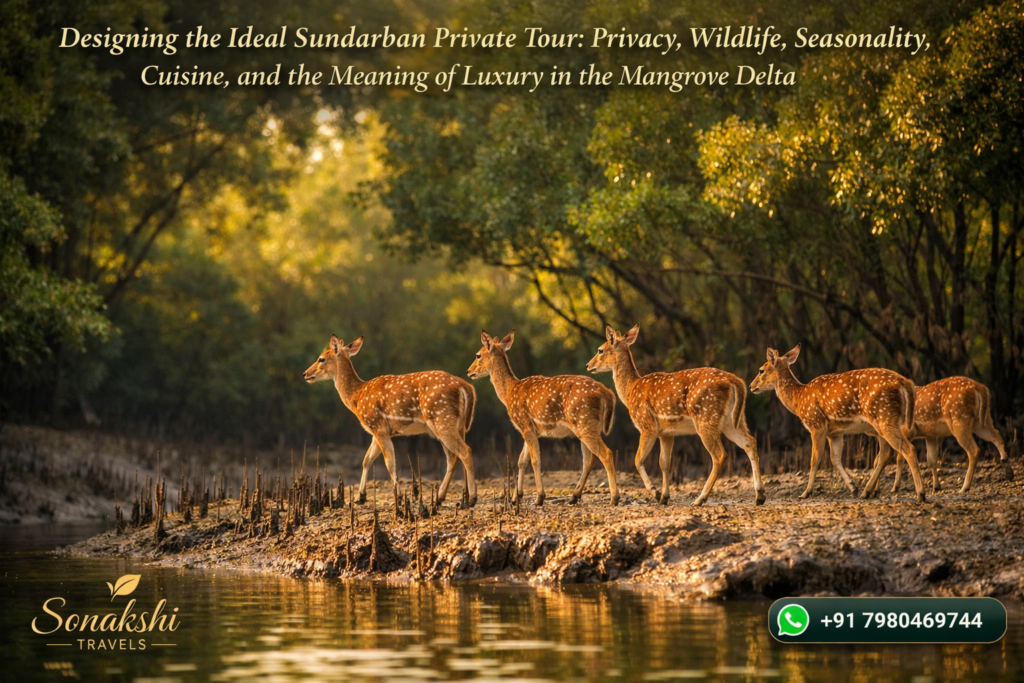
The wildlife dimension of the Sundarban is broad, layered, and often cumulative. The traveler may notice movement first through birds rather than mammals. There may be raptors overhead, smaller flashes of color near the waterline, or elegant waders in exposed tidal flats. Reptilian life may appear in stillness, almost blending into mud and riverbank until the eye learns where to rest. Deer, monitor lizards, crabs, estuarine textures, and signs of larger unseen life all contribute to the sense that the landscape is inhabited in ways that exceed the visible surface.
This is precisely where private touring offers a deeper advantage. A rushed itinerary may force travelers to treat wildlife as a success-or-failure test. A more carefully arranged format allows the traveler to understand that wildlife watching in the delta is as much about reading habitat as it is about spotting a specific animal. The guide’s interpretive role becomes very important here. A knowledgeable operator helps guests understand how tide, season, light, and route influence the quality of observation. In a private setting, those explanations are easier to absorb because the day is less fragmented by noise and group management.
The finest wildlife experiences also depend on mood. Long, comfortable hours on the water matter. Clear sightlines matter. The ability to pause without pressure matters. When a tour is designed for privacy and ecological attention, wildlife becomes part of a fuller sensory experience: the stillness before movement, the mirrored light on tidal water, the suspense of a narrow creek, and the patience required to let the forest disclose itself on its own terms. That is where the premium character of the journey becomes meaningful.
Why Customization Changes the Entire Character of the Tour
In a complex environment like the Sundarban, customization is not a superficial convenience. It can shape the entire emotional and practical quality of the trip. The difference between a standard outing and a deeply satisfying Sundarban private tour package often lies in how thoughtfully the itinerary is adjusted to the traveler’s priorities. Good customization does not mean endlessly rearranging logistics without purpose. It means aligning pace, focus, comfort, and experience with the character of the guests.
Some travelers want a stronger wildlife emphasis, with early departures, extended boat time, and a schedule that prioritizes observation over variety. Others may prefer a more balanced rhythm that combines forest cruising with rest, photography, cultural texture, and leisurely meals. Families may want comfort and flexibility above all, especially when traveling with children or older relatives. Honeymooners or couples may value privacy, quieter accommodations, and a more intimate atmosphere. Serious photographers may need route planning that considers light quality and timing rather than simple sightseeing efficiency.
This is why thoughtful travelers increasingly ask can I customize my Sundarban private tour itinerary. The question is not only logistical. It reflects a deeper desire to ensure that the journey feels intentional rather than generic. In an environment where each hour has a different tone, customization can determine whether the experience feels hurried, balanced, immersive, or restorative.
Customization also creates a more truthful form of luxury. Instead of filling the itinerary with unnecessary activity, it allows the operator to refine the essentials. Better transitions, more appropriate meal timing, more comfortable rest periods, meaningful route choices, and the right level of interpretive support all contribute to a stronger experience. In the Sundarban, excess can easily become distraction. Precision, by contrast, becomes elegance.
When the tour is personalized well, even simple moments gain greater weight. Tea on the deck after a long stretch of quiet observation feels more memorable. A slower passage through a narrow creek feels less like transport and more like immersion. An unhurried lunch feels connected to the day rather than inserted into it. This is how itinerary design influences not only convenience but perception.
Food as Cultural Depth, Not Just Hospitality
One of the most overlooked dimensions of private travel in the delta is food. Many travelers think of meals as a necessary support service—something included for convenience between excursions. Yet in a destination so deeply connected to river ecology, Bengali identity, local produce, and the rhythms of hospitality, food often becomes part of the interpretive richness of the journey. It is not simply about being fed. It is about entering the region through taste, atmosphere, and cultural familiarity.
A well-arranged Sundarban luxury tour package generally recognizes that meals matter not only in quality but in tone. The style of preparation, the timing of service, the calmness of the setting, and the balance between local authenticity and guest comfort all help define how memorable the experience becomes. Travelers who seek privacy often appreciate this even more, because private touring allows meals to feel less institutional and more intimate. They become part of the day’s rhythm rather than a crowded interruption.
For many guests, one of the most appealing questions is whether the journey can include regional flavor in a genuine form, which is why curiosity often centers on trying authentic Bengali food during a Sundarban private tour package. This interest is significant because it reflects a mature kind of travel desire. The traveler is not only asking what can be seen, but what can be understood and felt more deeply through local culture.
Food in this context adds emotional texture. A thoughtfully prepared Bengali meal can create continuity between landscape and experience. River regions are not only observed; they are inhabited through cuisine, hospitality, and sensory memory. In a private setting, meals can also be adjusted more sensitively to preference, dietary comfort, pace, and mood. This reinforces the larger principle that quality in the Sundarban is not merely about upscale provision. It is about coherence. When cuisine, timing, and environment align, the journey becomes more complete.
The Best Time Matters Because the Delta Is Seasonal in Mood, Access, and Experience
No serious travel planning for the Sundarban can ignore seasonality. The region changes not only in temperature but in visibility, comfort, river character, and the general feel of exploration. This means that the best time for a private or luxury tour is not just a question of climate preference. It is about matching the season to the kind of experience the traveler hopes to have.
Some periods may feel more comfortable for extended boat movement and daytime observation. Others may create a denser atmospheric mood, where the forest feels softer, heavier, or more dramatic. Light behaves differently across the year. The quality of air, the comfort of afternoon travel, and the overall rhythm of the day all influence how the delta is perceived. For wildlife-focused guests, this becomes even more important, because season affects both physical ease and observational opportunity.
That is why informed planning naturally includes the question of the best time for a Sundarban private tour. The answer is rarely as simple as naming one perfect month. A better response considers purpose. Travelers seeking mild weather and smoother comfort may prefer one window. Those drawn by a particular mood, photographic quality, or style of travel may interpret the seasons differently. What matters most is that the operator helps align timing with intention.
In a premium context, seasonality also affects the meaning of comfort. A journey planned with awareness of weather patterns, daylight conditions, and guest tolerance creates a more composed experience. The day flows better. Fatigue is reduced. Wildlife watching becomes more enjoyable. Even meals and rest periods feel better integrated. In this way, choosing the season is not a minor logistical step. It is one of the structural foundations of a successful Sundarban luxury tour.
Choosing the Right Agency Is Ultimately Choosing the Quality of Interpretation
When travelers think about selecting an agency, they often begin with visible factors such as price, accommodation, or transport. These are important, but they are not enough to determine quality in a place like the Sundarban. The strongest agency is not the one that merely lists the most inclusions. It is the one that understands how to compose an experience with integrity. This includes pacing, route judgment, ecological sensitivity, culinary coherence, guest comfort, and the ability to shape privacy without making the trip feel isolated from the spirit of the region.
In other words, a capable operator does more than organize movement. It interprets the landscape. It knows when to slow down, what to emphasize, and how to build a tour around attention rather than noise. It recognizes that the traveler is not only purchasing transport and lodging, but also trust. In a terrain defined by tides, distance, and subtle perception, trust in the operator matters enormously.
This explains why travelers frequently explore the question of which agency offers top-rated luxury tours in Sundarban. At its heart, the question is about confidence. Who can shape the trip responsibly? Who understands that privacy should not lead to detachment, that comfort should not undermine authenticity, and that luxury should support ecological appreciation rather than dominate it?
A top-level agency in this space usually demonstrates a combination of practical strength and interpretive maturity. It should be able to tailor itineraries intelligently, support expectations honestly, present the region without exaggeration, and create an environment where guests feel both comfortable and meaningfully connected to place. In the Sundarban, that combination is far more valuable than a polished sales vocabulary alone.
The Finest Sundarban Journeys Are Designed Around Depth, Not Display
The most memorable private journeys through the Sundarban are rarely the ones defined by one feature alone. They are not memorable only because of wildlife, only because of cuisine, or only because of comfort. Their power comes from integration. The season is chosen thoughtfully. The itinerary is shaped around the traveler rather than imposed upon them. Wildlife is approached with patience and realism. Food contributes cultural depth. The operator understands the difference between luxury as appearance and luxury as calm, precision, and access.
This is why a well-designed Sundarban private tour stands apart from ordinary travel formats. It allows the delta to be experienced as a living landscape rather than a rushed destination. It gives the traveler time to notice, interpret, and inhabit the experience more fully. When done properly, a Sundarban luxury tour package does not distance the guest from the forest. It creates the conditions under which the forest can be encountered with greater care, clarity, and meaning.
In the end, the ideal journey is not the one that promises the loudest outcome. It is the one that respects the nature of the place. The Sundarban is a world of tide, silence, movement, and layered life. To travel through it well is to accept that quality lies in the way the experience is composed. Privacy, customization, seasonality, wildlife, cuisine, and skilled guidance are not separate luxuries. Together, they form the true architecture of an immersive and deeply rewarding journey into the mangrove delta.