Updated: March 11, 2026
From Sorshe Ilish to Paturi: 5 Classic Hilsa Dishes at Sundarban Festival 2026
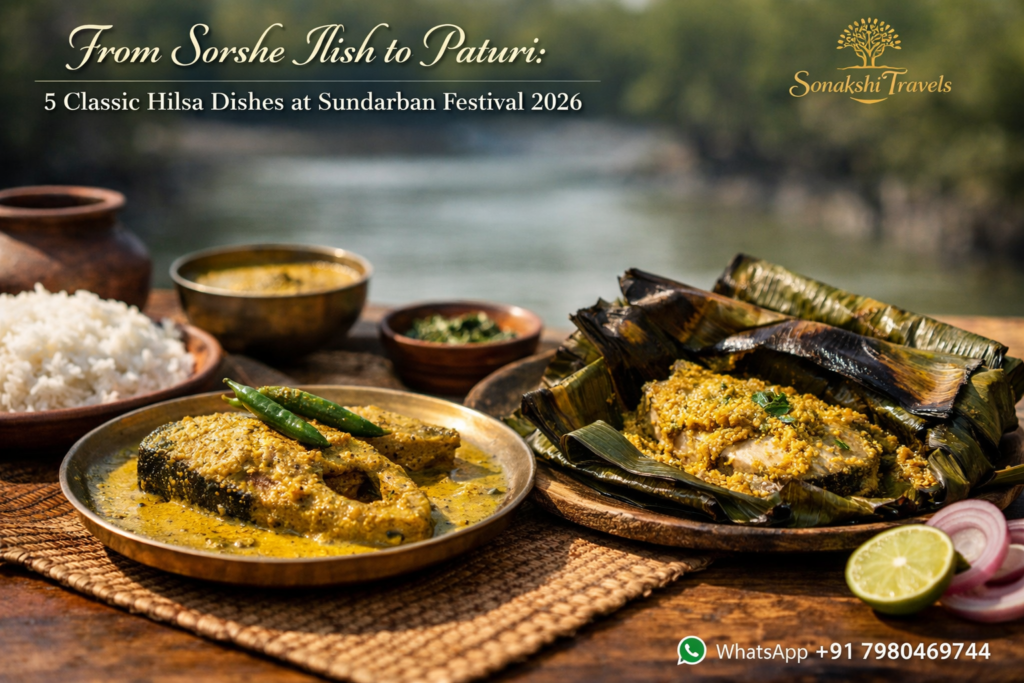
Food festivals often promise abundance, but only a few reveal the character of a region through the discipline of a single ingredient. That is what makes the Sundarban hilsa festival 2026 so compelling. It is not simply a gathering built around appetite. It is a culinary conversation about river identity, memory, technique, and the cultural seriousness with which Bengal approaches hilsa. In the Sundarban setting, that conversation becomes even richer. The mangrove landscape gives the dining experience a special emotional register: the smell of mustard rises in air touched by tidal moisture, banana leaves release steam beside open water, and the silver body of hilsa becomes part of a broader river narrative rather than only a dish on a plate.
Hilsa, or ilish, occupies a rare place in Bengali food culture. It is admired not only for taste but also for texture, aroma, bone structure, cooking behavior, and seasonal prestige. A great hilsa dish is never accidental. The fish demands careful cutting, balanced salting, precise heat, and an understanding of how much spice should speak and how much should remain quiet. Too much intervention destroys its elegance; too little leaves its depth unopened. This is why traditional hilsa cooking is often less about flamboyance and more about judgment. At the festival table, that judgment becomes visible in each preparation.
The beauty of the Sundarban ilish Utsav 2026 lies in the way it honors variety without losing respect for the fish itself. The dishes are different in color, body, and mood, yet all of them return to the same central truth: hilsa is at its best when the cook understands restraint. Mustard may dominate one recipe, curd may soften another, banana leaf may perfume a third, but the finest plates still allow the oil-rich flesh of the fish to remain the intellectual and sensory center of the meal.
Why Hilsa Becomes the Center of a Festival Table
Hilsa is not treated like an ordinary festival ingredient because it carries more than flavor. It carries inheritance. In Bengali households, hilsa recipes are often transmitted through observation rather than measurement. A grandmother may judge the bitterness of mustard by smell alone. A mother may know exactly how long a parcel wrapped in banana leaf should rest before steaming. A cook may decide whether a cut is better suited to fry, steam, or gravy based on fat distribution near the belly or spine. Such knowledge rarely enters recipe books in full. It survives in kitchens, in memory, and in taste.
At a festival devoted to hilsa, that domestic knowledge is elevated into public culture. The meal becomes a document of regional intelligence. Each preparation reflects a theory of cooking: whether sharpness should lead or fragrance should lead, whether moisture should be trapped or released, whether the fish should be touched lightly or enriched more generously. For anyone interested in cuisine as a serious expression of place, the hilsa spread at this festival offers much more than indulgence. It offers an edible archive of Bengal’s river civilization.
That is also why the dishes discussed here matter so much. They are not random menu items placed together for convenience. They represent major styles of hilsa preparation that have endured because each one reveals a different quality of the fish. One emphasizes pungency, one softness, one smoke-like leaf aroma, one creamy balance, and one elemental simplicity. Together, they form a complete culinary portrait.
1. Sorshe Ilish: The Fierce and Fragrant Classic
If one dish stands as the intellectual emblem of Bengali hilsa cooking, it is Sorshe Ilish. This is the preparation most closely associated with conviction. Mustard is not used here as background seasoning. It is the dominant force that frames the fish in sharp, aromatic intensity. Yet the best versions are never crude. Good Sorshe Ilish does not taste aggressively bitter or excessively oily. It delivers a clean mustard attack followed by the rich sweetness of hilsa flesh.
The structure of the dish appears simple: hilsa pieces, mustard paste, green chilli, turmeric, salt, and mustard oil. But every element requires precision. The mustard must be ground carefully so that its pungency remains lively without turning harsh. The oil must be present enough to carry aroma but not so heavy that it buries the fish. The gravy should cling rather than flood. A diluted mustard sauce weakens the dish; an over-thick one flattens it. Balance is the real craft.
At the festival table, Sorshe Ilish often becomes the benchmark against which all other hilsa dishes are mentally measured. Diners immediately notice whether the cook has respected the temperament of mustard. When done well, the dish carries a thrilling clarity. The nose receives mustard first, the tongue encounters warmth and bitterness in disciplined proportion, and then the hilsa opens with its deep, almost buttery softness. It is a preparation that feels both rustic and aristocratic at once.
This is also the dish that most clearly expresses why hilsa occupies such a dignified place in Bengali culinary thought. The fish does not hide behind spice. It confronts spice and remains itself. In that sense, Sorshe Ilish is not only delicious; it is structurally intelligent.
2. Bhapa Ilish: Steam, Softness, and Controlled Richness
If Sorshe Ilish is the declarative voice of hilsa cuisine, Bhapa Ilish is its more inward form. This is a dish of enclosure and concentration. The fish is usually coated in a mustard-coconut or mustard-curd mixture, then steamed so that flavor does not escape but settles inward. Steam changes the emotional quality of the meal. Where frying adds edge and open flame adds character, steaming preserves intimacy. It allows the flesh to remain moist, fragile, and quietly luxurious.
Bhapa Ilish deserves special attention because it demonstrates how technique can alter perception without changing the essential ingredient. The same hilsa that seems bold in a mustard gravy can feel almost meditative when steamed. The oil contained within the flesh mingles with the paste during cooking, producing a sauce that is smoother and more integrated than a conventional curry. The result is not merely tender fish. It is fish that seems to dissolve into its own aromatic environment.
At a festival centered on hilsa, Bhapa Ilish often draws those who appreciate detail over force. The pleasure lies in the seamlessness of the dish. No component feels detached. The steam softens the edges of spice, the green chilli offers freshness instead of aggression, and the fish emerges with remarkable composure. One tastes not only the recipe but also the restraint behind it.
In the context of the Sundarban hilsa festival, Bhapa Ilish reminds the diner that Bengali food culture values silence in flavor just as much as intensity. Some dishes announce themselves immediately. This one unfolds more slowly, and that is precisely its distinction.
3. Ilish Paturi: Banana Leaf as Aroma, Vessel, and Memory
Paturi is one of the most elegant forms in Bengali cooking because it transforms wrapping into flavor. Hilsa pieces are coated with a mustard-based paste, enclosed within banana leaf, tied or folded securely, and then cooked so that the leaf becomes more than packaging. It becomes a breathing skin around the fish. As heat rises, the leaf releases a green, warm, almost sweet aroma that enters the flesh and changes the character of the preparation.
This is why Ilish Paturi feels so complete as a dish. It engages multiple senses before the first bite. There is anticipation in opening the parcel. There is fragrance in the escaping steam. There is visual pleasure in the slight staining of the leaf by turmeric and oil. And then there is the taste itself, more rounded and perfumed than an exposed curry, more dramatic than a plain steam, and more evocative because of the leaf’s unmistakable contribution.
Paturi also reveals a great deal about Bengali culinary aesthetics. It shows a preference for containment, aroma transfer, and patient cooking rather than hurried assembly. Nothing about the dish feels careless. Even the act of serving suggests care. A parcel arrives whole, then opens into a concentrated world of oil, mustard, and fish. It is almost ceremonial.
Within a festival setting, Ilish Paturi often becomes the dish people remember most vividly because it carries atmosphere so well. The banana leaf links kitchen technique with a wider ecological imagination. In a river-and-mangrove environment, leaf-cooked fish feels especially appropriate. It reflects an older South Asian habit of allowing natural materials to shape taste instead of treating them as neutral containers. That is one reason the journey from Sorshe Ilish to Paturi feels so meaningful on a Sundarban table. One dish celebrates the sharp intelligence of mustard; the other celebrates the quiet eloquence of enclosure.
4. Doi Ilish: Soft Acidity and Aristocratic Balance
Doi Ilish occupies a different register from the mustard-dominant classics. Here, curd introduces softness, mild acidity, and creamy structure. The dish does not try to compete with Sorshe Ilish in pungency. Instead, it creates balance through tempering. The slight tang of yogurt works against the richness of the fish, producing a preparation that feels composed, polished, and deeply satisfying.
What makes Doi Ilish noteworthy at a festival is its capacity to show the adaptability of hilsa without diminishing its prestige. Some ingredients overpower fish. Curd, when handled properly, does not. It cushions the flesh. It allows spice to remain refined. It creates a gravy that feels fuller in body but gentler in expression. This is especially important with hilsa because the fish already carries its own oil and fragrance. A successful Doi Ilish uses curd to frame those qualities, not to erase them.
The best versions maintain subtlety. Excess sourness would fracture the dish. Too much sweetness would sentimentalize it. Too heavy a gravy would make the fish feel trapped. Good Doi Ilish avoids all three errors. It remains delicate, creamy, and controlled. The experience is less fiery than mustard-based preparations, yet it is no less serious.
From a cultural point of view, Doi Ilish shows how Bengali cuisine has always been able to hold together intensity and gentleness. Not every memorable hilsa dish needs sharpness. Some achieve distinction through calmness. That calmness can be especially striking amid a festival spread where stronger flavors dominate the imagination. Doi Ilish offers pause, and that pause has value.
5. Ilish Bhaja: Simplicity, Texture, and Pure Fish Character
Ilish Bhaja may appear to be the simplest of the five dishes, but simplicity in hilsa cooking is never a lesser art. A lightly seasoned piece of hilsa fried to the correct point can reveal the fish more directly than any elaborate gravy. The skin must gain color without turning hard. The flesh must remain moist. The exterior should carry a fine crispness, while the interior releases the distinctive oil that gives hilsa its luxurious reputation.
This dish matters because it strips away interpretive layers. There is no mustard paste to dominate, no leaf to perfume, no curd to soften. What remains is fish, heat, oil, salt, and timing. A poor fry exposes every mistake immediately. Too much heat dries the flesh. Too little heat leaves the texture dull. Overhandling causes the delicate pieces to break. When executed properly, however, Ilish Bhaja becomes one of the most convincing arguments for hilsa’s greatness.
At the festival, fried hilsa often works as both contrast and anchor. After more complex preparations, its directness feels refreshing. One notices the natural grain of the flesh, the fragile bones that require attentive eating, and the savory richness that lingers after each bite. There is something intellectually satisfying about such a dish. It proves that a revered ingredient does not always need adornment. Sometimes technique alone is enough.
In Bengali dining culture, fried hilsa also carries emotional familiarity. It belongs to home meals as much as celebratory spreads. That familiarity gives it strength. At a festival devoted to memory-rich cuisine, Ilish Bhaja does not appear humble; it appears foundational.
What These Five Dishes Reveal About Bengali Culinary Thought
Taken together, these five dishes form more than a menu. They reveal a philosophy. Bengali hilsa cooking does not pursue monotony through repetition. It explores variation through disciplined methods. Sorshe Ilish values pungent authority. Bhapa Ilish values inward softness. Paturi values aromatic enclosure. Doi Ilish values creamy balance. Ilish Bhaja values elemental truth. All are different, yet all remain loyal to the central identity of the fish.
This diversity is significant because it shows how a single ingredient can support multiple culinary grammars without losing integrity. In many cuisines, variety is achieved by changing the ingredient itself. Here, variety is achieved by changing the relationship between ingredient, medium, and aroma. Mustard speaks differently in steam than in gravy. Banana leaf changes the logic of heat. Curd changes how richness is perceived. Frying changes surface and concentration. Hilsa becomes the subject through which technique can be studied.
That is why the festival should not be read merely as a seasonal food event. It is also a public lesson in texture, balance, and memory. The fish becomes a way of thinking about Bengal’s food heritage at a high level of seriousness.
The Festival as a Cultural Meal, Not Just a Culinary Attraction
The strongest food festivals are those in which eating becomes a way of understanding place. The Sundarban hilsa festival 2026 achieves that because it does not separate taste from setting. A plate of hilsa in this context feels connected to river life, tidal imagination, Bengali domestic memory, and the ceremonial respect attached to fish in the regional mind. Each recipe carries history, but the festival also gives that history a shared public stage.
For many visitors, the meal becomes the most memorable part of the wider Sundarban tour package experience because it transforms regional cuisine into something both immediate and interpretive. It is one thing to hear that hilsa matters in Bengal. It is another to encounter five classic preparations side by side and understand, through taste, why that reverence has endured for generations.
Even then, the power of the festival lies not in excess but in distinction. It does not need endless dishes to create depth. These five are enough because together they show the full expressive range of hilsa. They move from sharp to soft, from open to enclosed, from rich to restrained, from complex to elemental. In doing so, they give diners a coherent and memorable experience rather than a crowded one.
Conclusion: From Mustard Fire to Leaf-Wrapped Elegance
From Sorshe Ilish to Paturi, the classic hilsa dishes at this festival create a progression that feels almost literary in structure. The meal begins in sharpness and authority, moves through steam and perfume, pauses in creamy balance, and returns finally to the pure simplicity of fry. Each dish carries its own mood, but together they tell one story: hilsa is not merely beloved because it is delicious. It is beloved because it invites intelligence, memory, precision, and emotional attachment.
That is the enduring achievement of the Sundarban ilish utsav. It presents food not as spectacle alone, but as a refined expression of regional knowledge. Anyone who approaches the table with attention will discover that the five classic hilsa dishes are not only satisfying to eat. They are also meaningful to study, compare, and remember. In that sense, the festival succeeds at the highest level. It turns a celebrated fish into a complete cultural experience.