Updated: 3 March 2026
How much does a Sundarban tour package cost?
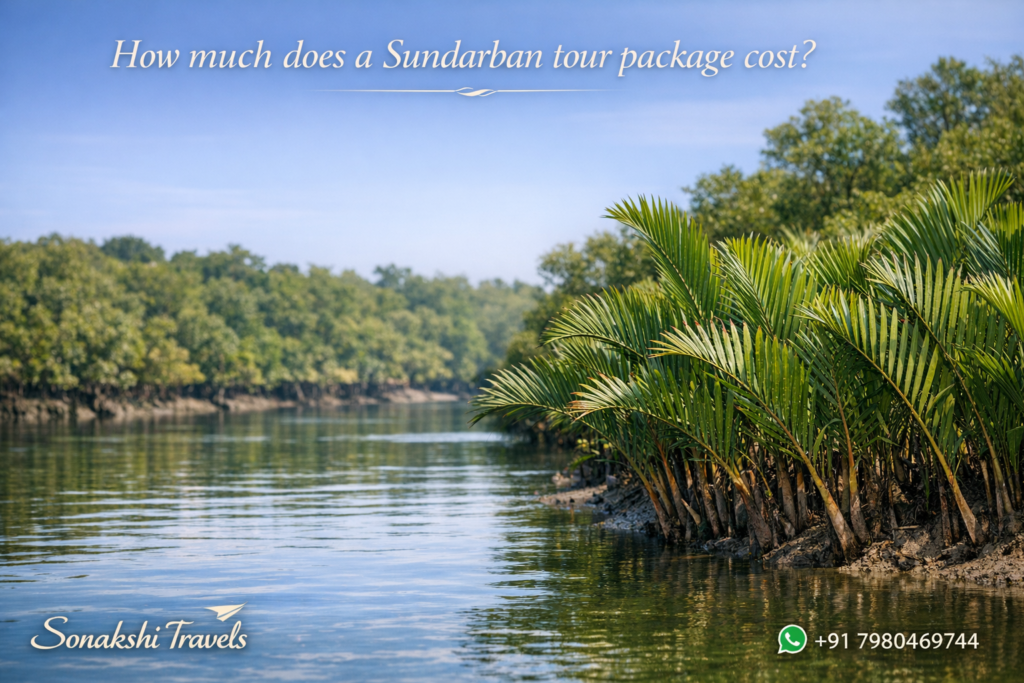
A high-resolution editorial landscape photograph representing “Golpata (Nypa palm) grows along creek edges”, bright day light over the Sundarban mangrove river, calm tidal water reflecting the sky, dense mangrove forest in background. Shot on 85mm lens, f/2.8, professional natural lighting, cinematic depth of field, ultra-sharp focus on primary subject, realistic skin texture, detailed environment, 4K resolution, photorealistic, natural color grading, documentary travel photography style, National Geographic quality, no illustration, no artwork, no cartoon effect.
Add elegant professional title text at top: “How much does a Sundarban tour package cost?”
Add company branding in subtle premium logo style: “Sonakshi Travels” Add WhatsApp contact in clean typography at bottom corner with WhatsApp icon: “+91 7980469744” Keep layout clean, balanced composition, no clutter, no exaggerated HDR, no artificial filters, realistic shadows, authentic travel atmosphere
A high-resolution editorial landscape photograph representing “Golpata (Nypa palm) grows along creek edges”, bright day light over the Sundarban mangrove river, calm tidal water reflecting the sky, dense mangrove forest in background. Shot on 85mm lens, f/2.8, professional natural lighting, cinematic depth of field, ultra-sharp focus on primary subject, realistic skin texture, detailed environment, 4K resolution, photorealistic, natural color grading, documentary travel photography style, National Geographic quality, no illustration, no artwork, no cartoon effect.
Add elegant professional title text at top: “How much does a Sundarban tour package cost?”
Add company branding in subtle premium logo style: “Sonakshi Travels” Add WhatsApp contact in clean typography at bottom corner with WhatsApp icon: “+91 7980469744” Keep layout clean, balanced composition, no clutter, no exaggerated HDR, no artificial filters, realistic shadows, authentic travel atmosphere
“In the hush where rivers dream and tigers roam free,
Where mangroves murmur tales in salty breeze—
There lies a world the maps don’t show,
A Sundarban Tour is where your soul must go.”
Understanding the Real Cost of a Sundarban Tour Package
A Sundarban tour package cost is rarely a single fixed number. It is the outcome of several essential services working together to make travel safe, regulated, and workable in a protected delta landscape. Readers who want a reliable reference point for how tour services are commonly structured can begin with the resource hub at SundarbanTravel.com, then compare pricing using the same inclusion standards across operators.
Unlike many destinations where the main cost is accommodation and local sightseeing, Sundarban pricing must absorb forest permissions, licensed boat operations, approved guides, and controlled access systems. These are not optional extras added later. They are the operating base of a legitimate trip. When any one of these elements is removed from a quote, the “cheap” price often becomes misleading because the missing cost appears later as a separate charge.
For travelers starting from Kolkata or nearby towns, the practical question is direct: how much should a Sundarban tour realistically cost when all key items are included? The most accurate answer depends on duration, service level, group size, accommodation category, and whether the arrangement is shared or private. If you treat price as a single number without checking what it covers, it becomes difficult to judge whether the quote is fair.
In most cases, pricing falls into three broad ranges: short day excursions, standard overnight tours, and luxury or specialized journeys. Each tier reflects a different balance between cost control and service depth. Before comparing package rates, it helps to understand the operational expenses that are usually embedded inside a standard Sundarban Tour Package.
Core Elements That Determine the Price of a Sundarban Tour
A Sundarban tour package price is built from mandatory components that support legality, safety, and basic comfort in a remote forest-river environment. When a tour is planned responsibly, most of these costs are not negotiable. They are the minimum operating structure required to enter and move within regulated zones.
Forest Entry Permits and Regulatory Fees
The Sundarbans sit within a protected biosphere system, and several areas are governed by strict entry control. Operators must arrange permits for visitors and for the boat, and must also comply with guide registration rules. These charges usually include access permissions, route approvals, and forest administration fees. While the exact amounts may vary by visitor category and route permissions, these costs form a base layer of every legitimate tour price.
Boat Operations and River Navigation
River travel is not an add-on in the Sundarbans. It is the core transport method, and it has its own cost structure. Boats must be licensed, crews must be trained, and safety equipment must be maintained and checked. Fuel consumption rises directly with navigation hours, and longer tours involve more cruising time and more river planning. This is one major reason why a longer Sundarban Tour costs more even if the hotel category stays the same.
Accommodation and Hospitality Services
Overnight packages include lodging in riverside resorts or island stays near the forest access points. These properties operate with higher operating costs than city hotels because supplies, staff, and utilities are managed through long supply lines. If an air-conditioned room, upgraded amenities, or higher service staffing is included, the package cost rises accordingly. In short, the room category is not just about comfort; it also reflects the operational load of running hospitality services in a remote zone.
Meals and Food Preparation
Meals are often included in Sundarban packages because finding independent food options in the same way as a city trip is not realistic. Ingredients are sourced from mainland markets, transported to the delta area, stored safely, and cooked with limited infrastructure. The more meals included—breakfast, lunch, dinner, tea and snacks—the more the total cost increases. This is also why “meal excluded” packages can appear cheaper at first glance, even though the traveler pays later.
Professional Guides and Naturalists
Licensed guides are a regulated requirement for most forest-entry movements. Their responsibility is not only interpretation but also compliance: they ensure routes are followed, rules are respected, and communication with authorities is maintained. Skilled naturalists add educational value, but even the basic guide role carries a fixed cost because the service is essential for safe and legal entry. This cost is normally part of a properly priced package.
Typical Price Range of Sundarban Tour Packages
Based on pricing patterns commonly seen among established operators in West Bengal, most Sundarban packages fall into clear bands according to duration and service depth. These ranges help travelers evaluate whether a quote is within normal limits, or whether it likely hides exclusions.
Short Day Tour Packages
A day tour is usually the most economical option. Typical pricing ranges between ₹2,500 and ₹4,000 per person. This category is designed for travelers who want a short, time-bound experience without paying for lodging.
Because the schedule is compressed into a single day, the package is designed around essential inclusions: transfers, permits, a guided boat segment, and basic meals. The absence of accommodation costs keeps the price lower. However, a responsible operator still needs to cover permits, licensing, and staff costs, which is why unusually low day-tour prices often indicate missing items.
If you want to compare how inclusion-based pricing is presented for day trips, reviewing a dedicated page such as the Sundarban single day package can help you check what is typically bundled and what is sometimes billed separately.
Standard Overnight and Multi-Day Packages
Overnight packages are among the most commonly booked options because they provide more time without pushing the trip into premium pricing. Rates generally range from ₹5,000 to ₹10,000 per person, depending on accommodation category, food plan, and group size.
The price difference compared with day trips is mainly driven by the addition of lodging, extra meals, longer boat operations, and additional staff coverage. Even within this band, a wide gap can exist: a basic room category with shared group operations will sit on the lower end, while upgraded rooms and smaller group sizes will move closer to the upper end.
Luxury Sundarban Experiences
Luxury tours commonly begin around ₹15,000 per person and may reach ₹20,000 or more when service upgrades and exclusivity increase. This category is not only about a better room. It often includes higher privacy, more attentive service, a more controlled group environment, and stronger comfort features that reduce friction in a remote setting.
Luxury pricing rises when the tour is designed around exclusivity—such as dedicated boats, premium meal planning, and a limited group size that protects quietness and schedule control. In many cases, luxury packages are arranged as a private journey, where the same operating structure is reserved for one group and not shared. For travelers evaluating privacy-based pricing, reviewing how a Sundarban Private Tour is structured can clarify why per-person costs change when sharing is removed.
How Group Size Influences Package Pricing
Group size is one of the strongest pricing drivers because many Sundarban costs behave like fixed operational charges. Boat rental, fuel baseline, guide fees, and vehicle transfers do not shrink simply because fewer people are travelling. When these costs are divided among more travelers, the per-person price becomes lower.
This is why shared group tours often look significantly cheaper than private arrangements, even when the route and duration are similar. The economy comes from distribution of fixed costs across multiple participants. In contrast, private tours allocate the same operating resources to one group, so the price rises per person.
Private arrangements also add value in ways that directly relate to cost. A dedicated boat schedule can reduce waiting time, allow quieter movement, and make meal planning more flexible. These advantages are not “extra activities”; they are operational changes that require exclusive staffing and exclusive resource use. That exclusivity is the reason private travel pricing behaves differently from group pricing.
Why Extremely Cheap Sundarban Packages Can Be Misleading
Budget options exist, but extremely cheap quotes should be treated with caution. In many cases, the low headline price is achieved by removing essential inclusions that the traveler later must pay for. The problem is not affordability. The problem is incomplete pricing that makes comparisons unfair.
Common exclusions include forest permits, guide charges, boat fees, or meal costs. A quote may look attractive until the traveler learns that these items are required and are charged separately. When the missing parts are added, the final expense often exceeds what a transparent operator would have quoted from the start.
A simple comparison method helps avoid this issue: ask whether the quote includes permits, guide services, boat operations, meals, and lodging where relevant. If the operator cannot clearly confirm what is included, the package price cannot be evaluated properly. Clear inclusions protect the traveler from hidden additions.
Operational Challenges That Influence Tour Costs
The Sundarban delta creates specific operational costs because tourism services function inside a remote river network with limited infrastructure. Boats must be serviced and supplied, fuel must be arranged, and food must be transported and stored. Even routine tasks require careful planning because travel between points depends on water routes and local handling systems.
Accommodation providers and tour operators also manage practical constraints such as power backup, clean water supply, and staff logistics. In many places, electricity stability depends on generators or controlled distribution, which adds cost. Communication infrastructure and emergency response readiness require additional expense, even when everything runs smoothly.
Safety is another cost driver that is easy to overlook. Licensed boat crews, standard safety equipment, and communication arrangements are essential. These are not luxury features; they are part of responsible operations in a landscape where movement happens on water and access points are spread across the delta. When a price looks unusually low, it is worth considering whether safety and compliance standards have been reduced to achieve the discount.
Evaluating the Value Behind a Sundarban Tour Price
The most practical way to judge Sundarban tour pricing is to evaluate value through inclusions and operational quality, not through the lowest number. A well-structured package should clearly list what is covered: accommodation, meals, permits, boat services, guide support, and local handling. Without this clarity, a traveler cannot compare two packages fairly.
Transparent pricing also helps travelers understand what they are funding. A properly organized tour supports trained local staff, licensed boat crews, and regulated access systems. It also supports the local economy around the forest region, where tourism income is closely connected to livelihoods. When pricing is honest, it protects both visitors and the people who make the trip possible.
This is why a Sundarban package price is not only a commercial figure. It is a practical reflection of what it takes to operate responsibly in a protected ecosystem. If the operating standards are strong, the price typically aligns with the real costs of permits, safety, staffing, and remote logistics.
Conclusion: Understanding the True Cost of a Sundarban Tour
In most cases, a Sundarban tour package cost ranges from ₹2,500 for short day excursions to ₹20,000 or more for premium and luxury journeys. The variation is logical: it reflects differences in duration, accommodation standards, group size, and the level of service exclusivity. Behind every price is a set of operational requirements that includes regulated entry, licensed navigation, guide services, and hospitality in a remote landscape.
For travelers planning a visit, pricing becomes easier to judge when the comparison is based on what the package includes. Transparent quotes reduce the risk of hidden charges and allow a more accurate decision between shared and private arrangements, or between standard and premium service levels.
Ultimately, the cost of a Sundarban trip is the cost of accessing a fragile ecosystem in a controlled and responsible way. When a package is structured carefully, it becomes a clear financial plan rather than a list of uncertain add-ons. For readers comparing premium comfort with privacy, it can also be useful to review how a Sundarban Luxury Tour is typically priced, because many “luxury” differences are actually operational differences in staffing, resource allocation, and service control.
Let the Forest Know You Are Coming
If you want your budget to match your expectations, request a clear inclusion list before confirming any booking. A careful comparison based on services is the most reliable way to choose the right plan for your needs and avoid last-minute cost surprises.