Updated: March 20, 2026
What Wildlife Can I Expect to See on a Sundarban Luxury Tour?
A journey through the mangrove delta is never only about movement from one place to another. It is an encounter with a living environment where animals, birds, reptiles, fish, and unseen aquatic life remain deeply connected to tide, mud, salt, roots, and silence. On a carefully arranged Sundarban luxury tour, wildlife becomes the center of attention in a refined and comfortable setting, allowing travelers to observe the forest with patience rather than hurry. The experience is not limited to the hope of seeing one famous animal. It includes an entire web of life, from the largest predator to the smallest flicker of motion at the river’s edge.
Many people arrive expecting only the Royal Bengal Tiger, but the wildlife of this delta is much broader, more layered, and more intellectually rewarding. A well-planned Sundarban private tour offers the chance to notice patterns that are often missed in faster group movement. One may observe deer pausing in alert stillness, crocodiles warming themselves on muddy banks, kingfishers cutting across tidal light, raptors scanning channels from above, and mudskippers or crabs revealing the restless energy of the intertidal zone. The forest does not always reveal itself through dramatic events. Often, it speaks through signs, behavior, and tension in the landscape.
This is why the wildlife experience on a luxury journey feels distinctive. Comfort does not remove a traveler from nature. Instead, it creates the physical ease and mental calm needed for deeper observation. During a thoughtful Sundarban luxury wildlife safari, one begins to understand that the delta is not a random collection of species. It is an ecological system shaped by survival, camouflage, adaptation, and constant negotiation with water. Every movement has meaning because every creature here lives under pressure from tide, salinity, shifting ground, and predation.
The Royal Bengal Tiger as Presence, Mystery, and Possibility
The first wildlife question most travelers ask concerns the tiger, and naturally so. The Sundarbans are one of the most remarkable tiger habitats in the world because these big cats live inside a tidal mangrove ecosystem unlike the forest environments with which many people are more familiar. Yet the most honest answer is that the tiger in this landscape is not always seen directly. Even on a premium Sundarban luxury private tour, the tiger remains a creature of secrecy, intelligence, and sudden appearance.
Its power lies not only in visibility but in the way it shapes the whole atmosphere. Deer become tense for a reason. Birds break pattern for a reason. A silence along the bank may feel heavier for a reason. In the Sundarbans, the tiger is often first understood through absence, tension, and indirect evidence. Prints in the mud, claw marks, strong territorial signs, or unusual stillness in prey species all deepen the awareness that this predator is part of the living scene, even when not visible. That reality makes any possible sighting more meaningful, because it belongs to a true wilderness rather than a staged encounter.
When a tiger is seen, the moment is often brief. It may appear crossing a creek edge, moving between mangrove cover, standing near a mudbank, or emerging with quiet confidence from dense vegetation. The experience is powerful not because of theatrical display, but because the animal seems perfectly fitted to its environment. On a high-quality Sundarban premium wildlife tour, one learns that tiger observation is also an exercise in humility. The forest decides what is revealed.
Spotted Deer and the Language of Alertness
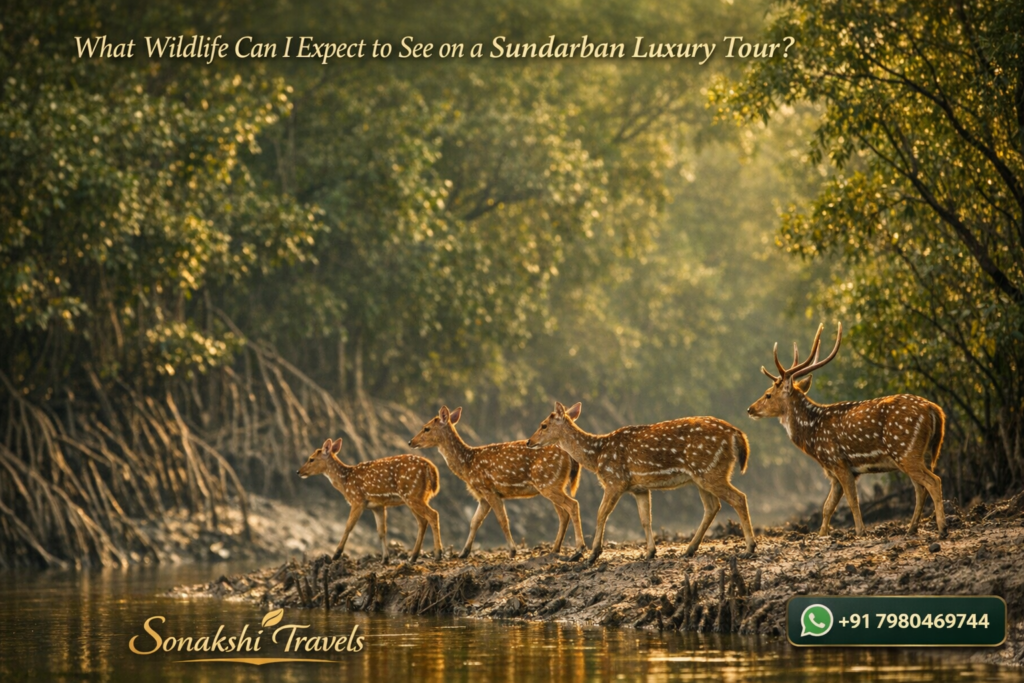
Among the most regularly noticed mammals in the region are spotted deer, also called chital. They are graceful, visually striking, and ecologically important because they form part of the prey base within the delta. On a Sundarban tour, deer may be seen at the forest edge, near open mudbanks, or in areas where vegetation allows short feeding intervals combined with rapid awareness of danger.
Watching deer in the Sundarbans is more than a pleasant visual experience. Their behavior often reflects the condition of the environment around them. The lifting of the head, the angle of the ears, the grouping pattern, and the sudden freezing of movement may all indicate a disturbance that human observers have not yet understood. In this way, deer become interpreters of the forest. Their beauty is undeniable, but their alertness may be even more memorable. They carry the atmosphere of vulnerability that defines prey life in a predator-governed ecosystem.
On a slow Sundarban nature tour, deer may appear in soft morning light or against the darker green of mangrove vegetation, creating one of the most elegant wildlife scenes in the region. The contrast between their delicate movement and the harsh conditions of the tidal world gives their presence unusual emotional depth. They are not ornamental animals in a peaceful meadow. They are survivors in a difficult and intelligent landscape.
Saltwater Crocodiles and the Ancient Stillness of the Riverbank
Another major species that travelers may encounter is the estuarine or saltwater crocodile. These reptiles are among the most impressive inhabitants of the delta, and their appearance adds a completely different tone to the wildlife experience. Whereas deer communicate sensitivity and nervous life, crocodiles communicate age, patience, and raw physical force. On a refined Sundarban private tour package, observing a crocodile along a bank or partially submerged near muddy water can be one of the strongest reminders that this ecosystem belongs first to wild creatures.
Crocodiles are often difficult to detect at first because their bodies merge so effectively with mud, shadow, and waterline texture. Then, slowly, the eye separates shape from background. A ridge of back, a heavy jaw, or the still curve of a tail becomes visible. This moment of recognition is one of the great lessons of Sundarban wildlife observation: much of what is present remains hidden until the observer learns how to look.
The crocodile represents the reptilian authority of the estuary. It belongs equally to water and land edge, and that dual command suits the delta. Seeing one at rest can be as powerful as seeing one move. Its stillness is not passivity. It is control. On a carefully organized Sundarban private wildlife safari, such sightings often deepen the sense that the rivers themselves are inhabited by ancient intelligence.
Birdlife That Gives the Forest Its Visible Motion
For many travelers, birds become the most constant and varied form of wildlife during the journey. Even when larger mammals remain hidden, birdlife keeps the landscape active, expressive, and visually rich. A serious Sundarban tourism experience should never reduce wildlife only to large headline species, because the avian life of the delta reveals the ecosystem hour by hour.
Kingfishers are among the most admired birds in the region. Their color, speed, and sharp hunting action make them unforgettable. Different species may be noticed depending on habitat and timing, but the effect is similar: a sudden strike of brightness across tidal quiet. Egrets and herons contribute another mood entirely. Their slow, deliberate posture suits the marshy edges and shallow feeding zones of the estuary. When they stand motionless beside water, they seem like extensions of the landscape itself.
Raptors such as brahminy kites add aerial drama. Their circling motion above channels and mudflats broadens the wildlife experience beyond immediate eye level. Cormorants, bee-eaters, sandpipers, plovers, and other species may also appear, each occupying a different ecological role. For travelers with a strong visual interest, a Sundarban bird photography tour can be deeply satisfying because the delta offers constant contrast between stillness and sudden flight, open river and dense foliage, muted mud tones and brilliant plumage.
The birdlife of the Sundarbans is not decorative background. It is a system of signals. Birds reveal feeding grounds, changing water conditions, and hidden productivity in the landscape. On a well-paced Sundarban wildlife safari, they help the traveler understand that life in the delta is distributed across air, branch, mud, and tide.
Monkeys, Wild Boar, and the Lesser-Spoken Mammal Life
Although the tiger and deer receive most attention, other mammals also contribute to the character of the forest. Rhesus macaques may sometimes be seen moving through vegetation or using elevated positions to observe their surroundings. Their intelligence and adaptability suit the complex edge conditions of the mangrove world. They often introduce social behavior into a landscape otherwise dominated by secrecy and caution.
Wild boar are another important presence. They are powerful animals, less graceful than deer but highly suited to the rough ground of tidal forest margins. A sighting of wild boar can feel especially significant because it reveals the rugged practical life of the forest floor. Their bodies appear made for contact with mud, roots, and unstable terrain. On an attentive Sundarban exploration tour, such animals help round out the understanding of the ecosystem. Wildlife in the delta is not only beautiful. It is functional, adapted, and physically shaped by the demands of habitat.
These mammals may not always be the main reason a traveler arrives, yet their presence enriches the experience by showing the diversity of survival strategies in the region. A thoughtful observer on a Sundarban luxury nature tour begins to value the whole ecological cast, not only the most famous members.
Reptiles, Amphibious Creatures, and the Hidden Drama of the Mud
One of the most fascinating aspects of the Sundarbans is that important wildlife exists not only in dramatic large forms but also in the transitional spaces between land and water. Mudflats, exposed roots, creek edges, and tidal banks contain rich small-scale life. This is where crabs, mudskippers, lizards, and other lesser-noticed creatures reveal how active the delta remains even when larger animals are out of sight.
Mudskippers are especially interesting because they embody the amphibious logic of the mangrove zone. Their strange movement across wet mud seems almost experimental, as though nature has designed a creature for a place where categories are unstable. Fiddler crabs, with their constant activity and distinct forms, animate the banks with detail and repetition. Water monitor lizards may also be encountered, and their elongated bodies, deliberate stride, and confidence near creeks add yet another layer to the reptilian identity of the region.
On a patient private Sundarban eco tour, these smaller forms of life become surprisingly memorable because they teach the eye to appreciate ecological texture. The delta is not interesting only when something large appears. It is interesting because every surface may hold movement, adaptation, or evidence of feeding and survival.
Aquatic Life and the Unseen Wildlife Beneath the Surface
Not all wildlife in the Sundarbans is visible from above the water. Much of the biological richness of the region remains below the river surface or appears only in fragments. Fish, crustaceans, and aquatic organisms support the food web that sustains birdlife, reptiles, and larger predators. Even when travelers do not directly observe this entire hidden system, its effects are visible everywhere. Diving birds, feeding reptiles, changing water movement, and productive mud zones all point toward life beneath the surface.
This unseen abundance gives the rivers their biological meaning. During a carefully managed luxury Sundarban river cruise, the traveler begins to understand that the apparent quietness of the channels is misleading. Underneath that calm exterior lies a continuous exchange of feeding, breeding, pursuit, concealment, and survival. The wildlife story of the Sundarbans is therefore never only terrestrial. It is estuarine in the fullest sense.
This hidden aquatic dimension also explains why the region supports such complex bird and reptile populations. The forest cannot be understood only by looking at trees. It must be read as a living interface between saline and freshwater influences, exposed mud and submerged productivity, roots above and life below. That ecological richness is part of what makes a Sundarban travel experience so intellectually engaging for attentive travelers.
Why Wildlife Viewing Feels Different on a Luxury Journey
A luxury wildlife experience is not defined only by premium accommodation or better boat comfort. Its deeper value lies in the quality of attention it makes possible. When travelers are not distracted by discomfort, crowd pressure, or rushed transitions, they can observe wildlife with steadier concentration. On a refined luxury Sundarban safari, the eye has time to adjust to the visual language of the mangroves. Small changes in movement become readable. Silence becomes informative rather than empty.
This slower observational quality matters greatly in the Sundarbans because the wildlife here is often subtle. Animals may appear through fragments rather than full display. The curve of a reptile against mud, the reflective line of an eye near water, the clustered pause of deer, or the directional alarm of birds all require attentiveness. A well-designed Sundarban luxury travel experience allows travelers to remain mentally present enough to understand these details.
Luxury also changes the psychological tone of the journey. Instead of feeling like one is chasing wildlife, the experience becomes one of entering a living environment with respect and patience. That is an important difference. The best wildlife moments often come not from forceful searching, but from disciplined quietness. In this sense, a carefully arranged Sundarban private boat tour can support deeper ecological perception.
The Emotional Reality of Wildlife in the Sundarbans
The wildlife of the Sundarbans does not create a simple emotional response. It is not only delightful, and it is not only frightening. It combines elegance, danger, intelligence, fragility, and endurance. Deer are beautiful, but their beauty exists under constant risk. Crocodiles are powerful, but their power emerges through stillness rather than display. Birds bring brightness, but their movement is tied to feeding and survival. The tiger is magnificent, but its magnificence is inseparable from the tension it casts over the forest.
This complexity is what makes the wildlife experience mature and memorable. On an exclusive Sundarban private tour, travelers often come away with more than a list of sightings. They come away with a changed understanding of how life organizes itself in a difficult habitat. The delta does not flatter human expectation. It teaches respect for adaptation. It teaches that beauty and danger may occupy the same frame. It teaches that what is hidden may be more important than what is obvious.
For that reason, one of the most valuable outcomes of a Sundarban luxury tour package is not simply the quantity of animals seen. It is the quality of attention developed during the journey. A traveler learns to look more slowly, think more ecologically, and appreciate the balance between presence and concealment.
What You Can Truly Expect
The most honest expectation is this: on a wildlife-focused luxury journey through the delta, you may encounter deer, crocodiles, a wide range of birds, reptiles, mudflat creatures, and the indirect or direct signs of apex predator life. You may also experience long stretches where the forest seems quiet, only to realize that the quietness itself is full of evidence. A meaningful Sundarban tour package centered on this habitat should never be judged only by dramatic sightings. It should be understood as entry into one of the most complex wildlife landscapes in India.
The wildlife of the Sundarbans is not arranged for easy display. That is precisely why it feels real. Every sighting carries weight because it belongs to a functioning ecosystem, not a predictable performance. A thoughtful traveler on a Sundarban private tour package discovers that the forest offers not only animals to see, but relationships to understand: prey and predator, water and bank, concealment and exposure, movement and stillness.
In the end, the answer to what wildlife one can expect on such a journey is both specific and profound. Yes, one may see tiger habitat signs, spotted deer, crocodiles, kingfishers, egrets, kites, monkeys, wild boar, monitor lizards, mudskippers, and rich estuarine life. But beyond that, one encounters an entire ecological drama unfolding through the mangroves. That is what gives a true Sundarban travel agency experience its lasting value. The wildlife is not only seen. It is felt, interpreted, and remembered.