Updated: March 16, 2026
What wildlife can I expect to see on a Sundarban private tour?
Wildlife in the Sundarbans does not present itself in the manner of an open grassland or a fenced reserve. It is more elusive, more atmospheric, and far more dependent on patience. That is why this question deserves a careful answer. On a properly arranged Sundarban private tour, one should not expect a parade of animals appearing on command. One should instead expect a layered encounter with a living tidal forest where signs, sounds, silhouettes, movement in water, sudden wingbeats, mud impressions, and intervals of silence are all part of the wildlife experience.
The Sundarbans are one of the most distinctive estuarine ecosystems in the world, and the wildlife here reflects that uniqueness. The forest is amphibious in character. Land and water are never fully separate. Salinity, tidal rhythm, mangrove roots, mudflats, creeks, and riverbanks shape how animals move, hide, feed, and survive. For this reason, a serious wildlife-oriented Sundarban private wildlife safari is not only about what is fully seen. It is also about what is partially revealed: the curve of a crocodile’s back, the flash of a kingfisher, the sudden alarm call of birds, the trace of claws in wet mud, or the hovering attention of deer at the forest edge.
The Royal Bengal Tiger as Presence, Possibility, and Ecology
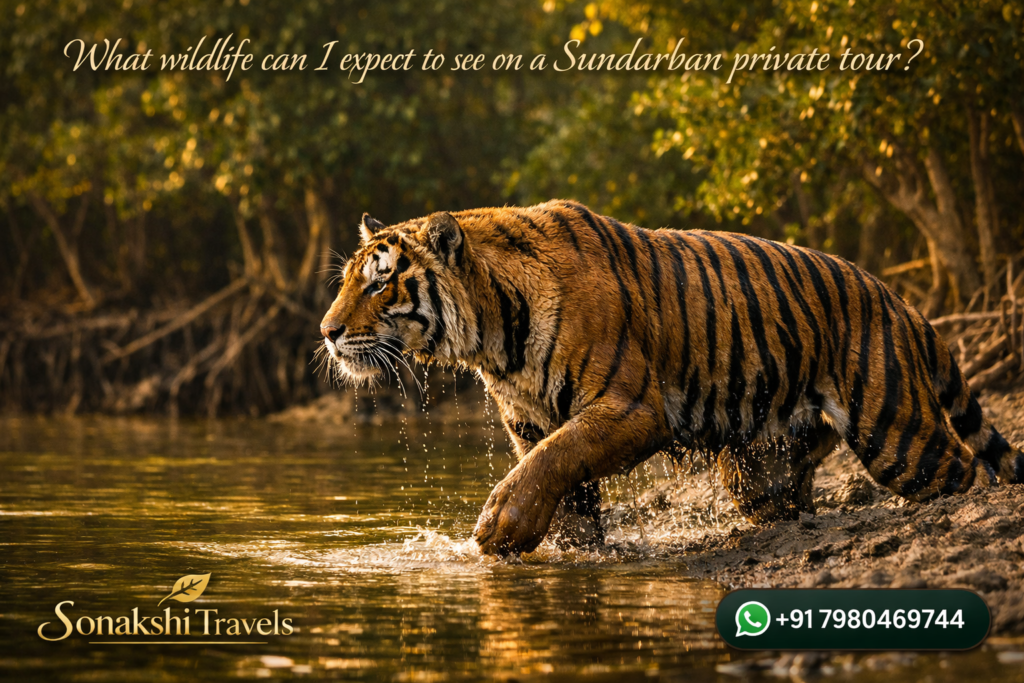
No wildlife discussion about the Sundarbans can begin anywhere else. The Royal Bengal Tiger remains the most powerful symbol of the region, yet on a private journey one must understand the tiger correctly. In the Sundarbans, the tiger is often experienced first as presence rather than appearance. It is the invisible authority of the landscape. Even when unseen, it shapes the behavior of prey, the attention of forest staff, and the emotional tone of the journey itself.
A tiger sighting is possible, but it is never guaranteed, and a truthful Sundarban luxury private tour should never reduce the forest to that single expectation. The tiger here is adapted to a mangrove environment that is unlike the dry forest or meadow habitat many travellers imagine. It swims across channels, navigates mudbanks, moves through dense cover, and uses camouflage with remarkable efficiency. The striped coat, so dramatic in photographs, becomes unexpectedly difficult to detect among roots, shadows, and broken light. Often the first clue is not the animal itself but a shift in atmosphere: birds falling quiet, deer becoming alert, or boatmen narrowing their gaze toward a particular embankment.
On some journeys, travellers see only pugmarks on a mudbank, fresh enough to hold shape after the receding tide. On others, one may glimpse a tiger crossing a creek, standing at a river edge, or disappearing through mangrove cover in a matter of seconds. Even such brief sightings leave an unusually deep impression because the encounter feels earned rather than staged. Within a refined Sundarban private tour package, this possibility is best understood as part of the forest’s integrity. The tiger remains wild because it remains difficult.
Spotted Deer and the Visible Grace of the Forest Edge
If the tiger is the unseen sovereign of the mangroves, the spotted deer is often the most regularly visible large mammal. Also known as chital, these deer are among the most recognisable animals in the region. They often appear along creek margins, grassy clearings, muddy embankments, and transitional areas where forest cover opens slightly toward water. In the soft light of morning or the gentler hours of afternoon, a group of deer standing alert near the edge of a channel can become one of the most memorable sights of the entire journey.
Deer in the Sundarbans are not merely decorative wildlife. Their behavior tells a story about vigilance. They feed, pause, listen, raise their heads together, and frequently stand with a kind of collective alertness that reflects the pressure of predation. On a calm stretch of water, when a private boat drifts without harsh engine noise, travellers often get the chance to observe this behavior more closely than on a crowded vessel. That is one of the quiet strengths of a private wildlife-focused river journey. An exclusive Sundarban private tour allows more sustained observation, and sustained observation is often what transforms a sighting into understanding.
The beauty of spotted deer in the Sundarbans lies partly in contrast. Their patterned bodies appear delicate, yet their survival depends on constant sensitivity. One notices the tension between elegance and danger. In this ecosystem, every open bank is both feeding ground and risk zone. To see deer well is therefore to see something fundamental about the forest’s emotional texture: beauty under watchfulness.
Crocodiles, Water Monitors, and Reptilian Stillness
Among the most striking wildlife encounters on a Sundarban luxury tour are the reptiles, especially when the eye becomes trained to notice forms that first appear to be part of the riverbank itself. Estuarine crocodiles belong to this visual world of concealment. They may be seen basking at muddy edges, half-submerged near creek mouths, or lying so still that only the shape of the head and the faint glint of the eye reveal life. Their apparent laziness is deceptive. These are ancient, efficient predators perfectly adapted to tidal water.
A private boat experience often improves the quality of reptile observation because it makes it easier to reduce unnecessary disturbance and pause at a respectful distance. Crocodiles do not need dramatic movement to command attention. Their power is felt through composure. In the Sundarbans, stillness itself can look predatory. When a crocodile slips into the water, the motion is almost disappointingly slight, yet the effect is unforgettable because the surface closes almost at once and the animal seems to vanish into the river rather than simply swim away.
Water monitor lizards are another important reptilian presence. Larger individuals can appear surprisingly prehistoric in outline as they move across mud or along embankments with deliberate, muscular motion. They are often seen near exposed banks, around crab-rich areas, or in places where the tide leaves edible opportunities behind. Their forked tongues, rough skin, and alert yet unhurried movement make them compelling animals to observe. In a strong Sundarban private safari tour, these sightings add depth because they remind travellers that the forest is not organized around one flagship species alone. It is a full system of ancient adaptations.
Birdlife as One of the Great Strengths of the Experience
For many attentive travellers, birds become the most continuous and rewarding part of a Sundarban tour. The birdlife of the delta is rich in mood, color, motion, and ecological variety. Some birds announce themselves through bright plumage and clean flight paths. Others remain subtle, emerging through calls, shoreline posture, or movement among mangrove branches. Because a private tour permits more flexibility in pace and attention, it often becomes easier to appreciate birds not as incidental background but as central actors in the landscape.
Kingfishers are among the most beloved sightings. Several species may be encountered, including small brilliantly colored forms perched over creeks as well as larger, heavier-beaked varieties with commanding presence. Their sudden dives, sharp calls, and disciplined stillness before a strike give the riverside scene much of its energy. Egrets and herons, by contrast, often represent patience. They stand in shallow margins with quiet concentration, embodying the logic of waiting that the entire delta seems to teach.
Raptors also contribute to the drama of the sky. Brahminy kites, with their chestnut body and white head, are especially memorable as they circle above water channels or descend toward floating prey. Their flight has a noble, unhurried quality that suits the moral atmosphere of the Sundarbans. One may also encounter eagles, harriers, or other birds of prey depending on habitat and seasonality of movement, but even without naming every species, it is clear that the avian life of the region is not ornamental. It reflects the food web, the health of the mudflats, the productivity of tidal waters, and the continuity between canopy, bank, and open sky.
On a carefully paced Sundarban bird photography tour or a quiet private river outing, smaller birds also become significant: bee-eaters, drongos, sandpipers, cormorants, storks, and various waders. Their presence teaches the traveller to observe scale more intelligently. The Sundarbans are not only dramatic when large animals appear. They are equally profound when a mudbank fills with foraging birds whose feet, beaks, and timing are perfectly adapted to receding water and exposed sediment.
Mudskippers, Crabs, and the Living Surface of the Tidal World
Many first-time visitors ask about famous animals, but a serious answer must also include the smaller life forms that make the ecosystem feel truly alive. The exposed banks of the Sundarbans are often animated by fiddler crabs, burrowing crabs, and mudskippers. At first glance these may seem minor compared with deer or crocodiles, but in ecological and sensory terms they are extremely important. They give motion to the mud itself.
Mudskippers are especially fascinating because they seem to blur categories. Fish-like yet land-active, they hop, pause, and slide across wet surfaces in a manner that perfectly expresses the amphibious logic of the mangrove world. Their existence reminds the traveller that the Sundarbans are not structured by rigid boundaries. Water becomes land and land returns to water. Life here evolves accordingly.
Crabs contribute both visually and ecologically. Their burrows punctuate the banks, their movement creates restless surface activity, and their role in sediment turnover and nutrient cycling is crucial. What appears to be a silent mudflat is in fact a working biological field. Within a thoughtful private Sundarban eco tour, this level of observation matters because wildlife is not only the charismatic animal at the center of a photograph. It is also the entire choreography of the estuary.
Otters, Wild Boar, Monkeys, and the Less Predictable Encounters
There are also animals that are seen less regularly but remain part of the genuine wildlife expectation. Wild boar may sometimes be observed near forest fringes or muddy clearings, moving with surprising speed and practical force. Rhesus macaques can appear in certain areas, often revealing the more adaptive, opportunistic side of mammalian life in the delta. Their alertness and social behavior contrast with the quieter watchfulness of deer.
Otters, when seen, produce an especially joyful impression because their movement brings playfulness into an otherwise tense and watchful ecosystem. They may be glimpsed in water channels or near banks, quick and sleek, never lingering long enough for certainty unless conditions are favorable. Such encounters are valuable precisely because they feel accidental in the best sense. They emerge from the integrity of the place rather than from a predictable route of display.
A refined Sundarban customized private tour often increases the quality of these incidental wildlife moments because smaller groups tend to be quieter, more patient, and better positioned to respond when something fleeting appears. The difference is not magic. It is attentiveness.
What a Private Format Changes in Wildlife Observation
The phrase Sundarban private boat tour should not be understood merely as a comfort label. In wildlife terms, privacy changes the mode of perception. A quieter boat, fewer distractions, more flexible pauses, and closer coordination with skilled local crew all improve the conditions under which wildlife can be noticed. In a crowded environment, people often look only for spectacle. In a private one, they begin to read the landscape.
This matters because the Sundarbans reward continuity of attention. One starts noticing how deer choose edges, how birds respond to tide lines, how crocodiles use sun and shadow, how mud retains the memory of passage, and how silence itself can become informative. A properly arranged private Sundarban river cruise allows the traveller to inhabit these rhythms rather than rush past them. Wildlife becomes not a checklist but a sequence of relationships.
There is also a psychological advantage. Private travel often creates a calmer observational state. One speaks less, listens more, and begins to understand that wildlife visibility is partly a matter of behavioral humility. The forest does not perform for impatience. It reveals itself to those willing to accept partial knowledge, delayed reward, and the possibility that one remarkable sign may mean as much as one full sighting.
The Truest Expectation
So what wildlife can one expect to see on a Sundarban private tour? One may realistically expect birds in satisfying variety, spotted deer with some regularity, reptiles such as crocodiles or water monitors under favorable conditions, abundant smaller estuarine life on mudbanks, and the constant ecological presence of the tiger whether or not the animal is directly seen. One may also encounter boar, monkeys, and other less predictable species depending on circumstance. But beyond species lists, one should expect something more valuable: a serious lesson in how wildlife exists when land, tide, concealment, and survival are inseparably joined.
That is the real distinction of the Sundarbans. The wildlife here is not isolated from the landscape. It is fused with it. Animals appear through rhythm, edge, caution, and adaptation. A high-quality Sundarban travel experience therefore asks the traveller to become patient enough to notice not only animals, but conditions. When that happens, even a brief sighting acquires unusual depth. A tiger becomes more than a tiger. A deer becomes more than a deer. A heron standing in tidal light becomes part of a much larger truth about how life persists in a world ruled by water and uncertainty.
For that reason, the most honest expectation is also the most rewarding one. Expect not a theatrical display, but a richly alive mangrove wilderness in which every creature is shaped by the discipline of the estuary. In such a setting, wildlife is not merely seen. It is interpreted, felt, and remembered.