Updated: March 10, 2026
Where the mangrove roots are your muse—follow a Sundarban Private Tour
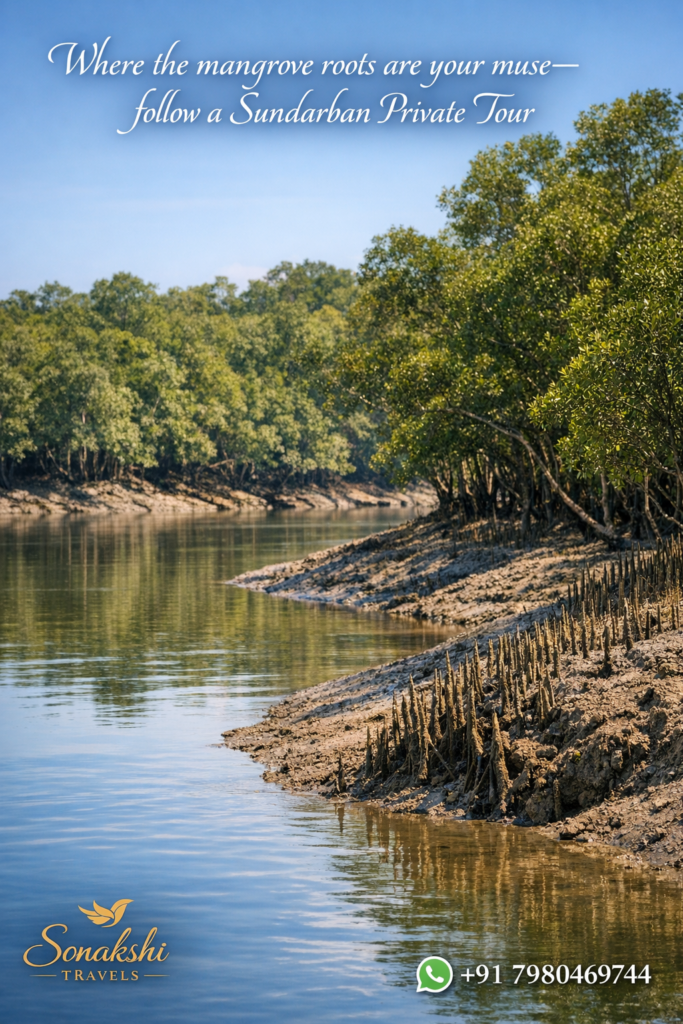
There are landscapes that impress by scale, and there are landscapes that shape the mind by pattern. The Sundarban belongs to the second kind. It does not rely on dramatic peaks, sudden spectacle, or a single dominant view. Instead, it works through repetition, texture, pause, and return. Water slides past banks of mud, light settles on the breathing roots of mangrove trees, and silence is never empty. In such a place, observation becomes more than sightseeing. It becomes a form of attention. That is why a Sundarban private tour feels especially meaningful. It allows the traveler to encounter the forest not as a crowded attraction, but as a living composition whose details can be read slowly and deeply.
The image of mangrove roots as a muse is not merely poetic. It is ecologically precise. These roots are among the defining visual and biological structures of the delta. They rise, bend, spread, and pierce the mud in forms that seem at once practical and artistic. Their purpose is survival. In waterlogged, saline, oxygen-poor soil, the forest must invent unusual ways to breathe and anchor itself. The result is a landscape of astonishing sculptural intelligence. When one follows a Sundarban private tour, these details do not pass by as background scenery. They begin to feel like lines in a manuscript written by tide, salt, and time.
The roots teach the eye how to see
Most travelers arrive with a habit of looking for the obvious. They search for the grandest river bend, the largest bird, the most dramatic movement in the water. Yet the mangrove landscape does not reveal itself fully to a hurried eye. It asks for a slower visual discipline. The roots at the river’s edge are the first teachers of that discipline. Some stand upright like clustered reeds made of wood. Some arch outward and disappear under the mud. Some form dense lattices that seem to hold both land and water in a delicate balance. Their presence changes how one reads the shoreline. What at first appears monotonous becomes intricate. What seems still is full of adaptation.
In a well-paced Sundarban luxury private tour, this change in perception becomes central to the experience. The traveler is not rushed past one creek after another. There is room to notice how root systems differ between stretches of forest, how the bank curves under tidal force, how mud retains the memory of movement, and how every low branch seems shaped by a conversation between water and wind. The result is not only visual pleasure. It is intellectual pleasure as well. One begins to understand that beauty in the Sundarban is inseparable from function, and function here is extraordinarily refined.
The forest therefore becomes a place where form and meaning are not divided. A root is never only a root. It is an instrument of respiration, a grip against erosion, a refuge for smaller life, and an emblem of the forest’s patience. This is what makes the landscape artistically powerful. It does not imitate art; it produces the conditions of artistic thought. It shows how necessity can generate elegance. It shows how repetition can produce variation. And it shows how an environment shaped by stress can still appear graceful.
Why privacy changes the experience of the forest
In many destinations, privacy is valued for comfort. In the Sundarban, privacy matters for perception. A quieter setting changes not only how one feels, but what one is able to notice. When the pace is controlled, when voices do not dominate the air, and when observation is not interrupted by constant social noise, the mangrove world becomes legible in a different way. A solitary bank lined with exposed roots can hold attention for several minutes without exhaustion. The changing sheen on tidal water becomes interesting. The silence between bird calls becomes meaningful. This is one reason a Sundarban luxury tour can feel intellectually richer than a more crowded experience.
Privacy also allows the traveler to establish a rhythm with the landscape. The forest has its own tempo. It does not move according to human impatience. Tides shape visibility. Light shifts gradually. Mudbanks emerge and withdraw. Creatures reveal themselves through intervals rather than performance. When a traveler is able to remain within this tempo, rather than forcing a separate human one upon it, the experience deepens. The mind becomes less extractive. It stops asking, “What can I take from this place quickly?” and begins asking, “What is this place already saying?”
This is where the title’s image becomes especially fitting. A muse does not shout. A muse alters attention. The mangrove roots do exactly that. They slow the observer, refine concentration, and create the conditions for reflection. The forest does not ask for invention before it asks for listening. On a carefully paced luxury Sundarban cruise, that listening becomes possible in a sustained way. The river is not simply crossed. It is read.
The psychology of rhythm in a tidal forest
The Sundarban has a strong psychological effect because its rhythms differ so sharply from those of urban life. Cities train attention toward interruption. The Sundarban trains attention toward recurrence. Water touches the bank, leaves, and returns. The eye follows the same line of roots from different angles as the vessel moves. Similar forms appear again and again, but never identically. This recurrence is calming not because it is empty, but because it is ordered. The mind begins to rest in pattern.
Research in environmental psychology has often shown that natural settings marked by soft fascination restore attention more effectively than settings filled with hard demands. The Sundarban offers an unusually strong version of this effect. Its details are complex enough to hold interest, yet gentle enough not to exhaust cognition. Mangrove roots, shifting reflections, narrow creeks, and layered vegetation create a field of structured subtlety. The traveler’s attention is engaged, but not strained. In a Sundarban private tour, this restorative quality becomes more pronounced because the experience is not fragmented by crowd pressure or excessive commentary.
The roots themselves contribute to this mental quiet. Their repeated forms offer visual continuity. Their contact with mud and tide suggests endurance. Their upward thrust from difficult ground conveys resilience without drama. These impressions work below the level of overt analysis. One does not need to name them for them to be felt. The result is a mood of deep steadiness. The forest seems composed, not passive; alert, not anxious. For many travelers, this becomes one of the most memorable features of the journey. The Sundarban does not overwhelm the mind. It reorganizes it.
Ecology as the source of beauty
The visual power of the mangrove edge cannot be understood apart from its ecological logic. Mangrove systems occupy one of the most demanding zones on earth: the unstable meeting place of river and sea, freshwater and salinity, deposition and erosion. To survive there, plants must solve several problems at once. They must anchor themselves in shifting sediment, manage salt, and access oxygen where the soil offers very little. The unusual roots seen across the Sundarban are part of these solutions. Their forms are not decorative accidents. They are biological responses to pressure.
This makes the forest intellectually satisfying to observe. Beauty here is not superficial. It is the visible expression of adaptation. A bank crowded with pneumatophores, for example, is not only a striking pattern of vertical forms; it is evidence of the forest breathing through the mud. A tangle of stabilizing roots is not only picturesque; it is part of the defense against erosion in a tidal landscape. When such features are given time and silence, they invite a different kind of admiration—one based on understanding rather than consumption.
A thoughtful Sundarban private tour therefore becomes an ecological encounter as much as an aesthetic one. The traveler begins to see that the mangrove edge is a system of negotiations. Nothing is fixed absolutely. Water advances and retreats. Soil forms and dissolves. Vegetation holds, yields, and returns. The roots are the visible grammar of that negotiation. To follow them with the eye is to witness the forest thinking through structure.
The artistry of restraint
One remarkable quality of the Sundarban is that it never appears to display itself. Its beauty is not theatrical. It does not compose grand scenes for easy applause. Instead, it offers restrained complexity. A single stretch of mudbank with exposed roots, reflected in afternoon light, can remain compelling for a long time because the forms are balanced without being rigid. Curves answer lines. Density meets openness. Shadow enters texture. Such scenes often feel closer to drawing or etching than to spectacle.
This restraint is central to the region’s power as a muse. It leaves interpretive space. It does not dictate a single emotion. Depending on light, tide, and mood, the same roots can seem severe, tender, ancient, or quietly luminous. A crowded setting often weakens this ambiguity by replacing contemplation with activity. But in a measured Sundarban luxury private tour, the traveler can remain with the scene long enough for its tonal complexity to emerge.
Silence, sound, and the living edge of the river
To say that the roots are a muse is also to acknowledge that inspiration in the Sundarban is never purely visual. The riverbank is acoustic as well. Water taps against wood. Soft current brushes the mud. Leaves move with a dry, restrained whisper. A distant call from the forest breaks the stillness and then disappears into it. These sounds do not compete with the roots; they complete them. The visible and the audible belong to one atmosphere.
In a more public setting, such delicate acoustics are easily lost. Yet they are essential to the emotional texture of the place. The roots seem different when heard as well as seen. Their stillness stands beside the moving water. Their firmness contrasts with the fluidity around them. The entire shoreline becomes a study in relationship—solid and shifting, grounded and passing, silence and signal. A luxury Sundarban cruise that allows these subtleties to remain audible offers more than comfort. It preserves the integrity of the landscape’s own language.
This language is one reason creative people often respond so strongly to tidal forests. The place does not flood the senses with novelty. It organizes them into depth. It reveals how much can be expressed through variation within limits. For writers, photographers, painters, and reflective travelers, the mangrove roots become emblematic of this principle. They show that repetition need not be dull. It can be the ground of revelation.
The emotional intelligence of the mangrove landscape
Some places are memorable because they dazzle. Others remain because they seem to understand the mind. The Sundarban belongs firmly to the latter category. Its tidal logic mirrors emotional life in subtle ways. Much is hidden, then shown. Much returns in altered form. Stability exists, but not as rigidity. The mangrove roots embody this emotional intelligence. They hold fast without pretending the ground is secure. They survive in uncertainty without losing form. For many travelers, this quiet lesson is deeply moving.
That is why the phrase Sundarban private tour can signify something more than exclusivity. It can indicate a mode of encounter in which emotional interpretation is allowed space. The traveler is not pushed immediately toward summary. There is time to feel what the forest suggests: endurance, adaptation, patience, and a disciplined kind of grace. These are not abstractions imposed from outside. They arise from the visible reality of the roots, the tide, and the forest edge.
In this way, the Sundarban becomes both subject and method. It gives material to thought, and it also teaches how to think with more patience. The roots show that support may exist beneath surfaces that appear unstable. The tide shows that withdrawal is not absence. The silence shows that attention can be full without being loud. These are powerful impressions, especially in a time when many travelers are overstimulated before they even arrive anywhere. The forest restores proportion.
Following the muse without forcing meaning
One of the most refined pleasures of this landscape is that it never demands a single interpretation. The mangrove roots can be read scientifically, visually, emotionally, or philosophically, and none of these readings cancels the others. This makes the experience generous. The traveler may enter through curiosity, composition, or simple quiet, and the forest accommodates each path. Such openness is best preserved when the environment is not overexplained. A well-held Sundarban luxury tour can support this balance by offering access without intrusion.
To follow the roots as a muse is therefore not to sentimentalize the forest. It is to respect its capacity to generate meaning from real structure. The mud is real. The salinity is real. The adaptive pressure is real. So too is the beauty that arises from them. In the Sundarban, inspiration is not separate from ecology. The two meet at the waterline. Every rooted form along the bank is both a scientific fact and an aesthetic event.
That combination is rare. Many beautiful places are visually impressive but conceptually thin. Many ecologically important places are discussed in technical language that obscures their felt reality. The Sundarban resists this division. Its forms are intellectually rich and sensorially powerful at once. For that reason, a traveler who moves through it attentively does not return merely with images. One returns with a changed sense of what landscape can mean.
Conclusion: when the forest becomes a quiet instructor
Where the mangrove roots are your muse, the journey becomes less about accumulation and more about refinement. The traveler learns to notice slower patterns, quieter textures, and deeper forms of beauty. The riverbank ceases to be a margin. It becomes the central text of the experience. Root by root, curve by curve, the forest teaches the eye to become patient, the mind to become receptive, and the emotions to settle into a more durable rhythm.
This is the singular value of a Sundarban private tour from Kolkata. It offers the conditions under which the mangrove world can be encountered in its true register—not as noise, not as checklist, and not as decorative wilderness, but as a living intelligence written into mud, tide, and root. To follow that intelligence is to discover that the most powerful landscapes do not always announce themselves loudly. Sometimes they wait at the water’s edge, breathing through the earth, until the traveler has become quiet enough to understand them.