Updated: March 16, 2026
How long does a standard Sundarban Luxury Tour usually last?
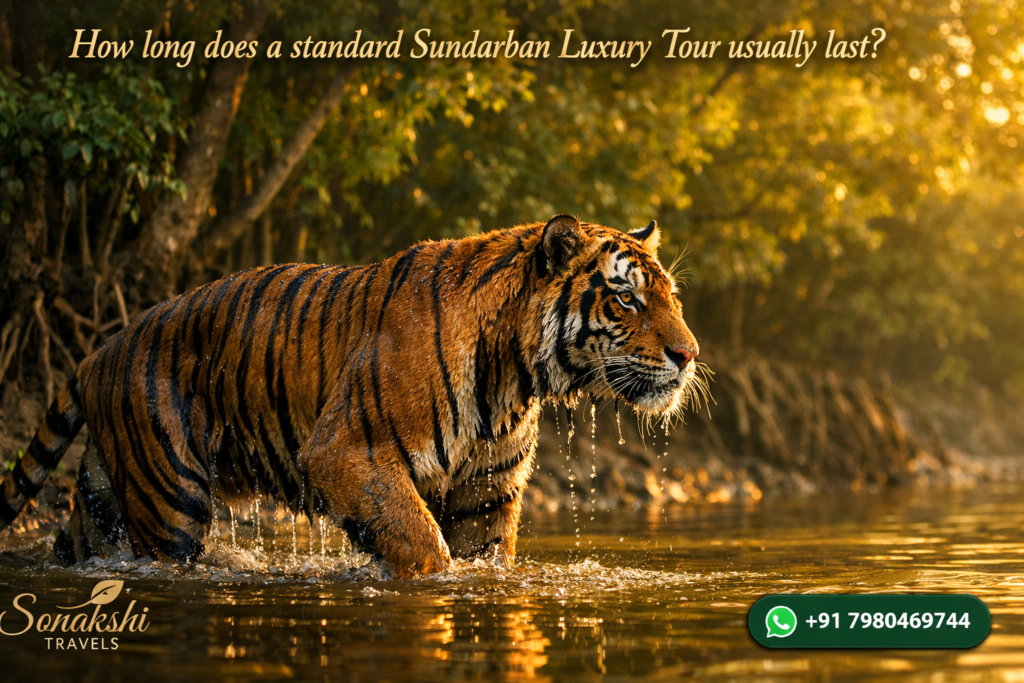
A standard Sundarban luxury tour usually lasts 2 nights and 3 days. That is the duration most often regarded as complete, balanced, and meaningful for a refined journey into the tidal forest. It is long enough to let the landscape unfold gradually, yet not so long that the experience becomes physically heavy or emotionally diluted. In the Sundarbans, duration is not a simple numerical matter. The question is not merely how many hours a guest spends in a room or on a boat. The real question is how much time is required for the forest, rivers, silence, and shifting light to become legible.
The Sundarbans do not reveal themselves instantly. This is not a destination that gives its meaning in one quick glance. Its atmosphere works through rhythm, recurrence, distance, waiting, and careful observation. For that reason, the length of a standard Sundarban luxury tour package is usually designed around the psychology of immersion. Two nights and three days provide enough time for the traveller to move beyond arrival, beyond first impressions, and into a more settled mode of attention. Only then does the place begin to feel coherent.
Why 2 Nights and 3 Days Has Become the Standard
The 2-night, 3-day format has become standard because it matches the nature of the environment itself. In many destinations, one may move rapidly from one attraction to another and feel satisfied. The Sundarbans work differently. This estuarine forest is shaped by tide cycles, river width, mangrove density, changing silence, and long visual intervals. Meaning accumulates slowly. A shorter stay may provide movement through the region, but it often does not provide enough time for perception to deepen.
During the first stage of the journey, the mind is usually still carrying the pace of urban life. Travellers arrive with noise, deadlines, and habit still present within them. Even in a refined and carefully arranged Sundarban luxury private tour, the first day is often a transition between those mental conditions and the slower order of the delta. One begins by noticing space, then silence, then intervals between sounds. Only after this transition does one begin to experience the Sundarbans properly rather than merely passing through them.
That is why the standard duration is rarely just one night. One night allows for arrival and departure, but often not enough time for genuine absorption. By contrast, 2 nights and 3 days allow the journey to breathe. There is time for the senses to adjust, for the eyes to become patient, and for the environment to be understood as a living system rather than a backdrop.
What a Shorter Duration Often Misses
A shorter stay can still be pleasant, but it is usually partial. In a place as layered as the Sundarbans, brevity often produces a surface experience. The traveller may see riverbanks, mangrove edges, open sky, and passing channels, yet still remain outside the deeper rhythm of the landscape. The forest often appears quiet at first because it does not announce itself dramatically. Its character becomes clearer only with time. Bird calls begin to separate from one another. Mudflats stop looking empty and begin to show signs of movement. Water stops seeming uniform and begins to reveal direction, pressure, and tide memory.
This is especially important in a premium or exclusive setting. A serious Sundarban private tour is not valuable merely because it offers privacy. Its real strength lies in the quality of attention that privacy makes possible. Without crowd pressure, without rushed group timing, and without constant interruption, travellers can remain with a moment longer. But that advantage only reaches its full worth when the overall duration supports it. If the stay is too short, privacy exists, yet the environment still passes by too quickly.
In practical emotional terms, a brief journey often ends just as the traveller begins to understand how to be present in the delta. One starts to appreciate the quiet movements of water, the slow arc of the boat, the changing density of afternoon light, and the disciplined stillness of the mangroves, and then the departure begins. A standard duration avoids that abruptness.
Why the Landscape Demands Time
The Sundarbans are not visually loud. Their depth is often subtle, and subtle environments demand duration. A tidal forest is read through repetition. One creek resembles another until the eye becomes more trained. One line of roots seems similar to the next until texture begins to matter. One expanse of river looks open and empty until one starts noticing birds circling, banks collapsing softly, and the slight change in current where water folds around a bend.
For this reason, the length of a standard Sundarban luxury tour is closely related to the cognitive process of recognition. Human attention needs time to move from novelty to comprehension. In the beginning, a traveller simply sees “forest” and “river.” Later, that same traveller begins to perceive tension, fragility, adaptation, and ecological intelligence. The forest ceases to be scenery and becomes a system. The experience becomes richer not because more has been added, but because perception has matured.
This is one of the most important reasons why 2 nights and 3 days remain the accepted standard. It allows enough repetition for pattern recognition. The traveller experiences multiple phases of light, silence, and water movement. That repetition gives depth. Without it, the region can remain beautiful but vague.
The Role of Mental Adjustment in Tour Duration
Luxury in the Sundarbans should not be understood merely as softness, décor, or convenience. At its best, it is a condition that protects stillness and steadiness. A refined Sundarban private tour package usually creates an environment where the mind is not fragmented by noise or hurry. Yet even with such comfort, mental adjustment still takes time.
Most travellers arrive with an expectation that nature should perform quickly. The Sundarbans resist that expectation. The forest does not behave like a sequence of staged scenes. It offers long pauses. It offers uncertainty. It offers the possibility that nothing dramatic will happen for some time, and then suddenly a small movement will become intensely meaningful. This form of experience can feel unfamiliar to those accustomed to constant stimulation.
During the first day, many visitors are still learning how to wait. By the second day, waiting often becomes easier. By the third, they begin to understand that waiting is not emptiness here; it is method. A standard duration therefore supports not only sightseeing but transformation of attention. That is one of the most overlooked reasons why a shorter luxury stay can feel incomplete.
Why the Experience Feels Complete at This Length
A journey feels complete when it includes arrival, immersion, and reflective closure. The 2-night, 3-day structure supports all three. Arrival provides orientation. The middle portion deepens observation. The final phase allows the traveller to leave not in confusion or haste, but with a formed impression of the place. That sense of completion matters greatly in editorial, ecological, and emotional terms.
The Sundarbans are experienced through mood as much as through sight. Sound, humidity, distance, and stillness shape the meaning of the journey. A standard Sundarban luxury tour package usually lasts long enough for these atmospheric elements to settle into memory. One does not remember only a boat or a forest edge. One remembers the measured pace of movement, the pressure of silence before a turn in the river, the soft dull sound of water against the hull, and the changing emotional texture of the day.
That completeness is difficult to achieve in a very brief format. By contrast, an excessively long duration is not always necessary for the average traveller seeking a standard high-quality experience. Beyond a certain point, extension serves specialists, researchers, photographers, or those with unusually deep interest in sustained observation. For most guests, 2 nights and 3 days provide enough length for the experience to feel serious and whole.
The Difference Between Presence and Passage
There is an important distinction between moving through a place and being present within it. A short stay often creates passage. A standard luxury duration creates presence. Presence means that the traveller is no longer merely consuming views. Instead, one is beginning to register tempo, restraint, and ecological tension. Presence produces a different kind of memory: slower, denser, and more exact.
In that sense, the duration of a standard Sundarban luxury private tour is not arbitrary. It reflects the environmental character of the region. Mangrove ecosystems are not theatrical in the conventional tourist sense. They communicate through structure, silence, and adaptation. The traveller must remain long enough for these qualities to become perceptible. Once they do, even apparently quiet stretches of river begin to feel full of information.
This is why many thoughtful travellers report that the second day is the most important. By then, the mind has slowed down enough to notice more. The landscape stops being distant. It begins to enter consciousness in a more disciplined way. That second day is often the true center of the experience, and it would not exist in a meaningful form within a stay that is too short.
How Duration Supports Luxury Itself
Luxury in wilderness travel is often misunderstood as excess. In the Sundarbans, its more authentic form is spaciousness of experience. It means one is not being hurried, compressed, or made to consume the place too quickly. A standard Sundarban luxury tour usually lasts 2 nights and 3 days because this duration preserves that spaciousness without losing structural coherence.
Comfort alone cannot create refinement. Refinement comes from rhythm. Meals, rest, observation, quiet conversation, and moments of solitary looking need to feel proportionate to one another. When a tour is too short, everything becomes compressed. Even if the accommodation is elegant and the service polished, the inner experience can still feel hurried. A proper duration gives luxury its true function: not indulgence, but depth.
This is equally true for couples, families, and small private groups. In a carefully arranged Sundarban private tour, travellers often value the ability to experience the forest without crowd disturbance. But privacy gains significance only when time allows it to mature into calm. A rushed private experience is still rushed. A standard-length private experience, by contrast, permits quiet observation to become the defining quality of the journey.
The Ecological Rhythm Behind the Standard Duration
The ecology of the Sundarbans also helps explain why the standard journey lasts as long as it does. This is a region structured by tides, salinity, mud exposure, channel depth, and patterns of animal and bird movement that are never fully fixed. The visual field changes with time. River surfaces alter in color and speed. Mangrove margins appear differently under shifting water levels. Even the emotional feel of the forest changes between morning stillness, midday brightness, and late afternoon softness.
To experience only one fragment of that cycle is to know the region incompletely. A standard Sundarban tour in luxury format usually extends long enough for the traveller to witness the forest under several changing conditions. This does not mean a full scientific understanding is achieved. Rather, it means the traveller begins to sense that the landscape is dynamic, not static. Such awareness is central to meaningful travel in ecologically sensitive places.
The standard duration therefore has an interpretive function. It teaches, without forcing itself into the language of instruction. By remaining within the region long enough, one begins to grasp that the Sundarbans are not a single image but a changing relationship between water, root, mud, silence, and life. This understanding cannot be rushed.
When Longer Than Standard May Matter
Although 2 nights and 3 days are generally standard, some travellers choose longer stays. That choice usually reflects a special purpose rather than a general need. Those who are deeply interested in ecological observation, bird study, visual documentation, or extended quiet retreat may benefit from more time. Yet this does not change the central answer. For a standard premium experience, the widely accepted and most workable duration remains 2 nights and 3 days.
The value of the standard format lies in its balance. It is long enough to move beyond superficiality, but short enough to remain focused and elegant. It gives the traveller time to settle, observe, reflect, and depart with a coherent impression. In editorial terms, it is the duration at which the experience can genuinely be called a completed Sundarban luxury tour package rather than a shortened glimpse.
Final Understanding of the Usual Duration
So, how long does a standard Sundarban luxury tour usually last? The clearest answer is 2 nights and 3 days. That duration has become standard not by habit alone, but because it corresponds closely to the pace at which the Sundarbans can be meaningfully experienced. It provides enough time for arrival, adjustment, immersion, and reflective closure. It allows silence to become understandable, movement to become meaningful, and the landscape to reveal its layered character.
A refined Sundarban luxury private tour is not measured only by comfort or exclusivity. It is measured by whether the traveller has had enough time to enter the rhythm of the delta without being rushed past it. In that respect, 2 nights and 3 days remain the most appropriate standard. It is the duration at which the journey begins to feel not merely seen, but understood.
For travellers seeking a serious and well-shaped Sundarban private tour package, this length usually offers the right balance between quiet immersion and structural completeness. The Sundarbans do not reward haste. They reward patience, repeated looking, and enough time for atmosphere to become memory. That is why the standard luxury stay lasts as long as it does, and why that duration continues to feel both practical and profoundly right for the place itself.