Updated: March 11, 2026
Brush your soul with green and gold—Sundarban Tour Package, brave and bold
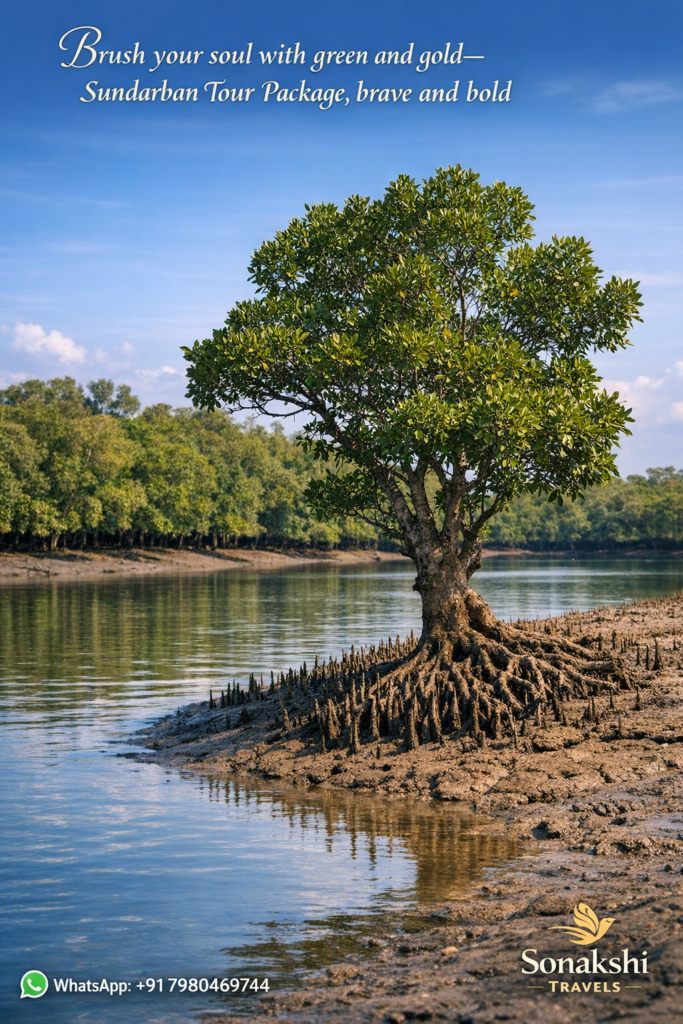
There are landscapes that entertain the eye, and there are landscapes that alter the inner texture of thought. The Sundarban belongs to the second kind. A Sundarban tour package is not simply a passage through a famous mangrove region. It is a gradual immersion into a world where green is never one shade, where gold is never one kind of light, and where courage is measured not by noise or conquest, but by one’s willingness to remain attentive inside a living wilderness. The title may sound poetic, yet the experience justifies that language. The mind arrives with habit, speed, and private unrest. The forest replies with rhythm, colour, stillness, and subtle force.
What makes the experience brave and bold is not theatrical danger. It is the humility required to move through a place that does not flatter human urgency. In the Sundarban, boldness begins with surrender. Water changes direction. Mudbanks appear and disappear. Mangrove roots rise like calligraphy from the earth. Light settles on river skin and then breaks apart with the current. In such a setting, a traveler does not dominate the scene; one learns to receive it. That is why a well-shaped Sundarban tour often leaves a stronger impression on reflective travelers than destinations built around spectacle alone. This landscape asks for alertness, patience, and a quieter kind of courage.
Where Green Becomes More Than Colour
Green in the Sundarban is not decorative. It is structural, ecological, and psychological. The forest presents green as a layered intelligence. Leaves catch salt, wind, and moisture. The canopy shifts from dense darkness to luminous transparency depending on the hour and the angle of light. Young foliage carries brightness; older growth holds shadow. The eye begins by noticing colour, but soon understands that colour here is evidence of adaptation. Mangroves live in conditions that would defeat many other ecosystems. Salinity, tidal movement, unstable sediment, and cyclic submergence make survival difficult, yet the forest persists with astonishing complexity.
This is where the emotional depth of a Sundarban eco tourism experience becomes clear. The traveler is not merely looking at beauty. One is witnessing resilience. Pneumatophores rise from the mud to breathe. Roots grip soft, shifting soil. Trunks tolerate waterlogged ground and saline stress. Such features are scientific facts, yet they also create a powerful symbolic effect on the human mind. Many visitors leave with the feeling that the forest has illustrated a principle of endurance without ever declaring it aloud. The green of the Sundarban is therefore not passive scenery. It is a visible form of persistence.
That persistence affects perception. In many places, nature is appreciated as background, a pleasant frame for leisure. Here, the vegetation behaves like a presence. It absorbs sound, divides light, and shapes mood. A serious Sundarban travel guide may explain the ecological value of mangrove systems, but the deeper lesson becomes experiential only when one sits long enough to see how every green surface participates in atmosphere. The forest cools the eye. It narrows thought. It strips away visual clutter. Instead of overstimulation, it offers concentration. That is one reason the memory of the place lingers.
How Gold Enters the Landscape
If green gives the forest its body, gold gives it its changing voice. Gold arrives through sunlight, but it does not behave uniformly. It touches silt, leaf, bark, rippling water, and open sky in different ways, producing a moving hierarchy of brightness. Early light may soften the mangroves into pale metallic edges. Later, the rivers can hold long golden corridors that seem almost architectural. At times the surface of the water becomes fragmented into broken coins of reflection. At other times the whole scene appears brushed with a thin, noble glaze.
In this setting, a Sundarban travel package becomes memorable not because of a single iconic moment, but because of repeated transformations of tone. The same channel of water can look meditative, alert, tender, or severe depending on how the light settles. Gold is never merely pretty here. It reveals texture. Mudbanks become sculptural. The slight movement of a branch acquires clarity. Feathers, ripples, and root patterns stand out with extraordinary precision. Even silence feels illuminated.
The psychological effect is striking. Gold light often creates a sense of blessing in human perception, yet in the Sundarban that feeling is accompanied by seriousness. The radiance does not romanticize the forest into softness. Instead, it reveals the dignity of a hard-won ecosystem. A Sundarban trip package centered on such observation teaches the traveler that beauty and toughness are not opposites. The most moving scenes in the delta are often those in which delicate light rests upon environments built by pressure, adaptation, and survival.
Bravery in a Landscape That Does Not Perform
The phrase “brave and bold” deserves careful interpretation. In the Sundarban, bravery is not loud. It is not the exaggerated thrill of trying to turn wilderness into entertainment. Rather, bravery lies in allowing the place to remain itself. Many travelers are accustomed to landscapes designed for immediate readability. A viewpoint explains the place in one glance. A sequence of attractions turns experience into checklist. The Sundarban resists that pattern. It unfolds through uncertainty, intervals, and small revelations. That can be unsettling for those trained to expect instant reward.
A thoughtful Sundarban private tour often deepens this quality because privacy allows concentration. Without the pressure of chatter or crowd rhythm, the traveler begins to notice how courage is involved in simple acts of attention: listening without interruption, watching a river bend without demanding climax, or accepting that what is most important in the forest may be atmosphere rather than event. The bold traveler in this environment is the one who does not rush to fill silence with commentary.
There is also an ecological ethics hidden inside this bravery. The Sundarban is a habitat of consequence, not a decorative garden. Respectful movement matters. Noise changes the experience. Restlessness dulls perception. Excess expectation can flatten the subtlety of what is actually being offered. A deep Sundarban luxury tour is often most successful when it understands refinement not as separation from the wild, but as a more disciplined way of being present within it. To be comfortable enough to observe well, and humble enough not to disturb, is its own form of boldness.
The Rhythm of Water and the Education of the Mind
The Sundarban teaches through repetition. The traveler sees water touch mud, withdraw, return, and reshape edges. That repeated movement has a meditative authority. Rivers do not simply carry boats; they write time into the visible world. Channels widen and narrow. Reflections fracture. Tidal flow reorganizes the relationship between land and water so often that permanence itself seems less important than rhythm. This is why a meaningful Sundarban tour packages experience can feel intellectually cleansing. It loosens the mind from rigid forms of thinking.
Modern life often rewards straight lines: direct routes, rapid outcomes, immediate conclusions. The Sundarban presents another logic. Curves matter. Delay matters. Quiet accumulation matters. Observing this can alter emotional tempo. Anxiety often depends on the illusion that everything important must happen at once. The delta disproves that instinct. It shows how meaning may gather through interval. A serious Sundarban tourism experience therefore becomes more than scenic pleasure. It becomes training in a slower intelligence.
This is also why the place often feels inward without becoming abstract. The mind responds physically to rhythm. The soft percussion of water against wood, the recurring pattern of roots along the bank, the pause before a birdcall, the return of light after shade—these repeated signals create a state of concentrated calm. One does not need grand narrative to feel transformed. A sensitive Sundarban tourism package can leave its mark through sequences so small that they become unforgettable precisely because they are not over-explained.
Wildlife as Presence, Not Performance
The wildlife dimension of the Sundarban is often misunderstood when discussed too loosely. In a mature reading of the place, animal life is not a guaranteed show arranged for human excitement. It is part of the moral seriousness of the ecosystem. Birds, reptiles, aquatic life, and the wider web of predation and survival all contribute to a sense that the forest is fully inhabited beyond us. A refined Sundarban wildlife safari should therefore be understood as an education in attention rather than a hunt for spectacle.
This distinction matters. Once the traveler stops demanding performance, perception improves. The gliding line at the water’s edge, the stillness of a branch that suddenly contains life, the alert geometry of wings against late light, the almost invisible tension of a riverbank—such details begin to carry weight. The forest does not need exaggeration. It already contains drama in structural form. Food chains, nesting patterns, tidal dependency, camouflage, and territorial caution shape the atmosphere even when nothing overt occurs. That is why the best luxury Sundarban cruise experiences are those that allow time for quiet observation instead of overstaging movement.
The emotional effect is profound. Wildlife seen in this manner inspires not consumption but respect. One becomes aware that the delta is not waiting to entertain visitors; it is maintaining life through fragile and resilient systems simultaneously. In that realization, a Sundarban luxury tour package can become intellectually richer than any loudly marketed wilderness excursion. The traveler leaves not with a bag of dramatic claims, but with a sharpened sense of ecological reality.
Silence, Atmosphere, and the Cleansing of Inner Noise
The most remarkable aspect of the Sundarban may be how it handles silence. This silence is not emptiness. It is layered, responsive, and alive with small signals. Wind through leaves has texture. Water against the hull has rhythm. Distant calls appear, separate the air, and disappear again. Mud absorbs more sound than stone. Open channels create spaciousness, while enclosed edges gather quiet into density. In such a setting, the human mind begins to hear itself differently.
Many travelers carry an invisible burden of mental noise. The Sundarban does not cure that through spectacle. It works more subtly. By offering an environment where sound is sparse yet meaningful, it encourages selective attention. The inner self grows less scattered. That is why a serious Sundarban travel experience is often remembered as emotionally clarifying. One returns with fewer thoughts, but better ones.
There is also a physical honesty to the atmosphere. The air feels worked upon by water, leaf, salt, and sediment. The smell of wet earth, river movement, and organic life enters perception before language does. A strong Sundarban luxury private tour allows this atmosphere to remain central rather than covering it under unnecessary performance. Comfort matters, but it should serve perception, not replace it. The finest version of refinement here is the ability to sit in ease while remaining fully exposed to the forest’s emotional vocabulary.
Why the Experience Feels Both Intimate and Vast
The Sundarban is unusual in the way it combines enclosure and openness. A narrow creek lined with mangroves can feel intimate, almost secretive. Then the river opens, and the horizon acquires breadth and formal grandeur. This alternation produces a unique psychological effect. One feels both sheltered and challenged, held and humbled. Few landscapes move so fluidly between closeness and scale.
Because of this duality, a Sundarban nature tour can touch different emotional registers within a single unfolding experience. Narrow passages invite concentration and inwardness. Open stretches restore proportion. The traveler senses that private thought and ecological magnitude are not separate realms. The soul, to borrow the title’s language, is brushed precisely because the environment keeps shifting between tenderness and authority.
This is where the phrase “green and gold” becomes more than ornament. Green represents living intricacy, endurance, and hidden breath. Gold represents revelation, dignity, and changing emphasis. Together they form an aesthetic language that feels intimate enough to calm the mind and vast enough to enlarge it. A well-observed best Sundarban tour packages experience does not merely show a forest. It gives the traveler access to a disciplined beauty that can reshape emotional proportion.
The Deeper Meaning of a Brave and Bold Journey
In the end, the bravery of the Sundarban experience lies in receptivity. One must be willing to be slowed, to look without immediate possession, and to accept that subtlety may be more powerful than spectacle. The boldness lies in entering a landscape whose authority does not depend on human approval. The forest is not trying to impress. It simply exists with tidal patience, ecological intelligence, and visual grace.
That is why the most rewarding interpretation of a Sundarban travel package is not commercial or superficial, but editorial and experiential. It is a journey through a living composition of colour, motion, breath, and silence. It invites the traveler to exchange speed for depth, distraction for perception, and noisy certainty for attentive wonder. In that exchange, the soul does seem brushed—by green that teaches endurance, by gold that reveals dignity, and by a wilderness that asks for courage of a quieter, finer kind.
To step into such a landscape is to discover that bold travel does not always announce itself through extremes. Sometimes it appears as steadiness before complexity. Sometimes it takes the form of calm attention in a place shaped by powerful natural forces. Sometimes it means allowing beauty to remain serious. A mature Sundarban tourism encounter leaves behind this exact impression: that the wild can be graceful, that grace can be strong, and that the deepest journeys are those that refine the traveler while never reducing the majesty of the land.
For this reason, the title is not exaggeration. The Sundarban truly can brush the soul with green and gold. It can make a person feel braver not by thrilling the nerves, but by training the senses. It can make the spirit feel bold not by offering domination, but by inviting respectful presence. And that is what gives a meaningful Sundarban tour package its lasting value. Long after the visible details begin to blur, the atmosphere remains: the green persistence of mangroves, the gold intelligence of light, the slow authority of water, and the memory of having stood, however briefly, inside a world where beauty and courage belong to the same sentence.