Updated: March 10, 2026
Sip comfort with the sound of crocodile calls—on a Sundarban Luxury Tour
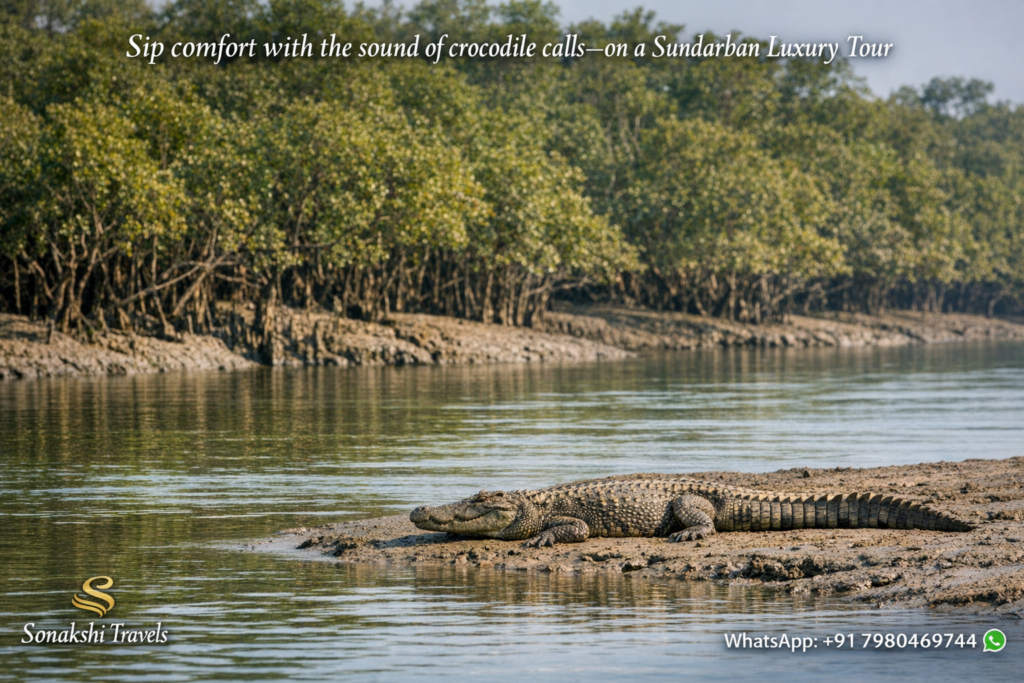
Luxury in the Sundarban is often misunderstood. Many imagine it as soft bedding, polished service, carefully prepared meals, and the reassuring distance that comfort places between the traveler and the wild. Yet the deeper reality is more interesting. In this tidal forest, true refinement lies in being able to listen without interruption, to sit with a warm drink in hand while the landscape continues its own speech, and to experience alertness without noise. That is why a Sundarban Luxury Tour can become something more than an indulgent journey. It becomes a disciplined encounter with atmosphere, where comfort does not weaken the wilderness but makes its subtler details more perceptible.
Among those details, few are as striking as the presence of crocodiles. Much is written about sighting them, but far less is said about sound. A riverine forest is not silent simply because humans speak less within it. Mud shifts. Tides brush against roots. fish disturb shallow channels. Birds break the stillness in layered intervals. And sometimes, from the edge where land and water remain undecided, a low reptilian signal enters the air. It may be brief, rough, almost primitive in texture. It does not fill the river like birdsong, yet it changes the emotional temperature of the moment. On a thoughtfully arranged Sundarban luxury tour package, that change is not rushed past. It is received.
Luxury as the ability to hear the landscape properly
In crowded travel environments, sound is often flattened by engines, overlapping conversation, hurried scheduling, and the constant pressure to move. The Sundarban demands the opposite rhythm. Its ecological character is tidal, layered, and patient. Nothing important arrives all at once. This is where the value of a carefully curated Sundarban luxury private tour becomes clear. Privacy, reduced crowd pressure, measured pacing, and attentive onboard hospitality create the conditions in which sound regains detail. A cup of tea or coffee taken in such a setting is not merely a hospitality gesture. It becomes part of the sensory frame. Warmth in the hand steadies the body; the body becomes still; stillness improves perception.
That is why the phrase comfort matters here in a more exact way than it does in many destinations. A comfortable seat facing open water, a quiet upper deck, clean air moving through the boat, and the absence of unnecessary commotion allow the mind to register layers that would otherwise disappear. The traveler begins to hear not a single forest note, but a structure of relations: a ripple after a submerged movement, an abrupt pause in bird activity, a distant wingbeat, the drag of water under the hull, and then, occasionally, the coarse impression of crocodile presence. What seems at first like luxury service becomes, in practice, an instrument of attention.
The meaning of crocodile calls in a tidal forest
Crocodiles belong to one of the most ancient evolutionary lineages still active in modern ecosystems. Their bodies often appear to represent stillness, but their ecology depends on remarkable sensitivity. They respond to territory, vibration, breeding behavior, prey movement, and changing water conditions. Although many travelers think of crocodiles as creatures known only through their physical form, they also participate in the acoustic life of wetlands. Their calls and vocal signals are not always loud or theatrical. Often they are low-frequency, textured, and situational. They do not dominate the environment the way human sound does. Instead, they appear as part of a larger pattern of warning, dominance, communication, or presence.
In the Sundarban, this matters because sound rarely exists in isolation. A crocodile-related call is not heard as an object detached from place. It is heard within mudflats, creek margins, mangrove shadows, and tidal pause. For the traveler, the experience is significant precisely because it is not staged. The call may be fleeting. It may leave uncertainty. One hears something rough near a bank, sees a disturbance at the waterline, notices how quickly the mind sharpens. The forest, in that instant, stops being scenic and becomes inhabited in a more serious sense.
That seriousness is one of the finest gifts of a Sundarban eco tourism experience when it is handled with maturity. The place does not become thrilling because it is dangerous in a sensational way. It becomes profound because its life remains fully its own. The traveler is not the center. The river is not a decorative corridor. The mangrove edge is not backdrop. Even the sound one hears from a reptile hidden near the bank reminds the listener that this is a sovereign biological world with its own hierarchies, habits, and claims.
Why the sound changes the emotional quality of comfort
There is a paradox at the heart of the experience. One sits in great comfort and yet becomes more aware of rawness. The tea is hot, the seating is steady, the service is composed, and the setting feels curated with care. But the call from the river margin complicates ease in a valuable way. It introduces humility. The traveler realizes that comfort here is not based on domination of the landscape. It is based on respectful nearness to it.
This difference is important. In many forms of leisure travel, comfort is designed to erase friction completely. The outside world is reduced to scenery. On a well-designed luxury Sundarban cruise, the opposite can happen. The surroundings remain legible as living territory. Hospitality does not numb perception. It refines it. The tea tastes warmer because the air is open. The silence feels richer because it is filled with concealed life. The crocodile call, or what the ear recognizes as its rough signature, does not destroy serenity. It deepens it by giving serenity an edge of truth.
Psychologically, this is one of the most sophisticated forms of travel experience. Human beings often seek peace in ways that remove all unpredictability. Yet a deeper peace is sometimes found when one remains safe and cared for while also acknowledging the independent existence of other life forms. The Sundarban performs that lesson with unusual clarity. It invites calm, but never emptiness. It offers elegance, but never sterilization. It allows rest, but never forgetfulness.
Rivers, mudbanks, and the acoustics of hidden presence
The Sundarban is not a forest that speaks only from within trees. Much of its acoustic life is shaped by open channels, exposed mud, tidal creeks, submerged movement, and reflected sound over water. That is why reptilian signals can feel so unusual here. The ear receives them not from a visible stage but from uncertain edges. A call may seem nearer than it is, or more distant than expected, because water carries and bends sound differently. Mangrove roots, embankments of mud, and open surfaces all influence how a sound travels to the listener.
For a traveler on a Sundarban tour, this creates a listening experience that is both ecological and psychological. One is not merely hearing a noise; one is trying to place it within space. Was it from the near bank? From a side channel? From a hidden recess behind a low stretch of foliage? That uncertainty heightens awareness. The landscape begins to feel dimensional in a more serious way. It is no longer only visual depth that matters. Acoustic depth enters the experience, and with it comes a fuller sense of how the forest holds life beyond immediate sight.
Luxury becomes meaningful here because the body is not distracted by discomfort. The traveler is able to stay with the moment long enough for interpretation to deepen. The first response may be curiosity. The second may be alertness. The third may be admiration for the precision with which the ecosystem conceals and reveals itself. This sequence of perception is one of the great intellectual pleasures of refined nature travel.
What a premium experience adds to the wild
The phrase Sundarban luxury tour should not be reduced to décor, menu, or room category alone. Its real value lies in the quality of encounter it makes possible. A well-managed boat, attentive hosting, quieter surroundings, orderly meal service, and uncluttered viewing spaces all serve a higher purpose: they preserve the continuity of observation. Instead of being pushed from activity to activity, the traveler is allowed to remain in relation with the river for meaningful lengths of time.
This continuity matters because crocodile presence is rarely experienced well through haste. Reptilian life rewards patience, not spectacle. One notices floating stillness that may not be driftwood. One sees a form slide away with almost no splash. One hears a rough disturbance from a shaded bank and feels how quickly the surrounding stillness reorganizes itself in the mind. Such moments cannot be forced into theatrical timing. They require conditions of restraint, and restraint is one of the overlooked marks of high-quality travel design.
In that sense, a premium river journey is not an excess placed upon nature. It can be an ethical form of mediation between human desire and ecological complexity. It reduces the impulse to conquer the experience. It helps the traveler receive rather than consume. Even a beverage served at the right moment—quietly, without interruption—can support that mode of receiving. The hand warms. The gaze steadies. The ear opens. The forest continues.
The sensory intelligence of a mangrove evening
As day settles into evening, the Sundarban becomes even more acoustically intelligent. The eye loses some authority, and the ear gains it. Texture replaces outline. Distance becomes interpretive rather than obvious. In such hours, the soundscape can feel almost ceremonial. Bird calls sharpen and then withdraw. Water takes on a broader, flatter voice. Small impacts near the bank become more noticeable. The listener becomes acutely aware that every sound belongs to a body, a movement, or an ecological intention.
Within that setting, the idea of a Sundarban tour package or even a premium journey category feels too administrative unless it serves this deeper reality. The most valuable design of any river experience is one that allows a traveler to feel the forest becoming more articulate as the light softens. Crocodile presence contributes to this atmosphere not because it is constant, but because it is possible. The possibility itself sharpens the senses. The traveler listens more carefully, looks longer at the waterline, and understands that stillness in the Sundarban may contain far more life than visible motion suggests.
This is also why the place resists superficial luxury language. The finest moments are rarely the most decorated ones. They are the most exact ones. A cup held between both hands. A deck chair facing a darkening channel. A low sound from somewhere near the mud edge. The subtle recognition that the river is not empty. These are not extravagant scenes. They are refined because they bring perception into precise alignment with place.
Wildness without theatrical noise
One of the great achievements of the Sundarban is that it can produce intensity without spectacle. Many travelers are conditioned to expect nature through obvious drama: large movements, loud events, immediate visibility. But the mangrove world often works through suggestion, interval, and withheld disclosure. Crocodiles embody this principle perfectly. They are ancient, formidable, and ecologically commanding, yet much of their power lies in stillness, concealment, and sudden legibility rather than constant display.
That is why a well-composed Sundarban travel guide should not merely list creatures or habitats. It should teach the reader how to value partial revelation. The sound of a crocodile call or near-bank disturbance is part of that pedagogy. It trains attention away from the demand for instant visual ownership. One begins to accept that hearing can sometimes be enough, and that enough can be deeply satisfying when the environment is authentically alive.
On a high-quality river journey, this creates a rare union of comfort and intellectual seriousness. The traveler does not merely relax. The traveler learns to perceive more responsibly. Luxury then ceases to mean insulation. It means the privilege of having one’s senses supported rather than overwhelmed.
The ethics of listening in a living estuarine world
There is also an ethical dimension to this experience. To listen carefully in the Sundarban is to acknowledge that other beings occupy the landscape with purposes entirely unrelated to human pleasure. Crocodiles are not there to complete a travel fantasy. They are part of a complex estuarine system shaped by territory, reproduction, feeding behavior, and survival. Hearing their presence, however faintly, reminds the traveler that the forest is not curated for reception. It is encountered on its own terms.
This recognition enriches the meaning of a Sundarban travel package when it is designed with maturity. The experience becomes not merely exclusive, but respectful. Not merely comfortable, but disciplined. Not merely beautiful, but ecologically literate. The crocodile call, rough and low against the greater architecture of water and mud, becomes a teacher of proportion. It places the human listener back into scale.
In such moments, even luxury acquires moral depth. Fine service is no longer about separation from the wild. It is about enabling a form of presence that does not flatten or trivialize what is being encountered. The traveler sips in comfort, yes, but does so while knowing that the surrounding silence is active, inhabited, and older than human arrangements of ease.
When comfort and caution become one experience
Perhaps that is the final distinction that makes this kind of journey memorable. The Sundarban does not ask the traveler to choose between elegance and alertness. It allows both to coexist. The boat may be graceful, the hosting warm, the atmosphere composed, and the service polished. Yet the mangrove margins continue to hold crocodiles, currents, mud, hidden movement, and ancient biological authority. The call from the riverbank, however brief, unites these two truths in a single instant.
One sips calmly, but one does not become careless. One feels safe, but not detached. One enjoys the privileges of a carefully arranged Sundarban luxury travel experience while also recognizing that the surrounding world remains irreducibly wild. That union is rare in travel, and it is one reason the Sundarban leaves such a durable mark on memory.
To travel well here is to understand that the finest luxury is not excess. It is clarity. It is the chance to sit in measured comfort while the estuarine forest reveals its hidden grammar: water against hull, mangrove hush, avian interruption, reptilian signal, and the deep composure of a place that has never needed to advertise its power. In that listening, a traveler discovers that comfort can be sharpened by wildness, and that the rough call of a crocodile, heard across still water, may be one of the most unforgettable sounds in all of refined nature travel.