Sundarban luxury tour through wild calm – Stillness wrapped in mystery
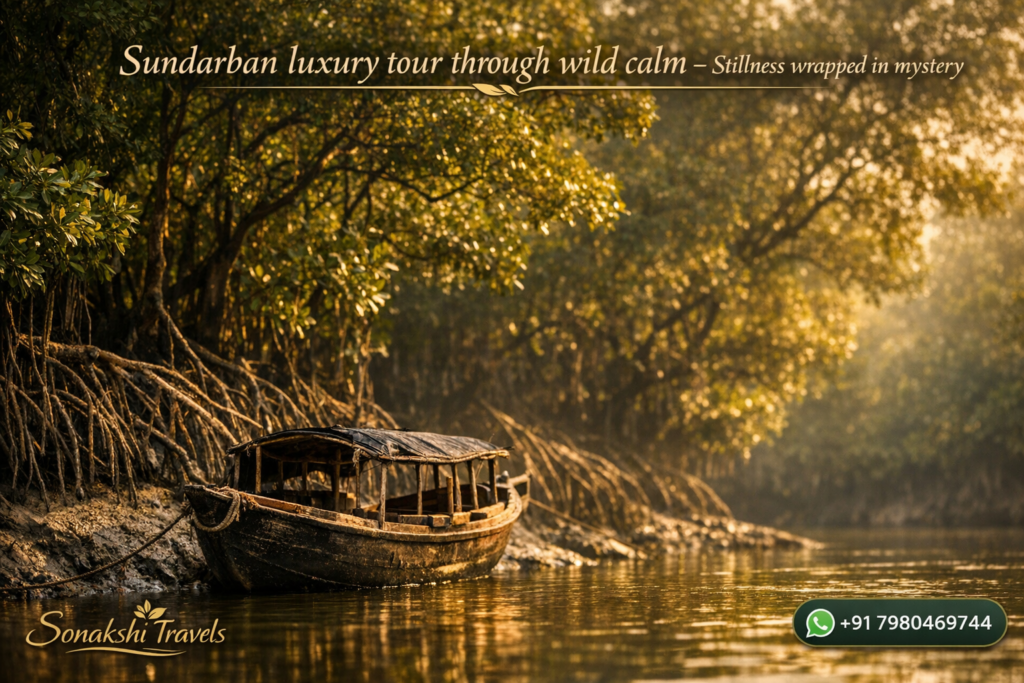
There are landscapes that impress the eye at once, and there are landscapes that work more slowly, entering the mind through silence, spacing, and mood. A Sundarban luxury tour belongs to the second kind of experience. It does not depend on noise, spectacle, or hurried movement. Its deeper meaning appears when the traveler begins to notice what quietness is doing inside the landscape. In the delta, stillness is never empty. It is filled with hidden life, shifting water, suspended attention, and a sense that the visible world is only part of the truth. That is what gives the journey its rare feeling of wild calm.
The phrase may sound simple at first. Calm usually suggests comfort, rest, and softness. Wildness suggests danger, instinct, and distance from control. Yet the Sundarban holds both realities at the same time. Water seems peaceful, but it is always moving under the surface. Banks appear settled, yet the tide changes their shape. Trees stand still, but roots below the mud are engaged in constant struggle with salt, water, and erosion. This tension between quiet appearance and hidden motion gives a Sundarban luxury tour package its unusual emotional depth. The traveler is not only seeing nature. The traveler is entering a mood where calm and uncertainty remain together without contradiction.
That is why the experience feels so refined when it is approached with patience. Luxury in such a setting is not a matter of loud display. It is a matter of space, pace, and attentiveness. It allows the visitor to witness the delta without rushing past its details. The value of the journey comes from how gently it frames the environment. The silence of the river is not interrupted. The wide sky is allowed to remain wide. The long pauses between one visual impression and another become part of the experience itself. In this sense, a Sundarban travel experience becomes meaningful not because it overwhelms the senses, but because it sharpens them.
Where stillness carries hidden movement
One of the most remarkable qualities of the Sundarban is that nothing here is truly fixed. Even when everything looks calm, the delta is changing. The waterline shifts. Reflections break and return. Mud carries signs for a moment and then removes them. Light slides across channels and changes the emotional tone of the same view within minutes. This is why the calm of the place never feels lifeless. It feels alert. A quiet river bend can hold a deep sense of waiting. A stretch of mangrove shade can feel watchful. The silence is not passive. It is active, observant, and full of possibility.
This is also where the mystery begins. In many destinations, mystery comes from dramatic ruins, legends, or visual darkness. In the Sundarban, mystery is created by partial revelation. You do not see everything at once. Vision is interrupted by bends, roots, reeds, shadow, and distance. One channel opens into another. One patch of green conceals another layer of green behind it. The eye is always invited forward, but never given the whole answer. A carefully designed Sundarban luxury private tour allows a traveler to remain inside this unfinished feeling long enough to understand its power. The landscape does not hide because it is empty. It hides because it is alive in a complex way.
Researchers and ecologists have long noted that mangrove systems are among the most dynamic coastal ecosystems in the world. Their stability depends on adaptation rather than stillness. Salinity, sediment, tidal movement, and root structure all shape what survives. That environmental truth is deeply connected to the emotional truth of the landscape. The calm that a traveler feels is not the calm of something inactive. It is the calm of something highly adjusted, balanced, and resilient. The forest does not need to perform. It simply continues in its own ancient rhythm. This gives the traveler an unusual impression of strength without display.
The psychology of silence in the delta
Silence affects human perception in powerful ways. In ordinary urban life, the mind is trained to process interruption after interruption. Noise, speed, and constant signals make attention restless. In the Sundarban, that pattern begins to loosen. Silence widens thought. It slows reaction. It makes smaller details feel larger. A distant ripple becomes noticeable. The angle of a branch begins to matter. The pause between bird calls starts to feel meaningful. During a Sundarban tourism encounter shaped by stillness, the traveler begins to understand that silence is not merely the absence of sound. It is a different condition of awareness.
This shift is one of the deepest luxuries the place offers. Many forms of travel fill the mind with more images than it can hold. Here, the opposite often happens. The mind empties enough to receive each impression more fully. When that happens, mystery becomes more intense, not less. The traveler feels that something important is present, but not fully explained. That feeling can be deeply calming. It removes the pressure to consume every moment quickly. It replaces quick judgment with quiet attention. In that space, the delta begins to feel less like a destination and more like a state of perception.
There is also a reason why the Sundarban leaves such a lasting mental impression. Human beings respond strongly to environments where visibility is limited but not closed. Such places create alertness without immediate panic. The nervous system becomes attentive. The imagination becomes active. In the mangrove landscape, this happens again and again. Open water suggests freedom, but dense edges suggest concealment. Soft light creates peace, but shadow creates uncertainty. This balance keeps the mind awake. A Sundarban luxury travel experience, when understood properly, is therefore not only scenic. It is psychological. It changes the quality of thought for the duration of the journey.
How mystery is shaped by water, root, and light
The mystery of the Sundarban is not abstract. It is built from physical elements. Water is the first of these. Rivers and creeks do not simply connect places here. They shape the entire emotional grammar of the landscape. Their surface can look smooth, metallic, dark, or softly luminous depending on the hour and the angle of light. Because water reflects, conceals, and distorts at the same time, it naturally produces ambiguity. It shows a doubled world. Sky appears below. Forest edges stretch and break. One cannot always tell where solidity ends and reflection begins. This visual uncertainty adds quiet drama to every movement through the delta.
Roots create a second layer of mystery. Mangrove roots are practical structures of survival, but they also give the forest its unusual visual language. They rise, twist, spread, and grip. They make the boundary between land and water feel unstable. They suggest struggle, endurance, and adaptation. When seen from a slow-moving boat, they often resemble script written in mud and shadow. Their shapes are irregular yet purposeful. This is one reason a luxury Sundarban cruise can feel so contemplative. The eye keeps encountering forms that are natural, functional, and strangely symbolic at the same time.
Light completes the atmosphere. In the Sundarban, light rarely behaves like a flat covering spread evenly over the world. It filters, breaks, reflects, and shifts. It may touch one patch of water and leave another in deep softness. It may make leaves glow while roots remain dark. It may transform ordinary surfaces into something almost secretive. Because of this, the landscape often feels layered even when it is visually simple. Light does not remove mystery. It often deepens it. It reveals just enough to make the hidden portion feel more powerful.
Wild calm as an ecological truth
The phrase wild calm is not only poetic. It also describes the ecological nature of the mangrove world. Mangrove ecosystems survive through an intricate balance of adaptation. Plants tolerate salt. Sediment settles and shifts. Aquatic and terrestrial life overlap. Boundaries remain porous. Such environments are highly productive, but their productivity does not always appear dramatic on the surface. Instead, it is distributed across cycles, niches, and hidden interactions. That is why the Sundarban often feels quiet while supporting such intense forms of life. The calm is not emptiness. It is ecological concentration.
This also explains why the landscape carries an impression of disciplined energy. Nothing is wasted. Forms are shaped by necessity. Branches bend according to stress. Roots rise according to need. Channels open according to water movement. In such a world, beauty comes from function, and mystery comes from complexity. A refined luxury mangrove forest tour gains depth when the traveler begins to sense this underlying order. The forest may look irregular, but it is not random. Its silence is structured by relationships that have evolved over long stretches of time.
There is also an important emotional effect in witnessing a place that remains governed by systems larger than human preference. It creates humility. It also creates relief. The traveler feels temporarily released from artificial urgency. The delta does not organize itself around human schedules or expectations. It continues according to tide, salinity, light, and biological need. That independence is part of its mystery. During a deeply attentive Sundarban luxury eco tour, one begins to see that calm is not always softness. Sometimes calm is the visible face of a powerful system that has no need to explain itself.
Luxury without noise, depth without excess
In many modern travel settings, luxury is associated with abundance of visible comfort. Yet in a place like the Sundarban, the highest form of luxury is restraint. It is the ability to experience the landscape without vulgar interruption. It is the quality of being held in comfort while the essential character of the environment remains untouched. This is why the idea of a Sundarban premium tour package becomes most meaningful when it supports slowness, privacy, and perception rather than display.
The traveler does not need constant distraction here. The landscape itself is enough, but only if the conditions of experience are thoughtful. Good design in such a journey means allowing silence to remain central. It means allowing long views to breathe. It means understanding that mystery is easily damaged by noise, crowding, and haste. When comfort serves attention rather than replacing it, the experience becomes richer. That is the quiet distinction of a true Sundarban luxury boat safari. It respects the emotional scale of the place.
This restraint also deepens memory. Loud travel often produces quick excitement and quick fading. The Sundarban works differently. It enters memory slowly and stays there because it was never fully exhausted in the moment. The traveler returns carrying impressions that continue to unfold later: a silver line on dark water, a bank of roots under slanting light, a silence that seemed full rather than empty. These fragments remain alive because the place was experienced with enough stillness to preserve its mystery.
The emotional character of a river-bound wilderness
Every landscape creates a different emotional climate. Mountains often inspire awe through height. Deserts create a sense of scale and exposure. Forests can create immersion through enclosure. The Sundarban is different because its emotional character comes from fluid boundaries. Water and forest are never fully separate. Open space and concealment exist together. Calm surfaces and hidden forces overlap. This gives the traveler a rare feeling that the world is both open and unreadable.
That unreadability is important. It is what prevents the landscape from becoming decorative. A merely pretty place can be consumed quickly. A mysterious place resists quick ownership. It remains partly beyond the viewer, and that distance gives it dignity. During a thoughtful Sundarban travel guide reading or a lived encounter in the delta itself, one learns that wildness is not always loud. Sometimes wildness is the right of a landscape to remain partly withheld. The Sundarban embodies that principle with unusual grace.
This is why the title of this experience feels so accurate. Wild calm is not a contradiction here. It is the essential emotional truth of the place. Stillness is present, but it is wrapped in mystery. Peace is present, but it never becomes complacent. Beauty is present, but it is never simple. The traveler is allowed to rest, but never fully forget that unseen life, hidden movement, and ecological tension remain close at hand. That awareness does not reduce comfort. It gives comfort depth.
Why this stillness remains unforgettable
Many journeys are remembered for what they showed. The Sundarban is often remembered for how it made perception feel. That is a more subtle form of memory, and often a more lasting one. The traveler remembers the strange fullness of quiet. The patience of water. The way mystery seemed to rise not from drama, but from withholding. A book Sundarban luxury tour search may begin as a wish for comfort in nature, but the deeper reward is often something less expected: an encounter with a landscape that teaches attention through calm.
For that reason, the experience does not end when the journey ends. Its mood continues inwardly. The memory of the delta often returns during noisy days because it offered an alternative rhythm of being. It showed that stillness can be alive, that mystery can be gentle, and that luxury can exist without separating the traveler from the truth of the environment. In that sense, a Sundarban travel agency may arrange the outer form of the journey, but the real gift of the place lies deeper: it restores the ability to notice what quietness contains.
That is the lasting power of a Sundarban luxury tour through wild calm. It does not rush to explain the forest. It does not reduce the delta to scenery. It lets the traveler remain close to a world where silence carries motion, beauty carries uncertainty, and calm itself has a hidden pulse. The result is not only a memorable journey. It is a rare encounter with stillness that feels alive from within, wrapped always in the deep and dignified mystery of the mangrove wilderness.