Updated: March 11, 2026
Sundarban Tour: Where the Tides Write Poetry on Muddy Mangrove Shores
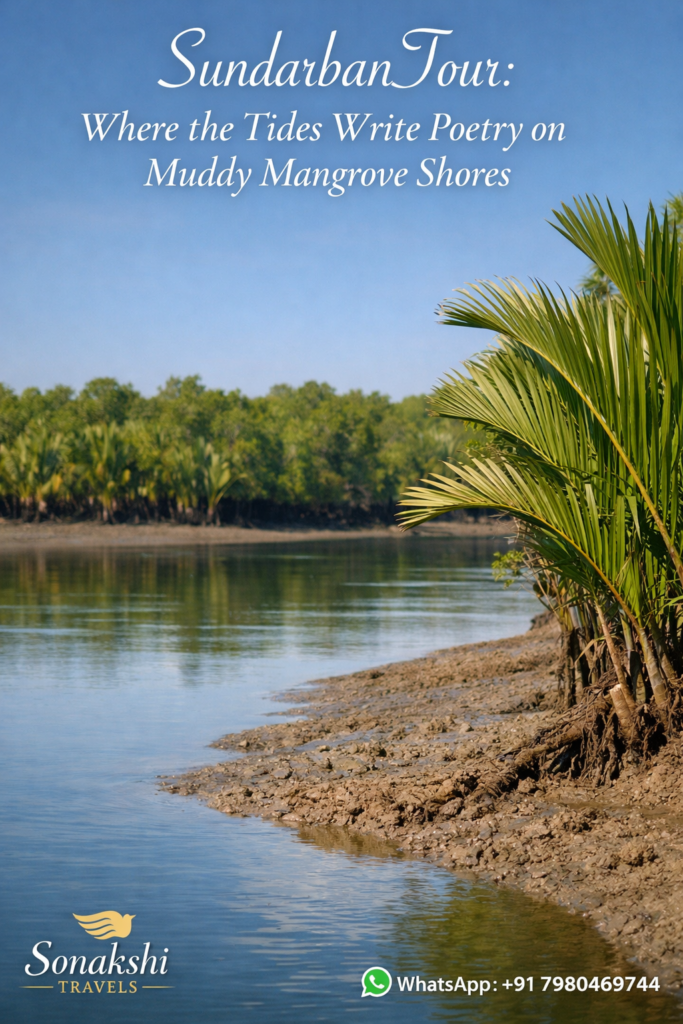
There are places that impress the eye, and there are places that alter the rhythm of thought. A Sundarban tour belongs to the second kind. Here, the landscape does not stand still long enough to be possessed by a hurried glance. It shifts, withdraws, softens, and returns, as if the earth itself were breathing through water and mud. The mangrove shores are not grand in the manner of mountains, nor neat in the manner of cultivated land. Their power lies elsewhere. They seem to write and erase themselves with each returning tide, producing a living script of roots, currents, shadows, and silences.
To travel through this tidal forest is to enter a place where permanence is never the main story. The channels widen and narrow without warning. Mud banks appear like unfinished thoughts and dissolve again under the patient insistence of the river. Trees rise not from stable ground, but from an amphibious world where land and water negotiate their borders hour by hour. In that unstable beauty, the visitor begins to understand that the Sundarbans are not merely seen; they are interpreted. A serious Sundarban tour package is meaningful not because it carries one to a famous destination, but because it allows time to notice how this landscape speaks in gesture rather than declaration.
The Language of Tides and Mud
The first lesson of the Sundarbans is that mud is not emptiness. It is evidence. It holds the memory of retreating water, the pressure of animal movement, the fall of leaves, and the slow chemistry of decay and renewal. On these muddy mangrove shores, the tide becomes both author and editor. It draws lines, smudges them, and redraws them with fresh emphasis. The result is a landscape that appears unfinished only to those who expect sharp boundaries. In truth, it is one of the most complete ecological conversations in the world.
What seems soft underfoot is actually the stage on which survival is negotiated every day. Mangrove roots arch upward, twist outward, and descend again, creating a dense architecture built against salt, submergence, and erosion. The eye soon notices that nothing here grows casually. Every trunk, root, and branch carries the record of adaptation. This is why a Sundarban travel guide that reduces the region to a checklist can never fully explain it. The Sundarbans demand slower reading. Their poetry lies in details: the glistening skin of wet silt, the dark mirror of tidal water, the fine lacework of pneumatophores piercing the ground like punctuation marks in a sentence written by the river.
That poetic quality does not arise from fantasy. It emerges from physical processes that are precise and relentless. Tides shape sediment distribution. Salinity influences plant structure. Water flow determines which channels remain open and which become quiet backwaters. The beauty of the place is inseparable from these scientific realities. A thoughtful Sundarban tourism narrative must therefore respect both the sensory and the ecological truth of the delta. The muddy shore is beautiful because it is functional. The rhythm is moving because it is alive.
Mangrove Silence Is Never Empty
Silence in the Sundarbans is layered. It is not the silence of absence, but the silence of concentration. Even when human speech falls away, the forest is active with signals. Water laps against the hull in irregular notes. Crabs vanish into holes with tiny bursts of movement. Leaves shift under the passage of wind. Somewhere beyond immediate sight, a bird breaks the stillness, not as interruption but as confirmation that the silence is inhabited.
This atmosphere changes the traveler’s inner pace. In ordinary settings, movement usually seeks destination. In the Sundarbans, movement becomes observation. A drifting boat, the turning of a creek, the slow passing of root walls—these do not feel like delay. They feel like entry into a different order of attention. For that reason, a Sundarban travel experience is as much psychological as visual. It asks the mind to release urban habits of speed and to accept uncertainty as part of perception.
The mangrove forest also teaches restraint. Visibility is partial. Distances are deceptive. Forms emerge through layering rather than open revelation. This creates a rare type of beauty: one built from suggestion. The forest does not show everything. It allows glimpses, textures, intervals, and traces. That partiality deepens the emotional effect of a Sundarban nature tour. Instead of overwhelming the visitor with spectacle, it cultivates listening, patience, and humility.
The Shoreline as a Living Manuscript
Few landscapes display change as visibly as a mangrove shore. Along these edges, the land seems to revise itself throughout the day. Freshly exposed mud glows under light with a metallic softness. Water returns and turns the same surface into reflection. Fallen twigs, shells, floating leaves, and animal marks briefly become lines of meaning before the next tide removes them. The effect is literary without being sentimental. It resembles writing because it carries sequence, variation, and disappearance.
Such imagery explains why the Sundarbans leave a lasting impression on serious observers. The place is not dramatic in one single frame; it is dramatic over time. A Sundarban travel package centered on shallow attention would miss this entirely. The delta reveals itself through repetition with difference. One creek resembles another, yet never fully. One mud bank mirrors the next, yet the lines of erosion, root exposure, and tidal pressure are always distinct. The visitor gradually learns that sameness here is only an illusion created by distance.
This is also where the emotional force of the region becomes clearer. The muddy shore is vulnerable, but it is not weak. It yields without surrendering. It shifts without collapsing into disorder. In an age that often values fixed forms, the Sundarbans present another model of strength: resilience through flexibility. That is one reason why Sundarban eco tourism, when interpreted responsibly, can offer more than scenic pleasure. It can encourage a deeper understanding of coexistence, adaptation, and ecological intelligence.
How Water Shapes Human Perception
In many landscapes, water is an element within the scene. In the Sundarbans, it is the medium through which the scene exists. Channels function like moving corridors of thought. Reflection doubles the visible world. Tidal height changes the scale of everything: roots appear longer, mud banks thinner, vegetation denser, banks nearer or farther. The eye must constantly adjust. This fluid instability produces a special form of awareness, one rooted in relation rather than control.
Even the color palette participates in this subtle transformation. The greens are often dark, mineral, and salt-tempered rather than lush in an ornamental sense. The browns of mud are not dull; they shift between bronze, grey, and deep earth tones depending on moisture and light. Water carries fragments of sky, leaf, and silt together in one moving surface. During a refined Sundarban luxury tour, this visual complexity becomes especially rewarding because it invites prolonged and undistracted attention rather than hurried consumption.
That is why the Sundarbans can feel almost musical. Repetition exists, but never as monotony. Instead, there are recurring motifs: the bend of a creek, the rise of mangrove roots, the soft break of water, the exposed seam of a muddy embankment. These return like phrases in a composition, each slightly altered by current, light, and time. A serious Sundarban exploration tour should therefore be understood not as a search for isolated highlights, but as an immersion in rhythm.
Wildness in Gesture, Not Performance
The wild character of the Sundarbans is often misunderstood by those who expect nature to perform visibly for them. This is a place where animal presence is often first felt through sign rather than sight: movement in the edge vegetation, markings in wet sediment, abrupt attention among birds, the charged stillness that spreads through a creek. Such moments are powerful because they preserve the dignity of the ecosystem. The forest remains self-contained. It does not rearrange itself for human satisfaction.
For that reason, the emotional intensity of a Sundarban wildlife safari lies not only in possible encounters, but in the heightened awareness the landscape produces. The visitor becomes alert to traces, intervals, and patterns of behavior. The mud shore is read almost like a page of field notes. Tiny details matter. A break in surface texture may indicate recent passage. A sudden burst of avian alarm may reveal hidden tension. This is wildness as intelligence, not spectacle.
There is also a moral dimension in such experience. The Sundarbans remind the traveler that genuine wilderness retains opacity. It is not fully knowable at a glance. It should not be reduced to decorative scenery. Even a carefully curated Sundarban luxury private tour is most meaningful when it protects that essential wildness rather than softening it into convenience. Comfort may frame the journey, but the forest itself must remain untamed in meaning.
The Emotional Architecture of a River Journey
Travel through the Sundarbans often unfolds by boat, and that matters deeply to the way the place is experienced. A river journey here is not merely logistical. It is interpretive. The boat creates a floating threshold between human presence and mangrove mystery. One is neither fully inside the forest nor outside it. This intermediate position heightens awareness. Shores pass near enough to study their textures, yet distant enough to preserve their secrecy.
Because of this, a Sundarban private boat tour can feel especially intimate. Without the noise of distraction, the subtleties of the river become clearer: the slight drag of current around a bend, the weight of humidity over open water, the layered geometry of roots leaning into the tide. The river does not carry the traveler toward conquest. It carries the traveler into relation. Every turn reveals another version of the same essential truth—that the delta is composed not of static scenery, but of ongoing exchange.
A more refined private Sundarban river cruise can intensify this contemplative quality. When observation is unhurried, the mangrove world appears less like a route and more like a text slowly opening. Light on wet bark, shadow under root systems, birds crossing the surface of still water—all these become part of the atmosphere of understanding. The journey becomes memorable not through quantity of sights, but through the depth of attention those sights awaken.
Ecology and Beauty Are One Story
The Sundarbans cannot be described honestly if ecology and beauty are separated. The same structures that make the forest visually arresting are the structures that sustain life in difficult conditions. Mangroves filter, hold, bind, shelter, and regenerate. Their aerial roots support respiration in waterlogged soil. Their dense margins reduce erosion. Their tidal channels support an extraordinary network of nutrient movement and habitat exchange. To admire the shoreline while ignoring these functions would be to read only the ornament of a poem and miss its meaning.
This is why informed writing about Sundarban tourism should remain grounded in ecological literacy. The beauty of a muddy shore is not accidental decoration. It is the visible form of adaptation. The maze-like channels are not romantic confusion; they are hydrological pathways. The quiet persistence of mangrove vegetation is not merely picturesque; it is an answer to salinity, inundation, and sediment flux. A mature Sundarban tourism package narrative should help readers see the landscape as process, not postcard.
Seen in this way, the delta acquires ethical gravity. It becomes a place where human admiration must be accompanied by respect. The more closely one observes, the more one understands how finely balanced the environment is. Even the mud bank, humble in appearance, is part of a larger system of deposition, rooting, feeding, and shelter. To call the shore poetic is therefore not to escape science, but to recognize that the scientific and the aesthetic are deeply interwoven here.
Luxury, Privacy, and the Discipline of Attention
In many destinations, luxury is associated with excess. In the Sundarbans, its highest form may be something quieter: the privilege of undisturbed perception. A well-conceived Sundarban private tour allows the traveler to engage the landscape with seriousness, dignity, and concentration. Privacy does not remove one from the forest; it may, in fact, draw one closer by reducing noise and fragmentation.
The same is true of a carefully arranged Sundarban private tour package. When the structure around the experience is calm and well-managed, the mind is freer to notice the essential things: the grain of the tide, the dark stillness under mangrove canopies, the reflective mood that open water induces. Luxury in such a setting should never overpower the destination. Its true function is to make perception more precise.
That is why phrases such as exclusive Sundarban private tour or Sundarban personalized travel package have value only when they point toward depth of engagement rather than social display. The delta resists vanity. It rewards humility. Even a luxury Sundarban cruise is most successful when it frames the mangrove world with elegance while allowing the raw intelligence of the tidal landscape to remain central.
Why the Sundarbans Stay in Memory
Some journeys remain vivid because of a single extraordinary event. A journey through the Sundarbans often remains vivid for another reason: its atmosphere settles slowly into memory and continues unfolding there. Long after the river has been left behind, one recalls the changing edge of mud and water, the disciplined forms of mangrove roots, the austere beauty of half-seen creeks, and the strange calm that comes from submitting to tidal rhythm.
This lasting power comes from the rare unity of sensation, thought, and place. The Sundarbans do not merely entertain the senses. They reorganize attention. They make silence legible. They reveal motion within stillness and permanence within change. Whether one encounters the delta through a classic Sundarban tour packages format or through a more intimate Sundarban private mangrove cruise, the essential experience remains one of reading a living shoreline whose script is written in tide, root, and mud.
For this reason, the title phrase feels less like metaphor and more like description. In the Sundarbans, the tides truly do write poetry on muddy mangrove shores. Their language is not made of words, but of recurring forms, subtle erasures, and resilient continuities. To witness that language with care is the real privilege of the journey. The forest does not ask for applause. It asks only that one pay attention. And once that attention is given, the Sundarbans do what very few landscapes can do: they continue speaking long after the water has slipped from view.