Updated: March 21, 2026
What Activities Are Included in a Sundarban Private Tour Package?
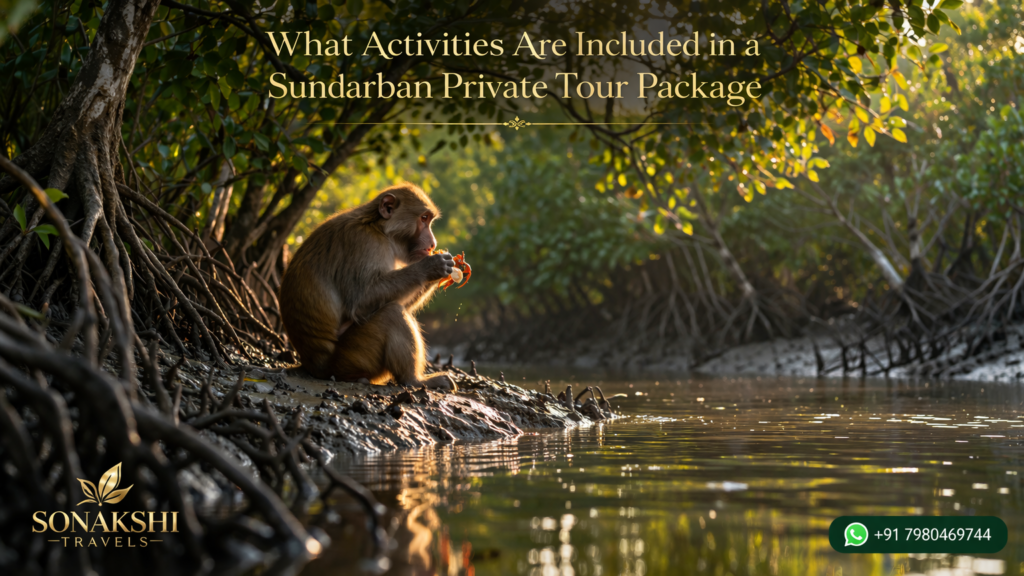
A well-designed Sundarban private tour package is not defined by movement alone. It is defined by the kind of attention it makes possible. In the mangrove delta, activities should not be understood as a checklist of entertainment. They are better understood as carefully arranged forms of access. A private format changes the way each activity is experienced because it reduces crowd pressure, gives more control over pace, and allows the landscape to be observed with greater concentration. This is important in the Sundarban because the region does not reveal itself through speed. It reveals itself through silence, repetition, tidal change, bird calls, water texture, and patient looking.
For that reason, the activities included in a Sundarban private tour are meaningful not only because of what guests do, but because of how they are allowed to do it. A private arrangement usually creates more room for uninterrupted wildlife observation, slower river movement, quieter interpretation of the mangrove environment, relaxed mealtimes, more personal interaction with guides, and a deeper sense of immersion in the delta’s shifting mood. The package is private, but the experience it opens is ecological, sensory, and reflective.
When travelers ask what activities are included, the most accurate answer is that a private journey in the delta usually combines river-based exploration, mangrove observation, wildlife tracking, birdwatching, cultural contact, quiet deck time, nature interpretation, local food experiences, photography opportunities, and periods of stillness that become part of the activity itself. In many ordinary trips, silence is treated as empty time. In a private delta journey, silence becomes one of the most important parts of the experience because it allows the forest to be heard on its own terms.
Private Boat-Based Exploration as the Core Activity
The central activity in most private journeys is controlled exploration by boat. The delta is a water-shaped landscape, so movement through rivers and creeks is not a secondary detail. It is the core structure of the experience. In a private setting, the boat is not simply transport. It becomes the main observational platform from which guests study banks, roots, birds, mudflats, tidal marks, and animal movement. This is why many travelers specifically look for a Sundarban private boat tour or a private Sundarban river cruise rather than a crowded shared departure.
The private boat experience changes the quality of observation. Without the constant interruption of a large mixed group, guests can remain quietly focused on one section of river for longer. They can watch fiddler crabs moving along exposed mud, note the pattern of pneumatophores rising from the wet soil, observe a kingfisher waiting in still concentration, or follow the small shock of movement when a reptile slips from the bank into the water. In a shared group format, these moments are often cut short by noise or timing pressure. In a private format, they become part of the real value of the journey.
Because of this, boat-based exploration in a Sundarban customized private tour often includes slow navigation through wider channels, attentive passage near mangrove edges, pauses for wildlife movement, and relaxed deck time during which the river itself becomes the main subject. The act of looking is not rushed. The forest is studied as a living border where water and land are constantly negotiating their shape.
Wildlife Observation as a Quiet and Continuous Activity
Wildlife observation is one of the most expected activities in the delta, but in a serious private package it is handled with discipline rather than excitement alone. The Sundarban is not a theatrical forest where animals appear on command. It is a habitat of concealment, caution, and indirect signs. That is exactly why wildlife observation here is intellectually rich. Guests are not only looking for dramatic sightings. They are learning how an estuarine ecosystem behaves.
Many travelers choose a Sundarban private wildlife safari because it offers a more concentrated encounter with this process of observation. The guide can explain the difference between random movement and meaningful ecological sign. Bird calls, water disturbance, mud impressions, deer alertness, crab activity, and silence in the canopy can all become part of the interpretive experience. Instead of simply waiting for one famous animal, guests begin to understand the forest as a system of relationships.
A private safari setting also helps maintain behavioral sensitivity. Wildlife is less likely to be disturbed by excess crowd sound. Guests themselves become more alert because the environment is not filled with unrelated conversation. As a result, a Sundarban private safari tour often feels deeper than a louder public-format excursion, even when the visible action is subtle. A change in the posture of a bird, the sudden stillness of a mudbank, or the ripple caused by unseen life below the surface can become memorable when the setting is quiet enough to notice it.
In some packages, this wildlife focus is expressed in a more premium format described as a Sundarban luxury private tour or luxury Sundarban safari. In such cases, comfort and wildlife observation are combined, but the essential activity remains the same: careful, respectful attention to the living delta.
Birdwatching and Fine-Scale Nature Observation
Birdwatching is often one of the richest activities included in a private package, even for travelers who do not initially identify themselves as bird enthusiasts. Mangrove environments support a pattern of avian life that rewards patience. In a private setting, guests have more freedom to stop, watch, and interpret movement carefully. A hovering brahminy kite, the sudden speed of a kingfisher, the elegant scanning posture of an egret, or the distant line of waterbirds across a mudflat all gain meaning when observed without hurry.
This makes the journey feel close to a Sundarban nature tour, because the attention given to birds naturally expands into attention to habitat. Guests begin by watching a bird and soon start asking why it chooses a certain branch, a certain inlet, a certain bank, or a certain tidal margin. Observation deepens from species recognition into ecological reading. That is one of the strongest educational activities a private package can include.
Along with birds, guests often observe mudskippers, crabs, reptiles, changing water color, plant form, and subtle transitions between river edge and forest interior. A refined private experience teaches that nature observation in the delta is rarely about one spectacular sight alone. It is about the disciplined enjoyment of many connected details. This is why some travelers also describe the experience as a Sundarban exploration tour rather than a simple sightseeing trip.
Mangrove Interpretation and Ecological Learning
One of the most valuable activities included in a strong private package is guided interpretation of the mangrove ecosystem itself. The Sundarban cannot be understood by appearance alone. It requires explanation. The roots that rise above the soil, the shifting boundaries of mudbank and channel, the salt-tolerant vegetation, the role of tidal force, the adaptive behavior of animals, and the fragile balance between land and water all need to be interpreted if the journey is to become intellectually complete.
For this reason, a serious private package often includes long stretches of ecological explanation. Guests may learn how mangrove plants breathe in difficult soil conditions, how salinity shapes vegetation, how tidal action creates both fertility and erosion, and why animal behavior in this landscape is strongly linked to concealment and timing. This interpretive layer is what separates a superficial outing from a meaningful Sundarban travel guide-level experience within the journey itself.
In many cases, this educational element is one of the quiet strengths of a private Sundarban eco tour. The package is private not only for comfort, but for concentration. Without crowd distraction, explanation becomes clearer. Guests can ask questions freely, revisit ideas, and connect what they see with what they are being taught. The activity is part natural history, part landscape reading, and part ecological literacy.
This is also where the meaning of Sundarban eco tourism becomes practical rather than decorative. In a responsible private tour, ecology is not a slogan. It is part of the actual experience guests receive through interpretation, observation, and behavior.
Village Interaction and Cultural Contact
Many private packages include carefully arranged local interaction as part of the overall experience. This does not mean turning village life into performance. In a properly handled package, cultural contact remains respectful, limited, and grounded in the rhythms of the delta. Guests may observe aspects of daily life shaped by river dependence, local resource use, fishing practices, food traditions, craft habits, or household adaptation to a tidal environment.
This activity matters because a private journey through the Sundarban is never only about forest space. It also involves understanding the human edge of the mangrove world. The delta is a lived landscape. Local culture has been shaped by uncertainty, resilience, water knowledge, and close environmental dependence. When guests encounter this dimension with patience and humility, the activity adds human depth to the package.
For families, this often becomes an especially meaningful part of a Sundarban family private tour. Adults receive context, while younger travelers begin to understand that landscape and livelihood are connected. For couples, the experience may feel quieter and more reflective, giving emotional texture to a Sundarban couple private tour. In both cases, the activity is valuable because it extends the journey beyond passive viewing into relational understanding.
Deck Time, River Silence, and the Activity of Stillness
One of the most misunderstood inclusions in a private delta journey is unstructured deck time. In ordinary tourism language, people may not think of stillness as an activity. In the Sundarban, it is one of the most important ones. To sit quietly on the deck of a well-managed vessel, watching water widen and narrow, hearing distant calls, reading cloud reflections on the river surface, and feeling the slow rhythm of movement through the channel is not empty time. It is one of the most revealing ways to experience the delta.
This is why the atmosphere created by a Sundarban private mangrove cruise or luxury Sundarban cruise can feel so different from an ordinary group boat ride. Guests are not being pushed from one noisy moment to another. They are given space to absorb. That absorption is central to the landscape because the Sundarban acts gradually upon perception. Its beauty is often cumulative. The silence is not absence. It is a medium through which small details become audible and visible.
In a more refined format, such as a journey using a Sundarban private luxury boat or a broader Sundarban luxury tour, comfort may make this quieter observation easier. Seating, privacy, service rhythm, and unobstructed viewing can support longer periods of concentrated stillness. Yet the real activity remains the same: the patient perception of a tidal forest from water level.
Photography as Observation, Not Interruption
Photography is very often included in a private package, but the best private journeys treat it as a disciplined form of seeing rather than a constant interruption of the moment. The Sundarban does not always reward rushed image-making. It rewards anticipation, framing, and sensitivity to distance, contrast, reflection, and movement. A private format is particularly useful for this because it gives travelers more flexibility to wait for the right angle, light texture, or behavior.
Even when a package is not sold specifically as a Sundarban wildlife safari or Sundarban photography tour, many private travelers naturally use the experience for serious visual documentation. River bends, mangrove silhouettes, birds in profile, rippled reflections, changing mud color, and boat-deck perspectives all become part of a photographic record. In the best cases, photography strengthens attention rather than distracting from it.
A private structure helps because the guide and crew can support pauses without the impatience that often appears in mixed groups. Guests can follow their own visual curiosity. Some may focus on wildlife, others on texture, others on human-river interaction, and others on the geometry of roots and tide marks. The activity becomes a form of concentrated field observation expressed through images.
Food Experience and the Rhythm of Dining in a Private Setting
Meals are also part of the activity structure in a private package, though their importance is often underestimated. In a delta journey, dining is not only about consumption. It helps shape the pace of the day. When meals are served privately and without crowd confusion, they create intervals of rest, conversation, and sensory reset. Guests return to observation with a calmer mind and a more settled rhythm.
Food in a private package often supports the feeling of a Sundarban personalized travel package because service can be better aligned with the group’s preference, dietary need, and pace. This does not mean turning the package into a culinary tour. It means recognizing that the way food is served affects the psychological quality of the overall experience. A crowded meal creates noise and hurry. A private meal creates continuity and comfort.
In more premium arrangements, especially those associated with a Sundarban luxury tour package, dining may also carry an added sense of refinement. Yet even there, its true value lies in how it supports the larger ecological and emotional rhythm of the journey. The meal becomes a pause between acts of observation, not a separate spectacle disconnected from the landscape.
Personalized Guiding and Flexible Attention
Another major inclusion in a private package is personalized guiding. This is one of the most practical differences between a shared departure and a private one. In a shared format, explanation must be generalized for many people at once. In a private arrangement, the guide can respond directly to the interests of the guests. One group may want stronger wildlife interpretation. Another may be more drawn to mangrove ecology. Another may focus on culture, river atmosphere, or quiet photography. The activity of guiding becomes more exact and more responsive.
That is why many travelers value an exclusive Sundarban private tour or a Sundarban tailor-made tour. The package becomes less mechanical. Attention can be allocated where it matters most to the guests. Questions can be answered in depth. The guide can notice what the travelers are responding to and shape the interpretive flow accordingly. This flexibility gives private travel its real depth.
In this sense, a strong Sundarban custom travel package is not simply a matter of privacy. It is a matter of interpretive precision. Guests are not passive bodies being moved through scenery. They are participants in a closely guided encounter with a difficult and subtle environment.
The Emotional Activity of Attention
Perhaps the most important activity included in a private Sundarban journey cannot be listed in brochure language at all. It is the emotional and mental reordering that happens when people are placed in a tidal landscape that demands attention without noise. The Sundarban has a way of slowing internal restlessness. The eye begins to work differently. Instead of scanning quickly for constant novelty, it learns to dwell. Instead of demanding spectacle, it begins to value pattern, interval, and sign.
This is one reason why a private journey can feel more complete than a standard group outing. The package includes not only movement and service, but the conditions in which perception changes. Guests begin to recognize how much of the delta’s character depends on patience. Water is no longer background. Silence is no longer emptiness. Distance is no longer lack. Each becomes active material in the experience.
That is why the activities in a Sundarban private tour package should be understood as a connected system. Boat exploration, wildlife observation, birdwatching, ecological interpretation, village contact, quiet dining, deck time, photography, and personalized guiding all support one larger purpose: deeper access to the living texture of the mangrove delta. A well-composed private package does not merely show the Sundarban. It teaches guests how to notice it.
In the end, what is included is more than a sequence of arranged moments. It is a carefully protected atmosphere in which the landscape can be experienced with seriousness, privacy, and clarity. That is the real value of a private journey through the delta, and that is why so many travelers who want depth rather than noise choose a well-designed Sundarban private tour for their most meaningful encounter with the mangrove world.