Updated: March 10, 2026
Breathe in wild orchids, exhale your chaos—Sundarban Tour is therapy
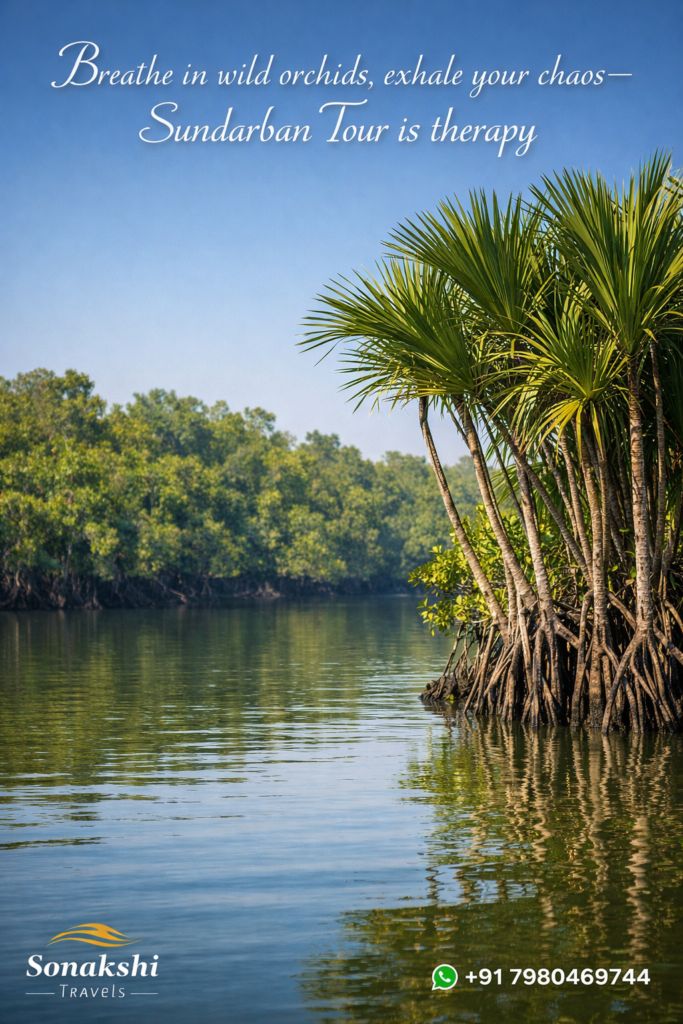
There are places that entertain the eye, and there are places that work more quietly, entering the mind through rhythm, scent, distance, and silence. The Sundarban belongs to the second kind. A Sundarban tour is not merely an excursion through a famous landscape. It is an encounter with a living system whose slowness begins to correct the hurried patterns of the human mind. In a world shaped by notifications, deadlines, noise, and constant self-explanation, the mangrove delta offers another grammar of existence. Water moves without argument. Roots rise without spectacle. Light falls across tidal channels without needing to impress anyone. The traveler, often without realizing it at first, begins to breathe differently.
The title may sound poetic, yet it describes something real. To breathe in wild orchids and exhale chaos is to enter a place where sensation and environment work together upon the nervous system. The Sundarban is not therapeutic because it is luxurious, convenient, or artificially peaceful. Its healing quality comes from a deeper source. It strips experience back to elemental forms—tide, leaf, current, mud, sky, birdcall, stillness, waiting. These are not decorative features. They are structural influences. They reorganize attention. They reduce internal clutter. They remind the traveler that not every meaningful experience must arrive through intensity. Sometimes restoration begins in a quieter register.
Why the Landscape Feels Restorative
The first thing many travelers notice is not drama but release. The eyes stop performing their usual urban labor. They are no longer scanning signboards, screens, traffic, advertisements, or crowded human intention. Instead, they meet long horizontal rivers, softened green margins, suspended reflections, and a horizon that unfolds without pressure. This matters more than it may seem. Research in environmental psychology has repeatedly shown that natural settings reduce cognitive fatigue by engaging attention gently rather than aggressively. The Sundarban does this with unusual precision. Its forms do not assault perception. They absorb it slowly.
That is why a Sundarban tour package, when understood beyond logistics, can become an experience of mental recalibration. The river does not ask for rapid interpretation. The forest does not reveal itself all at once. The landscape invites a mode of seeing that is patient, layered, and receptive. In such a place, the mind is freed from the exhausting duty of constant reaction. Thoughts that were once tangled begin to separate. Feelings that had become dull or overcrowded start returning in clearer forms. One does not “solve” life in the Sundarban. One hears it more accurately.
Even the physical composition of the delta supports this shift. Mangrove environments are transitional zones, neither wholly river nor wholly land. They exist in continuous exchange. Such liminal geographies have long affected human imagination because they resist fixed categories. In the Sundarban, this ambiguity becomes psychologically significant. Many forms of stress arise from rigidity—overdefined roles, overscheduled hours, overcontrolled expectations. But here, nothing remains static for long. Water lifts and withdraws. Mudbanks appear and vanish. Branches lean over mirrored surfaces that seem both solid and liquid. The traveler is reminded, gently, that life itself is tidal. Not everything unstable is dangerous. Some instability is natural, even healing.
The Deep Medicine of Silence
Silence in the Sundarban is not emptiness. It is layered with subtle sound: the light tapping of water against wood, the distant call of birds, the movement of wind through mangrove leaves, the faint crackle of hidden life in the undergrowth, the soft change in engine tone when the boat moves from open river into narrower channels. This kind of silence is profoundly different from the silence of an abandoned room. It is inhabited silence. It allows the nervous system to rest without feeling isolated.
Modern life creates a strange contradiction. People are surrounded by noise yet deprived of meaningful sound. The ears are busy, but the mind remains starved. In the Sundarban, sound regains proportion. Nothing is overamplified. Nothing is competing for emotional dominance. The result is not only peace, but correction. Many travelers arrive carrying internal overstimulation. After some time on the water, they begin to notice that their thoughts no longer collide at the same pace. The body starts trusting the atmosphere. Breathing lengthens. The shoulders descend. Speech becomes less urgent.
This is one reason the Sundarban eco tourism experience, when approached with sensitivity, feels different from more performative forms of travel. It encourages listening rather than consumption. It offers presence rather than spectacle. Its restorative effect comes not from distraction but from re-attunement. In other places, travel may help people forget their stress temporarily. Here, the landscape helps them understand the shape of that stress and gradually loosen its grip.
Wild Orchids and the Psychology of Attention
The image of wild orchids in the title is important because orchids symbolize a certain form of beauty—delicate, precise, and easily missed by a hurried observer. They do not dominate the forest. They reward attentiveness. This is therapeutic in a way that is both emotional and cognitive. To notice a fragile blossom in a vast mangrove environment is to recover a finer quality of perception. It means the mind has slowed enough to register subtlety again.
Stress often narrows awareness. It pushes people into survival patterns of thinking, even when no immediate threat is present. Under chronic strain, life becomes flattened into tasks, pressures, and unfinished loops of concern. A Sundarban travel guide might describe routes, habitats, or ecological features, but the deeper truth is that the place retrains attention. It helps the traveler shift from strained focus to receptive awareness. Instead of forcing experience into a checklist, one begins to notice texture, interval, relation, and pause.
That is where therapeutic value emerges. Healing is not only about comfort. It is also about recovering one’s capacity to notice life with depth. A blossom near the riverbank, a sudden opening in the green, the way evening light travels across tidal water, the way a single birdcall can widen the emotional space of a whole moment—such experiences are small in scale but large in effect. They teach the mind to inhabit the present without pressure.
Rhythm, Repetition, and the Unwinding of Mental Noise
The Sundarban does not move with urban tempo. Its rhythms are cyclical, not mechanical. This distinction matters. Mechanical time demands output. Cyclical time invites participation. A traveler on a Sundarban tourism journey begins to feel this difference almost physically. The river widens and narrows in a sequence that feels less like travel through space and more like entry into a living pulse. Repetition appears everywhere—tide lines, root structures, wave patterns, recurring calls, alternating bands of light and shadow. Instead of becoming monotonous, this repetition stabilizes the mind.
There is increasing research suggesting that patterned natural environments can regulate emotional state by lowering sensory overload and improving attentional recovery. The Sundarban offers this not in abstraction but in lived form. Repeating currents and recurring shapes help loosen mental congestion because they do not demand interpretive crisis. They reassure the mind that continuity still exists. For people who live under constant interruption, such continuity can feel almost medicinal.
This is why even a carefully designed Sundarban luxury private tour can have value beyond exclusivity. Privacy in such a landscape is not merely a premium feature. It can deepen the therapeutic effect by allowing silence and rhythm to remain undisturbed. In a smaller, calmer setting, the traveler does not need to manage the social energies of strangers. The environment can work more directly upon the senses. Stillness becomes more audible. Reflection becomes more available. The forest enters more fully.
The Boat as a Floating Space of Release
Movement on water affects the mind differently from movement on land. On roads, travel is goal-driven. One moves from one fixed point to another. On a river, especially in a tidal forest, movement feels less rigidly directional. It has drift, listening, interval, and suspension. The boat becomes a threshold space—neither the rush of departure nor the finality of arrival. This in-between quality is one reason why the Sundarban often feels emotionally clarifying.
A luxury Sundarban tour or a quieter river journey through the mangroves can create a rare psychological condition: forward motion without mental aggression. The body is traveling, yet the mind is not being pushed. That difference allows inner pressure to soften. Many people live in a state of perpetual anticipatory tension, always leaning toward the next obligation. On the water, that leaning eases. One starts inhabiting duration itself, not merely racing through it.
The river also changes perspective. Problems that felt enclosed within walls and routines begin to seem less absolute when viewed from an open channel bordered by tidal forest. This is not escapism. It is re-scaling. The mind remembers that its current burdens exist within a larger field of life. Such perspective does not erase difficulty, but it can restore proportion, and proportion is one of the foundations of psychological resilience.
Ecology and Emotional Humility
The Sundarban is not therapeutic because it flatters the visitor. In fact, one reason it heals is that it quietly decenters human self-importance. This is a place governed by estuarine logic, saline adaptation, root intelligence, sediment movement, and tidal negotiation. Mangrove trees survive through remarkable biological strategies. Their aerial roots help them breathe in waterlogged soil. Salt management systems allow them to endure difficult conditions. Entire zones of life cooperate with instability rather than resisting it.
To witness such ecological intelligence can affect the traveler ethically as well as emotionally. A Sundarban travel experience often becomes healing because it draws the mind out of self-enclosure. Anxiety tends to make existence feel narrowly personal. But in the Sundarban, one encounters a larger conversation already underway among water, silt, roots, birds, fish, and light. The traveler becomes participant rather than center. That shift can be deeply relieving.
Humility is underrated as a form of emotional medicine. Not humiliation, but humility—the recognition that one need not carry the whole world through constant mental strain. The delta demonstrates another truth: survival need not always look rigid. Adaptation can be supple. Strength can be rooted in responsiveness. Beauty can exist beside danger without becoming false. These lessons are not abstract philosophical ideas imposed upon the place. They arise from direct observation of how the landscape lives.
How Stillness Changes Human Behavior
One of the most striking aspects of the Sundarban is how it alters behavior without demanding formal discipline. People lower their voices. They look longer. They interrupt each other less. They become more willing to sit without immediate entertainment. The body begins mirroring the environment. This is a subtle but important sign that the landscape is not merely being viewed; it is being internalized.
In everyday life, behavior is often shaped by artificial urgency. Speech quickens because time feels scarce. Attention fragments because stimuli multiply. Emotional reactions sharpen because the system is already overused. In the mangrove environment, those habits begin to lose reinforcement. A quiet Sundarban private tour can intensify this effect because the traveler has more space to enter the mood of the place without interruption. The forest does not demand silence as a rule. It evokes it naturally.
This behavioral softening is part of the therapeutic dimension. Healing is not always dramatic. Sometimes it appears as the return of patience, the easing of speech, the willingness to observe before reacting, the rediscovery of restfulness without guilt. These are small behavioral recalibrations, yet they can carry into life after the journey has ended. The true value of the experience is not only what one feels there, but what one brings back in altered habit and clarified perception.
The Emotional Meaning of Distance
Distance in the Sundarban is unlike distance in cities or mountains. It is watery, soft-edged, and mobile. One sees things through atmosphere—an opening in the trees, a bend in the channel, a moving shadow, a line of green dissolving into misted light. This visual character matters because it creates emotional spaciousness. Not everything is immediate. Not everything presses forward demanding definition. The eye is allowed to rest inside uncertainty.
For many people, this is profoundly therapeutic. Modern systems condition individuals to seek instant clarity, instant reply, instant interpretation. But the psyche does not always heal through certainty. Sometimes it heals through spacious ambiguity, through environments that allow experience to remain open for a while. A Sundarban luxury tour package in the deeper experiential sense offers precisely this: not a flood of conclusions, but a widening of inner room.
That widening often makes buried fatigue visible. Many travelers only realize how tired they are when they finally enter a place that does not keep consuming them. The Sundarban holds them differently. It does not take attention by force. It receives attention, and in doing so, it reveals the exhaustion hidden beneath ordinary competence. This recognition can be tender, even sobering, but it is also the beginning of restoration.
Therapy Without Walls
To call the Sundarban therapeutic is not to reduce it to metaphor. Nor does it mean that a journey replaces formal clinical care where such care is needed. Rather, it acknowledges that certain landscapes can create conditions favorable to emotional regulation, reflective clarity, sensory balance, and existential relief. The Sundarban does this with unusual depth because its atmosphere is not manufactured. It is ecological, rhythmic, and alive.
A meaningful Sundarban tour packages experience, especially one shaped around quiet observation rather than hurried activity, can function as a form of environmental therapy. The mind is not treated through instruction alone, but through immersion. The body relearns pace. The senses relearn proportion. Attention relearns tenderness. The traveler does not need to force insight at every step. The place itself gradually performs the work of loosening, slowing, and rebalancing.
In that sense, the title becomes literal in spirit. One breathes in wild orchids—not only as flowers, but as symbols of precise, patient beauty. One exhales chaos—not because life becomes simple, but because the inner atmosphere becomes less crowded. The Sundarban does not cure existence. It does something more realistic and perhaps more valuable. It returns people to themselves in a cleaner state of mind.
What Remains After the Journey
The deepest travel experiences do not end when the traveler leaves. They continue as altered perception. After a serious encounter with the Sundarban, many ordinary things are felt differently: the quality of one’s breathing, the meaning of quiet, the need for pauses, the way attention is spent, the difference between noise and nourishment. This is the true afterlife of the journey. Not photographs alone, not memory alone, but subtle internal change.
That is why the finest understanding of a Sundarban tourism experience is not recreational in the narrow sense. It is restorative, interpretive, and deeply human. The mangrove delta reveals that calm is not laziness, silence is not emptiness, and slowness is not loss. These are capacities. They are part of health. In a fatigued age, to encounter a landscape that teaches them again is no small gift.
So when one says that the Sundarban is therapy, the statement is not decorative. It is observational. The place gives back scale to the overwhelmed mind, softness to the hardened rhythm, and receptivity to the overworked senses. It reminds the traveler that healing can begin in humble ways: a longer breath, a quieter river, a patient horizon, a single blossom noticed at the right time. In that world of tide and root, one does not merely visit nature. One is gently reorganized by it.