Sundarban private tour where silence feels alive
– Enter a forest that whispers to you
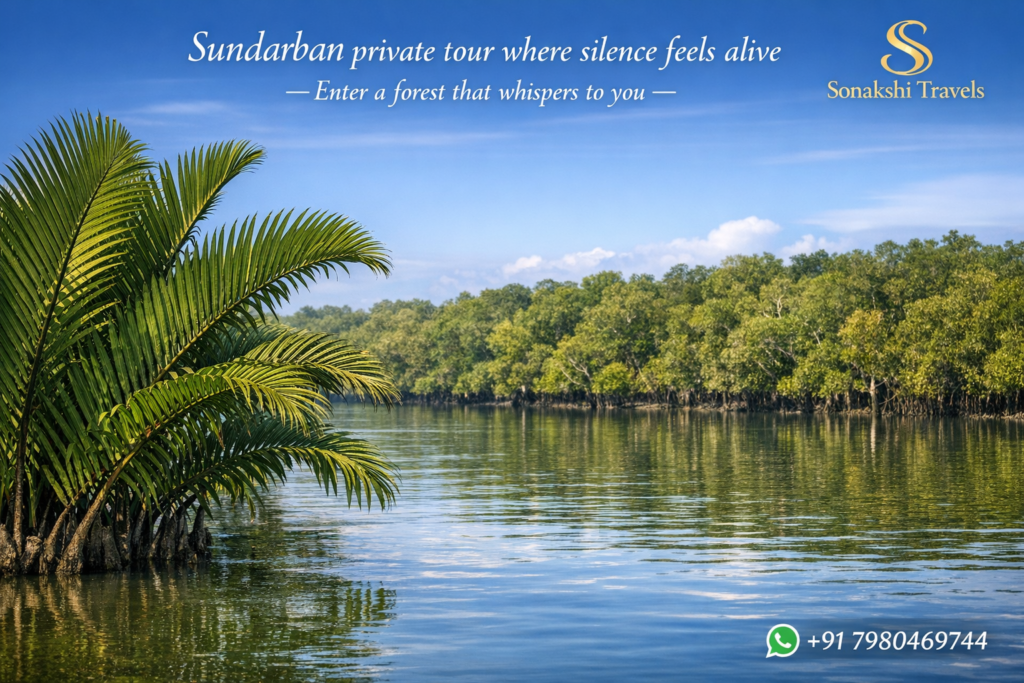
There are landscapes that impress the eye at once, and there are landscapes that work more slowly, entering the mind through rhythm, pause, and suggestion. The Sundarban belongs to the second kind. Its power does not rise from one overwhelming view. It gathers through small movements: the turn of tidal water against a muddy bank, the soft lift of roots from the earth, the sudden break of a birdcall in a field of quiet, and the long intervals in which nothing seems to happen, though everything is changing. That is why a Sundarban private tour can feel unlike any ordinary journey through a forest. It gives silence enough space to become part of the experience rather than merely the absence of noise.
In most places, silence is treated as emptiness. In the Sundarban, silence is active. It presses gently on the senses. It heightens attention. It changes the way the body listens and the way the mind arranges thought. What first appears quiet soon reveals itself as layered sound held in restraint: the faint tapping of water against wood, the dry friction of leaves, the call of unseen birds, the distant lift of wings, and the low murmur of wind moving through mangrove canopies. During a carefully held Sundarban luxury private tour, that restrained soundscape becomes easier to notice because nothing forces the visitor to divide attention between crowd, hurry, and distraction.
Why Silence Feels Different in the Sundarban
The quiet of the Sundarban is not the quiet of an empty place. It is the quiet of a living place organized by water, sediment, salinity, tide, and adaptation. Mangrove forests are among the most dynamic ecological systems in the world. The land is never entirely stable, and the line between water and earth is always under revision. This gives the landscape a strange emotional quality. One never feels fully on solid ground, even when standing still. The senses remain alert because the environment itself seems to be listening back.
That is why the silence here feels alive. It is structured by biological activity. Crabs work under the mud. Fish move through tidal creeks. Birds respond to hidden shifts in prey and water level. Roots breathe upward from oxygen-poor soil. The forest does not announce these processes through spectacle. It lets them gather quietly until the visitor begins to feel them. A thoughtful Sundarban tour may reveal this quality, but a private setting often sharpens it further because the pace of attention becomes more intimate and less interrupted.
Researchers who study human response to natural soundscapes often note that restrained natural environments can reduce cognitive fatigue and restore attention more effectively than chaotic ones. The Sundarban offers a powerful example of that principle. Its silence is not blank. It is patterned, and the mind responds to pattern. The repeated motions of tide, current, root, reed, and wing do not overwhelm the senses. They recalibrate them. On a Sundarban travel experience shaped around close observation rather than constant talking, that recalibration becomes one of the deepest rewards of the journey.
A Forest That Speaks Through Rhythm, Not Volume
Many forests are understood through density. The Sundarban is understood through intervals. Open river channels create distance. Mudflats create pause. The broken geometry of roots creates visual rhythm. Water enters and withdraws. Sound rises and falls. Nothing remains fixed long enough to become static. For that reason, the forest seems less like a scene and more like a slow conversation. It does not speak loudly. It speaks repeatedly.
During a Sundarban luxury tour, especially one arranged with privacy and patience, these repetitions become meaningful. A birdcall heard once may be pleasant; a birdcall heard within silence, then answered by another, then followed by the ripple of movement in the creek, begins to feel like part of a structure. The visitor starts to understand that the environment is organized by relationships rather than isolated events. Sound belongs to water. Water belongs to tide. Tide belongs to moon, channel, soil, and season. Even when one does not consciously map these forces, one feels their order.
This is part of the psychological force of a Sundarban travel experience centered on quiet. The environment seems to train perception. The eyes become more patient. The ears become more selective. The mind becomes less eager to dominate the scene with commentary. In ordinary life, silence can feel uncomfortable because it exposes restlessness. In the Sundarban, silence begins to soften that restlessness by giving it somewhere to settle.
The Importance of Tidal Sound
No understanding of this landscape is complete without attention to water. Tidal sound in the Sundarban is subtle, but it shapes the entire emotional register of the place. Water does not crash here in the dramatic manner of sea-facing coasts. It shifts, folds, touches, loosens, withdraws, and returns. That softer vocabulary matters. Because the sound is restrained, the listener leans inward. One does not merely hear it; one notices it. The result is an experience closer to listening than to hearing.
That is also why a private Sundarban river cruise can feel unusually immersive. When the setting is calm and the movement unhurried, the small contact between current and boat hull becomes part of the forest’s voice. One begins to sense that silence in the Sundarban is never the removal of sound. It is the careful spacing of sound, so that each note arrives with clarity.
How Privacy Changes the Emotional Texture of the Journey
Privacy matters in a landscape like this because the forest works through subtlety. A crowded setting encourages social attention. A private setting encourages environmental attention. On an Sundarban private tour package, the traveler is more likely to notice the finer gradations of the place: how light settles differently on still water than on moving water, how exposed roots create repeating shadows, how a distant call can change the feeling of an entire stretch of river, and how silence itself becomes less external and more internal as the journey deepens.
This does not simply make the journey peaceful. It makes it interpretive. The visitor no longer moves through the forest as a spectator alone. The visitor begins to receive mood, pressure, rhythm, and atmosphere. The same river bend can appear solemn in one hour, meditative in another, and almost theatrical when light and sound combine in a new way. A Sundarban personalized travel package or Sundarban customized private tour may be valued for comfort and control, but its deeper worth lies in attention. It gives enough room for the environment to speak in its own scale.
In a private setting, even conversation changes. People speak more quietly. Pauses lengthen naturally. Thought becomes less performative. The mind stops trying to consume the landscape and starts letting the landscape set the terms of engagement. This is one reason a Sundarban couple private tour or Sundarban family private tour can take on emotional depth beyond recreation. Shared quiet in a place like this often reveals more than constant speech ever could.
The Ecology of Whispering Space
The phrase “a forest that whispers” is not merely poetic when applied to the Sundarban. Mangrove ecology creates exactly the kind of restrained environment in which whisper-like perception becomes possible. Unlike forests dominated by heavy undergrowth and enclosed interior darkness, the Sundarban often opens itself through creeks, edges, riverbanks, and low tidal margins. These edges matter. Ecologists frequently treat edge environments as highly active zones because they bring different systems into contact. In the Sundarban, water meets mud, mud meets root, root meets air, and air carries subtle biological signals across open space.
This structure shapes the way sound travels. It also shapes the way animals behave. Many species in mangrove systems rely on alertness, concealment, timing, and pattern recognition. The forest teaches caution because visibility is partial and movement is often indirect. That behavioral atmosphere reaches the human visitor as well. During a Sundarban private wildlife safari or Sundarban private safari tour, one senses quickly that dramatic noise would feel out of place. The ecology itself encourages restraint.
Because mangrove forests are adapted to saline, unstable, and oxygen-poor conditions, their visual language is one of persistence rather than abundance in the ordinary sense. Breathing roots, layered sediment, and tidal lines all suggest a world built through survival. This gives the silence an ethical dimension. The quiet here is not decorative. It belongs to a system of hard adaptation. To enter it attentively is to recognize forms of life that have developed not by dominating instability, but by learning how to live within it.
For that reason, a well-conceived Sundarban eco tourism perspective is not separate from the emotional power of the place. Ecological understanding deepens atmosphere. When one knows that the roots are breathing because the soil below cannot easily supply oxygen, the image changes. When one understands that tidal movement carries nutrients, alters habitat, and shapes behavior, the river no longer appears as background scenery. It becomes the organizing force behind the whispering quality of the forest.
Silence as a Form of Ecological Respect
There is also a moral intelligence in being quiet here. Loudness in fragile landscapes often reflects a failure to perceive. The Sundarban rewards the opposite. Silence becomes a form of respect because it aligns the visitor with the scale of the place. A refined private Sundarban eco tour or Sundarban nature tour is not only about reduced noise from people. It is about accepting that the forest does not need to be conquered by voice in order to be meaningful.
This is where the difference between ordinary movement and attentive movement becomes visible. To move quietly is to let birds resume their patterns, to let water sounds remain legible, and to let one’s own mind become less intrusive. The forest then seems to answer, not through miracle or fantasy, but through access. More becomes perceptible because less is imposed.
The Psychological Effect of a Living Quiet
Modern life trains the mind toward interruption. Notifications, traffic, crowd noise, and constant decision-making create a condition in which attention is repeatedly broken and rarely restored. The Sundarban offers another model of mental experience. Here, attention extends. It settles on one line of water, one cluster of roots, one shift of bird movement, one changing band of light. The mind ceases to chase novelty and begins to dwell.
That dwelling has emotional consequences. Many travelers describe calm as if it were merely relaxation, but the calm produced by a silent forest is more exacting than that. It first exposes agitation. One becomes aware of how quickly the mind wants to fill space with thought. Then, gradually, the environment retrains that impulse. Repetition and subtle movement provide enough stimulus to hold awareness without scattering it. A carefully paced Sundarban private boat tour or Sundarban private mangrove cruise can therefore feel restorative not because nothing is happening, but because the right kind of happening is taking place.
There is also a distinct emotional humility in this setting. The visitor is not the center of the scene. The river does not pause for the traveler. The birds do not perform for the observer. The forest continues according to its own order. Strange as it may seem, that loss of centrality can feel relieving. One no longer has to command the environment. One can simply enter it. In that sense, a private journey through these waters often becomes less about escape and more about realignment.
This is one reason the finest forms of Sundarban tourism are those that understand atmosphere, restraint, and observation as serious values rather than decorative ones. The Sundarban is not memorable because it is loud, immediate, or easily summarized. It is memorable because it rearranges the scale at which feeling operates.
What the Forest Seems to Say
When people say the Sundarban whispers, they are often trying to describe a sensation that lies between perception and interpretation. The forest does not literally speak, yet the visitor often feels addressed. A certain bend of river may carry an unexpected solemnity. A stretch of roots under angled light may seem almost script-like, as if the landscape were writing something too old for direct language. A silence after bird movement may feel charged with meaning though no definite message can be extracted. This is not illusion. It is the human mind responding to an environment rich in pattern but poor in obvious declaration.
That is why a Sundarban tailor-made tour devoted to quiet experience can leave such a lasting impression. The memory does not remain as one fixed image alone. It remains as tonal recall: a soft current, a suspended pause, a field of mud marked by roots, a call across distance, a sense of being inside something alert and self-contained. The forest seems to whisper because it never wastes sound. Each small sign gains weight against the surrounding stillness.
Even the visual field reinforces this impression. Mangrove roots rise like gestures. Channels narrow and open without theatrical warning. Reflections break gently and reform. Nothing in the landscape looks careless. The result is a rare union of ecological structure and emotional suggestion. What one feels in the silence is not emptiness but intention, though the intention belongs to the system, not to the traveler.
Entering the Whisper Rather Than Observing It
The deepest experience of the Sundarban begins when the visitor stops treating the forest as an object and starts receiving it as an environment of relation. To observe from a distance is useful, but to enter the cadence of the place is different. That entry requires time, privacy, and restraint. It asks the traveler to accept incompleteness, to notice rather than collect, and to listen without demanding immediate revelation.
A serious Sundarban private luxury boat setting may provide comfort, but the real privilege is not softness or service alone. It is the privilege of unbroken attention. In a landscape where silence feels alive, uninterrupted perception becomes a rare form of wealth. One can sit long enough to hear the grammar of water. One can watch long enough to understand that the forest speaks through recurrence. One can be still long enough to sense that the whisper is not outside alone. It has begun to alter the rhythm of thought within.
That is the lasting meaning of a Sundarban private tour shaped around listening. It is not simply a journey through mangrove channels. It is an encounter with a landscape that teaches another mode of attention. The forest does not ask for admiration first. It asks for quiet. Once that quiet is granted, the rivers, roots, shadows, and distant calls begin to gather into one of the most unusual forms of presence found anywhere in the natural world. The Sundarban then ceases to be only a destination. It becomes a living field of silence in which the visitor discovers that stillness, properly entered, is never empty. It is full of voice.