Sundarban private tour when the forest listens
– Experience silence full of life
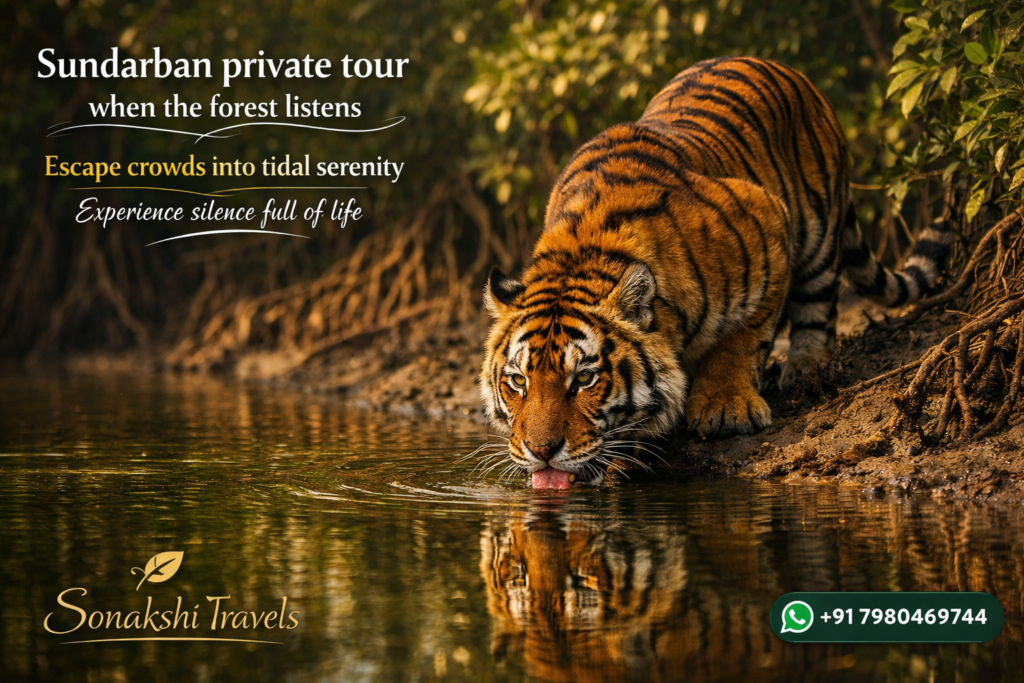
There are landscapes that speak through abundance, and there are landscapes that speak through restraint. The Sundarban belongs to the second kind. Its deepest impressions are not always formed by spectacle, noise, or sudden revelation. They are formed by intervals, by distance, by suspended attention, and by the strange fullness of silence. That is why a Sundarban private tour feels different from an ordinary outing into a scenic place. Privacy changes perception. It removes the pressure of crowd rhythm and allows the traveler to notice what the delta is actually doing. In that quieter condition, one begins to understand that the forest is never empty. It is listening, adjusting, receiving, and responding through countless subtle forms of life.
In the tidal mangrove world, silence does not mean absence. It means concentration. The river does not shout, yet it shifts. The banks do not move dramatically, yet they are always being shaped. Leaves barely tremble, roots stand partly exposed, light enters in fragments, and the horizon remains unstable because water and land are continually negotiating with one another. A private journey makes this more legible. The mind is less crowded, conversation becomes more deliberate, and sensory awareness grows sharper. What first appears quiet slowly reveals itself as layered with bird calls, insect vibration, distant wing movement, current pressure against the boat, and the low organic sounds of a living estuarine system.
That is the special strength of a Sundarban private tour package shaped around observation rather than interruption. Such an experience is not valuable because it isolates the traveler from the landscape. It is valuable because it reduces interference and restores proportion. The forest can then be encountered on its own terms. Instead of rushing toward a checklist, one begins to notice texture, timing, and relation. Mud is no longer just mud. It becomes a record of retreating tide, animal passage, root adaptation, and nutrient exchange. Silence is no longer just quiet. It becomes the medium through which the life of the delta can be heard.
Silence in the Sundarban Is a Form of Knowledge
Many travelers enter wilderness expecting movement to prove vitality. They look for the obvious sign, the dramatic appearance, the visible event that confirms that nature is present. The Sundarban teaches a more difficult lesson. Here, life often reveals itself indirectly. A patch of disturbed bank, a sudden arc of birds above a creek, a brief pause in surrounding sound, or the concentrated attention of a local boatman may all indicate that the environment is active in ways that are not immediately visible. This is why silence in the delta has interpretive value. It asks the observer to think relationally rather than superficially.
On a private journey, one has the rare opportunity to remain with a place long enough for its signals to become meaningful. The eye adjusts to repetition. The ear becomes less distracted. The body relaxes into the pace of the water. A Sundarban luxury private tour can be especially powerful when it is designed not around excess, but around composure. Comfort matters because it stabilizes attention. When the traveler is not hurried, crowded, or overstimulated, the mind becomes more capable of reading small changes in the environment. The result is not a louder experience, but a deeper one.
This quiet mode of travel also reveals something ecologically important. Mangrove ecosystems are built on balance, repetition, and adaptation. They do not exist in static peace, but in dynamic tension. Salinity, sediment, tidal flow, root respiration, and seasonal biological movement all interact within fragile limits. The apparent calm of the forest contains ongoing labor. Trees survive by specialized structures. Aquatic and terrestrial species share shifting margins. Birds feed according to subtle timing. Predators and prey move through a landscape that is partly concealed by design. To encounter such a world properly requires patience, and patience is one of the first gifts of privacy.
Why Privacy Changes the Experience of the Delta
A group journey often creates its own emotional weather. People talk over silence. Anticipation becomes collective. Attention is pulled outward and scattered. On a Sundarban private boat tour, the opposite can happen. The river becomes the dominant rhythm. Time lengthens. Conversation becomes responsive to the place rather than protective against it. This does not make the experience less social or less warm. It makes it more truthful. The delta is not a stage built for noise. It is a living field of relationships where stillness sharpens understanding.
The value of privacy in such a setting is psychological as much as practical. Human attention functions differently in reduced-noise environments. Research across environmental psychology has repeatedly shown that quieter natural settings improve concentration, deepen reflective awareness, and strengthen the sense of restoration. In a place like the Sundarban, these effects are intensified by uncertainty. Because the landscape is partly hidden and continually changing, the mind cannot dominate it easily. It must remain alert, receptive, and humble. A private tour supports this state by allowing each traveler to encounter the environment without constant disruption.
This is also why an exclusive Sundarban private tour feels less like consumption and more like participation. One does not simply look at the forest. One enters its listening field. The experience becomes dialogic, though not in any sentimental sense. The forest does not speak in language, yet it shapes mood, pace, and expectation. It asks for restraint. It rewards perception. It reveals life gradually, through rhythm rather than display. In that sense, privacy is not luxury alone. It is a method of seeing.
Movement Here Is Slow Because Meaning Is Slow
The most memorable moments in the Sundarban are often those in which almost nothing appears to happen. The boat drifts past a bank lined with roots like exposed script. The water carries reflected fragments of green and brown. Somewhere beyond sight, a bird gives a brief call. A branch holds still, then shifts slightly. Such moments resist ordinary travel language because they are not event-centered. Yet they are central to the feeling of the place. The silence is not blank. It is charged with potential. It holds animal caution, tidal memory, vegetal endurance, and human expectation in a single suspended atmosphere.
A well-conceived private Sundarban river cruise allows the traveler to remain inside these intervals instead of constantly moving beyond them. The difference is not trivial. To rush through the delta is to misread it. The environment is built from thresholds: fresh and saline, land and water, concealment and revelation, nearness and distance. Its meanings accumulate slowly because its forms are transitional. The boat does not merely transport the visitor through scenery. It becomes a floating observatory from which silence itself can be studied as a living ecological condition.
Even the body begins to adjust. Breathing slows. Speech becomes selective. The eye stops demanding climax and begins accepting subtlety. This change matters because it restores an older human capacity: the ability to attend without immediate possession. In many landscapes, tourism encourages extraction of image, memory, and proof. In the Sundarban, especially within a Sundarban personalized travel package, the more meaningful experience comes from remaining present without forcing the landscape to perform. One learns to notice how much life exists precisely beyond the threshold of certainty.
The Forest Is Full of Signals That Reward Attention
Sound That Arrives in Fragments
Sound in the Sundarban behaves differently from sound in an open forest or urban edge. It does not build continuously. It appears in fragments, separated by water, softened by vegetation, and altered by humidity. A bird note may seem near and then vanish. The splash of aquatic movement may carry farther than expected. The rustle of leaves may be produced by breeze, by hidden life, or by the subtle friction of the environment settling into a new tidal phase. In silence, each sound becomes legible because it is isolated. On a crowded route, such distinctions often disappear into social noise.
This is why a Sundarban private wildlife safari can feel intellectually richer than a louder excursion. The goal is not merely to spot life, but to interpret signs of life. The difference between hearing and listening becomes essential. Hearing is passive. Listening is relational. It involves direction, timing, interval, and context. The private traveler has a better chance to remain inside that interpretive mode. The forest, in turn, becomes less opaque.
Light That Reveals Without Explaining Everything
Light in the mangrove environment is highly selective. It filters through foliage, reflects from water, strikes wet mud, and withdraws behind sudden turns in the creek. Rarely does it illuminate everything evenly. This unevenness contributes to the emotional intelligence of the place. Certain areas glow while others remain withheld. Such visual incompleteness encourages careful observation. It prevents the eye from assuming mastery. On a Sundarban private mangrove cruise, one has time to understand how light creates not just beauty, but ecological readability. It reveals moisture, texture, contour, and depth. It also protects mystery, which is part of the delta’s truth.
Stillness That Conceals Activity
The Sundarban often appears motionless from a distance. Yet this stillness is deceptive. Tidal exchange continues below the surface. Crabs work in the mud. Insects move through air layers invisible at first glance. Birds watch from branches that seem empty. Root systems breathe through structures evolved for a difficult saline environment. A private Sundarban eco tour makes such realities easier to notice because the traveler is not compelled to chase only the spectacular. The ecological drama here is often microscopic, rhythmic, and dispersed across the scene.
Emotional Depth in a Landscape That Refuses Hurry
There is also a human reason why silence in the Sundarban feels so memorable. Modern life conditions people to treat quiet as emptiness to be filled. In the delta, that habit weakens. Quiet becomes substantial. It holds weight. It encourages inward rearrangement. Many travelers discover that the most striking aspect of a private journey is not what they say about the forest while they are there, but what the forest causes them to stop saying. Unnecessary speech drops away. Attention becomes less performative. One begins to register the emotional force of patience.
A Sundarban couple private tour or Sundarban family private tour can therefore become meaningful in ways beyond sightseeing. Shared silence is rare. In daily life, relationships are often structured by duty, explanation, and interruption. In the mangrove world, people may find themselves sitting together without needing to fill every interval. The forest offers a common field of attention. That alone can change the quality of togetherness. Silence, in such a setting, does not separate people. It refines their presence.
The same is true for the solitary traveler or the reflective observer. A Sundarban customized private tour centered on pace and perception can create a rare mental condition in which thought is both calm and alert. The river carries the body, the forest steadies the senses, and the uncertainty of what may or may not appear keeps awareness awake. This combination of calm and vigilance is one of the deepest signatures of the Sundarban experience.
Research, Ecology, and the Meaning of Living Silence
From an ecological perspective, the idea that silence is full of life is not poetic exaggeration. Mangrove systems are among the most productive transitional ecosystems in the world. Their energy is distributed through layered interactions rather than obvious display. Detritus feeds aquatic food webs. Root structures stabilize sediment and create habitat. Birdlife responds to feeding opportunities structured by tide and micro-topography. Reptiles, fish, crustaceans, insects, and mammals all occupy different niches across a constantly shifting matrix. Because much of this activity is concealed, the landscape can appear calm while functioning intensely.
Understanding this deepens the experience of a Sundarban private safari tour. The traveler is not merely moving through a quiet place. They are moving through a densely interactive environment whose life processes are often hidden by water, mud, vegetation, and distance. That hiddenness is not a lack. It is a defining structure of the ecosystem. The private mode of travel, by reducing noise and rush, is uniquely suited to honoring that structure.
Even the idea of luxury acquires a different meaning here. In many settings, luxury implies abundance of visible comfort. In the delta, a more intelligent form of luxury may be the protection of attention itself. A thoughtfully arranged Sundarban luxury tour or Sundarban luxury tour package allows the traveler to encounter the forest without needless friction, yet without drowning the experience in noise, decoration, or haste. Comfort supports stillness; stillness supports perception; perception reveals life. This sequence is central to the truth of the place.
When the Forest Listens, the Traveler Learns to Listen Too
To say that the forest listens is to acknowledge that the Sundarban responds to behavior. Noise alters encounter. Hurry reduces understanding. Restlessness blinds the eye to gradual revelation. The traveler who enters quietly receives a different experience from the one who demands immediate proof. This is not mysticism. It is the practical reality of a sensitive ecosystem whose forms of life often depend on distance, caution, and concealment.
That is why a private experience in the delta can remain in memory with unusual force. It is not only because the landscape is beautiful, though it is. It is because the landscape teaches a mode of attention that many people have nearly lost. In the silence of the Sundarban, one begins to notice that life is not always loud, and meaning is not always announced. Sometimes it waits in the bend of a creek, in the reflective skin of tidal water, in the patient geometry of mangrove roots, or in the brief call of a bird that disappears before the eye can locate it.
Those who seek such depth often find that a well-shaped Sundarban luxury private tour is not simply a premium variation of travel, but a more accurate way of entering this environment. It offers room for quiet, time for perception, and freedom from the crowd’s emotional pressure. Through that quiet, the forest ceases to seem remote. It becomes intimate without becoming tame. It remains mysterious, yet no longer unreadable.
In the end, the greatest gift of a Sundarban private tour is not the claim that one has seen everything. No honest traveler can say that in the Sundarban. Its deeper gift is the opposite: the realization that one does not need to dominate a landscape in order to receive it. One needs patience, humility, and the willingness to listen. Then the silence changes. It becomes inhabited, expressive, and unmistakably alive. In that living silence, the forest does not merely stand before you. It seems to recognize your presence, measure your pace, and reveal itself just enough to make you understand that the richest forms of life are often the quietest.
For this reason, even those familiar with broader Sundarban travel or a classic Sundarban tour often discover that privacy transforms the inner meaning of the delta. The change is not a matter of status. It is a matter of fidelity to place. The Sundarban is a landscape of withheld abundance. It reveals its truth most fully to those who arrive with enough quiet to perceive that its silence has never been empty at all.