Updated Date: 19 February 2026
In Fog-Veiled Hush and Birdwing Blur
—Truth Whispers Low on a Sundarban Tour
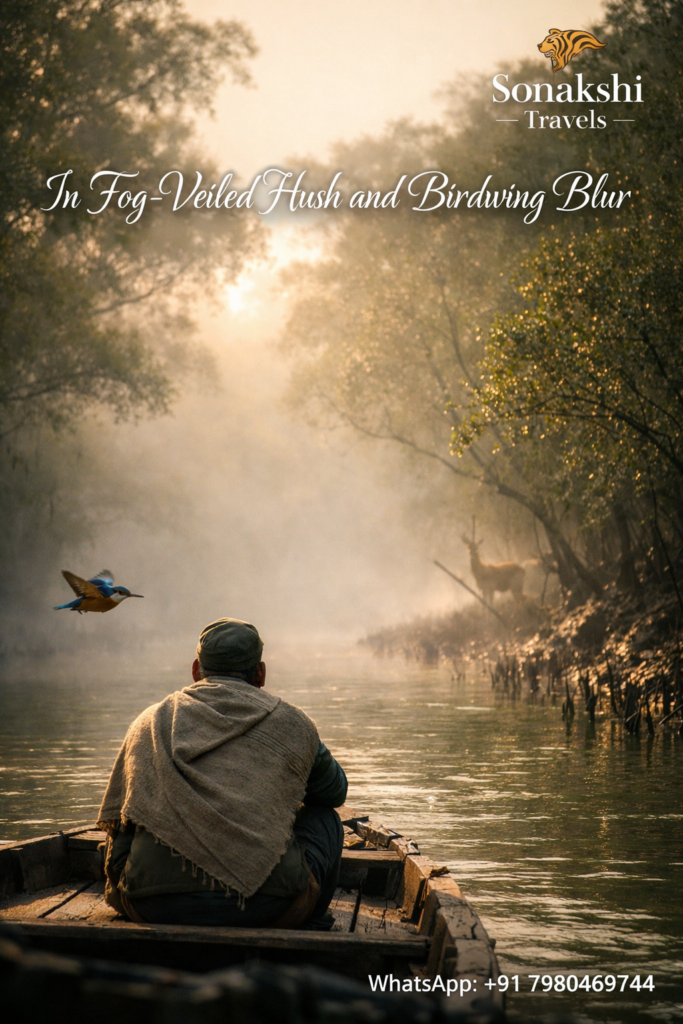
There are landscapes that impress the eye, and there are landscapes that recalibrate the inner ear. The mangrove wilderness does the latter. In the half-light of dawn, when mist settles low over tidal creeks and the horizon dissolves into pale silver, the world seems to withdraw from spectacle. Sound softens. Movement slows. Even thought appears to lower its volume. In that suspended hour, the understanding shaped by Sundarban Travel Agency is not merely geographic; it is an encounter with quiet authority.
The hush is not emptiness. It is density—of moisture, of roots, of unseen presence. Birds cross the fog in fleeting silhouettes. Wings do not merely beat; they brush the air like deliberate strokes on a canvas that erases itself each second. The experience resists capture because it is built on impermanence. Truth, here, does not announce itself in grand vistas. It arrives as a murmur carried on tide-breath and reed-rustle.
The Architecture of Silence
Silence in the mangroves is not accidental. It is structural. The interlaced roots rise like rib cages from the mud, filtering salt, stabilising silt, moderating current. This living architecture dampens both sound and motion. Water enters creeks with patience, not force. Wind threads through leaves rather than tearing at them. The ecosystem is designed to absorb disturbance, and the traveller becomes a witness to how restraint can be a form of strength.
Scientific studies of mangrove habitats describe their capacity to reduce wave energy and buffer coastlines. What those studies also imply—though rarely state outright—is the psychological effect of such buffering. When external turbulence is absorbed, the human nervous system begins to mirror that steadiness. Heart rate slows. Breath deepens. Attention lengthens. The forest becomes not only a physical shield, but a cognitive one, and the experience begins to resemble the contemplative pace many associate with a carefully planned guided mangrove journey.
Fog as Veil and Teacher
Morning fog in the delta is more than a meteorological condition; it is a lens. Vision narrows. Distances collapse. Forms simplify into gradients of grey and green. In urban spaces, clarity is prized. In the mangroves, partial obscurity sharpens perception. When you cannot rely on sight alone, you listen. You feel. You anticipate.
Neuroscientific research suggests that environments with reduced sensory overload encourage deeper focus and introspection. Fog performs precisely this function. It removes excess detail and invites inward orientation. The mind, relieved of constant visual demand, begins to notice subtler patterns—the rhythm of water against wood, the faint click of a crab beneath mud, the measured whisper of leaves exchanging salt-laden air. In such conditions, the simplest choices—where to look, when to pause, how quietly to move—become part of the experience, much as they do on a well-paced river-led mangrove excursion.
Birdwing Blur and the Discipline of Attention
Birdlife in the mangroves does not pose. It appears in fragments. A flash of rust and white from a kingfisher. The broad, deliberate arc of a kite riding thermal lift. A heron, poised like a thought about to form. Each sighting is brief, contingent on stillness and timing.
This transience demands disciplined attention. The observer must relinquish distraction. In a culture conditioned by screens and scrolls, such discipline feels almost radical. Yet the ecology insists upon it. Blink, and the moment dissolves into foliage. Hesitate, and the call fades into wind. The lesson is not simply that nature is quick; it is that meaning often arrives as an interval, and only a quiet mind can recognise it.
Ephemeral Beauty and Cognitive Shift
Psychologists describe “awe” as an emotion triggered by perceptual vastness and the need to adjust mental frameworks. In the mangrove creeks, awe does not arise from scale alone, but from delicacy. The smallness of each encounter—bird, ripple, shadow—contrasts with the depth of its impact. This recalibration of scale fosters humility. The self contracts; awareness expands.
Such shifts are not sentimental. They are measurable. Studies on exposure to complex natural systems demonstrate improved cognitive flexibility and reduced rumination. The mangroves, with their layered canopies and interdependent species, provide precisely this complexity. The “birdwing blur” becomes an instrument for retraining perception: it teaches the mind to remain present without demanding certainty, a discipline often deepened in quieter settings such as a single-day package on the water.
The Felt Presence of the Unseen
Not every truth in the delta is visible. The forest carries the suggestion of predators, of hidden movement beneath opaque water, of life continuing beyond the reach of human sight. Even without direct encounter, this felt presence alters behaviour. Voices lower. Gestures soften. The body adopts a careful economy.
This is not fear in its crude form. It is awareness sharpened by respect. The knowledge that one is not apex here, that another rhythm governs the territory, instils a reverence rarely experienced in managed landscapes. The unseen becomes teacher. Silence becomes protocol. When travel is designed to preserve this protocol—fewer interruptions, more stillness—the experience often aligns with the expectations of those who prefer a private, low-disruption exploration that protects the integrity of the hush.
Reverence as Environmental Literacy
Environmental scholars often argue that meaningful conservation begins with emotional connection. In the mangroves, connection is forged through vulnerability. The realisation that human control is limited fosters humility. That humility, in turn, deepens ecological literacy. The visitor begins to interpret signs: a broken reed, a sudden flight of birds, the stillness of water at slack tide.
Such literacy is experiential, not theoretical. It is acquired through immersion in the hush where truth whispers rather than lectures. Over time, the traveller recognises that the forest rewards restraint: the quieter the approach, the more the landscape reveals itself—not through spectacle, but through coherence.
Dusk and the Alchemy of Light
As daylight recedes, the delta transforms without spectacle. Gold bleeds into copper. Silhouettes sharpen against a sky that appears both close and infinite. The river becomes mirror and threshold. Sound shifts from avian calls to the low percussion of insects.
Dusk is a transitional hour, and transitions are inherently reflective. Anthropologists note that liminal spaces—those between defined states—often prompt introspection. Evening in the mangroves functions precisely as such a space. Neither day nor night, it suspends certainty. The mind, released from temporal urgency, drifts toward contemplation. In this softening light, even comfort can feel like a form of discipline, which is why travellers often describe an understated refinement—of pace, of silence, of intent—when they seek a luxury-oriented private journey that prioritises serenity over stimulation.
Night and the Restoration of Scale
In darkness, artificial illumination recedes. The sky asserts its depth. Stars appear not as distant decoration, but as immediate presence. Without urban glow to obscure them, they seem nearer, almost tactile. This restoration of celestial scale alters perspective. Personal concerns diminish against cosmic continuity.
Sleep in such an environment is textured by ambient sound—the steady hum of insects, the occasional splash against hull, the breath of wind through leaves. These rhythms regulate rather than disrupt. The body aligns with external cadence. Rest becomes participatory rather than imposed, and the mind learns that calm is not the absence of life, but life in balance.
The Human Current: Lives Shaped by Tide
Within this landscape of hush live communities whose daily existence is synchronised with water. Conversations are measured. Movements are efficient. There is little space for excess when survival depends on reading tide and terrain accurately.
Observing these rhythms reveals another layer of whispered truth: resilience without dramatization. The fisher’s oar slicing morning surface, the patient mending of nets, the quiet exchange of stories at river’s edge—each gesture reflects adaptation rather than conquest. The delta does not permit careless certainty; it educates through repetition, discipline, and restraint.
Work as Dialogue with Water
Fishing here is negotiation. It requires timing aligned with lunar cycles and tidal shifts. Honey collection, undertaken in forest depths, demands ritual as much as skill. These practices illustrate an embedded knowledge system passed through generations. The delta is not backdrop; it is collaborator.
Such collaboration underscores the central theme: truth whispered through participation rather than dominance. The landscape does not yield to force. It responds to listening. The traveller who learns this does not merely observe local life; they begin to understand that the ecosystem’s quiet is not passive, but maintained through continuous, careful relationship.
Inner Silence and Psychological Realignment
Extended exposure to the mangrove hush initiates a subtle internal recalibration. Thoughts, initially crowded and urgent, begin to space themselves. The constant internal commentary characteristic of urban life loses intensity. In its place emerges attentive stillness.
Clinical research on restorative environments suggests that immersion in complex natural systems enhances emotional regulation and decreases stress biomarkers. The mangroves provide a particularly potent example due to their layered sensory field—visual texture, rhythmic sound, tactile humidity. The mind, engaged yet unpressured, finds equilibrium. What feels like quiet on the surface is, in practice, a systematic reordering of attention.
Clarity without Escapism
The clarity that arises in this environment is not escapist fantasy. It is grounded awareness. Returning from the delta does not erase obligations or responsibilities. Rather, it reframes them. The visitor carries back a recalibrated sense of proportion, informed by hours spent in fog-veiled hush where urgency held no authority.
This is the transformation embedded within the phrase “truth whispers low.” It suggests that insight does not require volume. It requires presence. The mind learns to separate what is loud from what is important—an ability that often outlasts the journey itself.
The Enduring Echo
Long after departure, fragments persist: the muted glow of dusk on water, the blurred arc of a kite overhead, the quiet steadiness of mangrove roots gripping mud. These impressions resurface unexpectedly—in moments of stress, in pauses between tasks, in the brief silence before sleep.
The memory functions as internal refuge. Not to avoid reality, but to anchor it. The delta’s whisper becomes a reference point against which noise is measured and often found excessive.
In fog-veiled hush and birdwing blur, the wilderness does not overwhelm. It invites. It lowers its voice until only the attentive can hear. Those who accept the invitation discover that a Sundarban tour is not defined by spectacle, but by subtlety. The truth it offers is neither grand nor dramatic. It is steady, patient, and profound.
Let the fog narrow your vision until it sharpens your listening. Let the tide slow your pulse until it steadies your thought. In the hush of the mangroves, truth does not shout—it endures.