Updated: March 11, 2026
In the Heart of Tangled Roots and Roaring Silence, the Adventure of a Sundarban Tour Unfolds
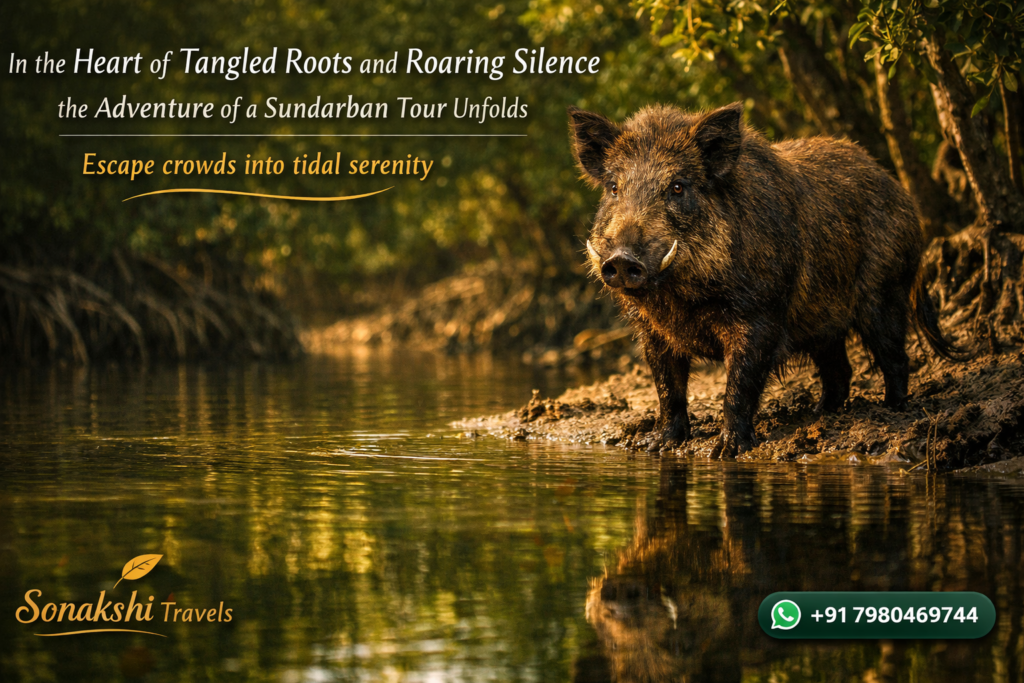
There are landscapes that impress through height, color, or immediate spectacle. Then there are landscapes that work through patience. The Sundarban belongs to the second kind. Its power does not arrive in one dramatic instant. It gathers itself slowly, through tidal movement, exposed mud, mangrove shadow, birdcall, stillness, and the strange force of silence that never feels empty. That is why a Sundarban tour is best understood not as a checklist of sights, but as a gradual unfolding of attention. The adventure here is not separate from quiet. It grows inside quiet.
In this forested delta, roots rise from the earth like breath held in suspense. Water folds around islands and returns again under a different light. Channels appear broad and then suddenly intimate. Banks that seem still reveal the marks of crabs, birds, and reptiles. The traveler is compelled to look carefully, then more carefully still. That act of looking becomes the beginning of transformation. What appears at first to be only river and vegetation slowly reveals a complete living system of tension, adaptation, concealment, and rhythm. The experience becomes deeper than scenery. It becomes an education in how wilderness sustains mystery.
Adventure Begins Where Noise Ends
The most striking quality of this landscape is that adventure does not announce itself loudly. In many places, excitement is staged through speed, height, or crowd energy. Here, it is built from alertness. The traveler moves through stretches of water where the surface may appear calm, yet every edge suggests hidden activity. Mudbanks hold prints. Branches carry movement so slight that only a trained eye notices it. Air changes temperature above shaded water. The silence itself feels structured, as though it contains instructions. This is why the adventure of the Sundarban cannot be reduced to ordinary travel language. It depends on perception.
To travel through this ecosystem is to enter a world where visibility is limited but awareness is heightened. Mangrove walls do not reveal everything. They interrupt the line of sight and force the mind to listen. A splash in the water, a sudden wingbeat, the distant cry of a bird, or the subtle shift of current against the boat all acquire meaning. The traveler does not conquer this environment. The traveler learns how to receive it. In that sense, the region offers one of the most intelligent forms of wilderness experience found in South Asia, where caution and wonder coexist in equal measure.
This is where Sundarban travel acquires its singular character. It is not merely movement through place. It is movement through uncertainty, pattern, and interpretation. The excitement comes not from constant revelation, but from the possibility of revelation. One spends time in a state of readiness. That readiness sharpens the senses. It also clears away urban habits of distraction. The mind, which is often fragmented elsewhere, becomes suddenly precise here.
The Mangrove World as a Living Architecture of Tension
The tangled roots of the Sundarban are not only visually arresting; they are ecological instruments. Mangroves survive in a region shaped by saline water, unstable soil, tidal force, and constant environmental negotiation. Their roots stabilize sediment, filter movement, and create shelter for small organisms that support wider food chains. What the visitor sees as a strange and beautiful tangle is, in fact, one of the most sophisticated survival designs in coastal ecology. The forest is not decorative. It is functional at every level.
That function lends the landscape a feeling of disciplined intelligence. Each root system seems to answer a pressure. Each exposed stem tells a story of endurance against erosion, shifting ground, and salt intrusion. This ecological reality strengthens the sense of adventure because it reveals that the environment is always active, always adjusting, always engaged in processes larger than human presence. A serious Sundarban travel guide would describe species and terrain, but the deeper lesson lies in understanding the forest as an architecture of resilience.
Even the silence here has structure because it is produced by these conditions. Dense vegetation absorbs and interrupts sound. Open channels carry sound farther than expected. Mud softens footsteps. Water reflects noise in irregular ways. As a result, the traveler often feels suspended between concealment and exposure. That tension is not imaginary. It is built into the physical environment. The landscape teaches humility through form.
Roaring Silence and the Psychology of Wildness
The phrase “roaring silence” may seem contradictory until one experiences the Sundarban directly. The silence of this place is never empty or passive. It has pressure. It presses against thought, reorganizes attention, and produces a state of inward listening. One begins to notice how much ordinary life depends on constant noise for reassurance. In the Sundarban, reassurance is replaced by awareness. That shift can feel unsettling at first, but it soon becomes one of the most compelling parts of the journey.
The human mind reacts strongly to environments where information is partial. When visibility is broken by roots, reeds, and muddy bends, imagination becomes more active. But this is not fantasy. It is a reasonable response to a habitat where much of life remains hidden until the right moment. The traveler begins to sense that the forest is fuller than it appears. That sensation creates a profound psychological depth. A Sundarban tourism experience at its best is therefore not loud or superficial. It is mentally immersive.
There is also a moral dimension to such immersion. The forest does not perform for the visitor. It does not guarantee spectacle on demand. It remains sovereign, and that sovereignty changes the quality of human behavior within it. People speak more softly. They watch more carefully. They become aware of their own scale. Such awareness is rare in modern travel, where destinations are often consumed through speed and image collection. Here, the landscape resists being consumed. It asks to be studied, respected, and remembered.
Water, Rhythm, and the Slow Mechanics of Discovery
The adventure of the Sundarban unfolds through water before it unfolds through land. Water is not only the route through the forest; it is the medium through which perception changes. Each channel has its own character. Some feel expansive, carrying a broad reflective calm. Others narrow into more intimate corridors where the banks seem to lean inward. The movement through these varied waterways creates a rhythm of expansion and compression. That rhythm becomes emotional as much as geographical.
Unlike landscapes dominated by fixed viewpoints, this region is experienced through continuation. One bend leads to another. One widening of water is followed by shadowed turns. Because the scenery is always shifting, the mind remains alert without becoming exhausted. Discovery here is incremental. It comes in layers: the line of roots first, then the disturbance in the mud, then the bird above the branch, then the realization that every element is linked to the tidal pulse beneath it all. This is the core of a true Sundarban exploration tour: not spectacle without context, but revelation through sequence.
Research on attention in natural environments often notes that patterned, non-mechanical complexity restores concentration more effectively than overstimulating settings. The Sundarban demonstrates this power with unusual clarity. The repeated yet never identical patterns of root, water, shadow, and sound hold the mind in a state of active calm. One is engaged, but not assaulted. Focus returns not through force, but through fascination.
Wildlife Presence as Seen, Unseen, and Inferred
The wildlife dimension of this landscape is especially powerful because it is not limited to direct sightings. Presence is often inferred before it is seen. The movement of birds, the caution of smaller animals, the marks on mudbanks, or the distinct behavioral changes in a guide’s attention all become part of the experience. The forest communicates through traces. That method of communication makes the wilderness feel intelligent rather than theatrical.
This is why a meaningful Sundarban wildlife safari is not built only on the moment of spotting an animal. It is built on learning to read the environment. The traveler begins to understand that evidence is everywhere: nesting behavior, feeding disturbance, water movement, resting branches, and subtle transitions in sound. Such details transform observation into interpretation. Adventure deepens because one no longer waits passively for a scene to appear. One becomes capable of sensing how the habitat speaks.
Birdlife plays a vital role in this feeling of layered presence. Calls echo across water with a clarity that often exceeds visibility. A bird may be heard long before it is seen, and when it appears, the sight feels earned rather than delivered. Reptilian life adds another texture of suspense, especially in places where bank, mud, and tidal water meet in fragile equilibrium. The traveler learns quickly that edges matter here. Every edge is ecological. Every edge may hold a story.
The Ethical Intelligence of Sundarban eco tourism
The forest’s complexity also invites a more thoughtful idea of travel. In a landscape as delicate and adaptive as this one, care is not an optional virtue. It is a practical requirement. The visitor who understands the place most deeply is not the one who demands constant excitement, but the one who recognizes the value of restraint. Sound, speed, waste, and impatience all disturb the very qualities that make the region extraordinary.
That is where the principle of Sundarban eco tourism becomes meaningful. It should not be treated as a decorative label. It refers to a mode of engagement in which ecology, local knowledge, and visitor behavior remain aligned. The Sundarban teaches this lesson naturally because every element appears connected to another. A root system protects soil. Soil supports vegetation. Vegetation shelters organisms. Tides regulate exposure. Human presence enters this system only temporarily and must do so with intelligence.
When this ethic is respected, the journey becomes richer rather than poorer. Restraint allows more to be heard. Slowness allows more to be seen. Silence allows the atmosphere to retain its power. In that sense, ecological awareness does not reduce adventure. It purifies it. It makes the experience more exact, more honest, and more memorable.
The Human Response to a Landscape That Refuses Simplification
Many travelers arrive with assumptions formed by other types of destinations. They expect a sequence of obvious highlights, a central spectacle, or a stable visual identity. The Sundarban resists all of these expectations. It is not one image. It is a field of relationships: water and mud, concealment and revelation, stillness and motion, softness and danger. This refusal to simplify is exactly what gives the place its lasting hold on memory.
A Sundarban tour package may provide entry into the region, but the deeper experience depends on the traveler’s willingness to think beyond routine tourism habits. To understand the title of this article is to understand that “tangled roots” are more than a visual motif and “roaring silence” is more than a poetic phrase. Together they describe a world where complexity and quiet intensity exist side by side. The traveler is drawn into that union and changed by it.
It is also here that the distinction between ordinary leisure and a more refined form of wilderness experience becomes clear. Some visitors may seek the intimacy of a Sundarban private tour or the comfort of a Sundarban luxury tour, but the essential truth remains the same across formats: the forest itself is the central force. Human arrangements may shape comfort, pace, and privacy, yet the adventure still comes from entering a habitat where nature’s rhythms remain dominant.
Silence as Memory, Adventure as Understanding
What remains after such a journey is rarely a single image. More often it is a sequence of impressions that continue to deepen after departure: the angle of roots against tidal mud, the strange brightness of water under a muted sky, the disciplined stillness of a river bend, the call of a bird crossing unseen distance, the sense that the forest held far more life than it ever fully displayed. These fragments return because they were never superficial to begin with. They were part of an environment that required participation of mind as well as eye.
This is why the Sundarban leaves behind a particular kind of memory. It is not only remembered as beauty, though beauty is everywhere in it. It is remembered as atmosphere, tension, and intelligence. The traveler recalls not merely what was seen, but how perception itself changed. One became quieter, more observant, less hurried, and more willing to accept that some of the deepest experiences are not those that explain everything, but those that reveal how much more there is to understand.
In that sense, the adventure of the Sundarban is complete only when it enters thought. The landscape does not end at the riverbank. It continues in memory as a lesson in complexity, patience, and reverence. The tangled roots remain a symbol of ecological strength. The roaring silence remains a symbol of living depth. And the Sundarban tour remains one of the rare travel experiences in which wilderness is not reduced for convenience, but encountered on its own terms, with all its tension, grace, and enduring mystery intact.
To stand within such a world, even briefly, is to recognize that adventure need not always shout. Sometimes it waits inside mud, shadow, tide, and breath. Sometimes it gathers in the pause before a sound, in the bend before a reveal, in the root before the river moves again. And sometimes, in the heart of tangled roots and roaring silence, it unfolds so completely that one understands the place not as a destination alone, but as a living argument for attention itself.