Sundarban Tour Beneath Monsoon Clouds
– Rain Transforms the Delta
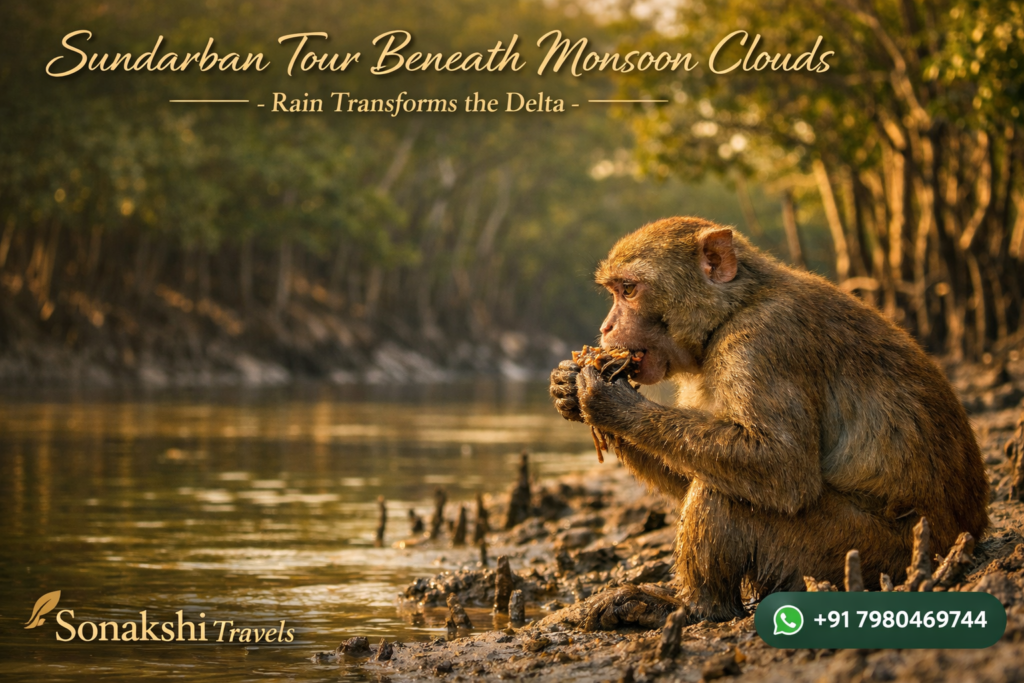
There are certain landscapes that reveal themselves most clearly when light is interrupted, when distance is softened, and when surfaces begin to speak through water. The tidal forest belongs to that order of places. Beneath monsoon clouds, the meaning of a Sundarban tour changes in a deep and visible way. Rain does not merely fall upon the delta as an external event. It enters the scene, alters the color of the rivers, darkens the bark of the mangroves, sharpens the smell of mud and salt, and turns every channel into a moving record of atmosphere. The forest appears less like a fixed destination and more like a living system in the act of renewal.
Under a clear sky, the eye often travels outward, searching for form, distance, and separation. Beneath monsoon clouds, attention moves differently. It settles closer. It notices texture before outline, movement before shape, and sound before spectacle. This is why a serious Sundarban travel experience in rain cannot be understood by looking only at scenery. The transformation is sensory, ecological, and psychological at once. Water gathers on leaves, trickles down prop roots, ripples through tidal edges, and creates a field of small changes that the visitor begins to read with unusual care. Rain makes the delta less theatrical and more truthful.
The Sky Comes Lower Over the Rivers
One of the first changes beneath monsoon clouds is the lowering of visual height. The sky no longer feels distant. It presses close over the waterways and seems to move with the boat rather than above it. This compressed vertical space gives the channels a more enclosed feeling. The riverbanks appear darker, the green canopy feels heavier, and reflections lose their brightness and gain depth. The entire delta seems gathered into a quieter, denser mood.
In such moments, the river does not behave like an open corridor. It becomes a shaded passage. Water no longer shines in a broad, flat manner. Instead, it holds broken light, drifting silver patches, and dark green shadows from mangrove leaves. The eye learns that rain is not only seen in falling drops. It is also seen in the changing weight of air, in the muted horizon, and in the way the river receives the cloud cover as tone. A thoughtful Sundarban tourism narrative must therefore pay attention to atmospheric structure, because monsoon light reorganizes the landscape from above before the rain even begins.
This lowered sky also changes emotional scale. In ordinary daylight, the delta may feel wide and distant. Under cloud, it feels immediate. The visitor is drawn into nearness. Tree lines, exposed roots, wet trunks, and tidal margins gain importance. The experience becomes less about panoramic command and more about patient observation. That shift is central to understanding why rain transforms the delta so completely.
Rain Changes the Surface Language of the Forest
The most visible work of rain is done on surfaces. Dry leaves reflect one kind of light; wet leaves reflect another. Mudbanks harden and soften in rhythm with water. Boat decks darken. Wooden railings deepen in color. Mangrove roots, which already carry sculptural force, become more pronounced when wet because moisture increases contrast and reveals fine ridges in bark and soil. This is why the forest after a shower often looks older, richer, and more intricate than it did moments earlier.
Rain also simplifies certain details while intensifying others. Fine distance may disappear into haze, but nearby textures become exact. Drops collect on leaf tips and fall at irregular intervals. Thin stems bend under water weight. Small ripples spread across creek surfaces where droplets strike. The result is not visual confusion. It is a different kind of order. The monsoon teaches the eye to understand pattern through repetition rather than through stillness.
For visitors who seek a more reflective Sundarban travel guide to the landscape itself, this matters greatly. The delta beneath rain cannot be reduced to a single dramatic image. Its beauty is cumulative. It grows through layered perception: wet bark against soft sky, moving water beneath still roots, pale foam beside dark current, and the steady interval of falling drops along the edges of silence.
Water on Leaves, Bark, and Mud
Each material in the delta responds differently to rain. Leaves brighten and darken at the same time, holding sharper highlights but deeper green body tones. Tree bark becomes more serious in appearance, its cracks, fibers, and stains easier to notice. Mud gains gloss, and that gloss reveals slope, depth, and the recent movement of water across the banks. Even the simplest shoreline begins to show history: where the tide had reached, where the rainwater collected, where small creatures crossed, and where plant roots held the earth together.
This is one reason a rain-filled Sundarban eco tourism experience can feel intellectually rich without becoming loud or dramatic. The forest under monsoon conditions teaches observation through evidence. The visitor sees process rather than only appearance.
Sound Becomes a Primary Form of Perception
When rain enters the delta, sound gains authority. Vision remains important, but it is no longer the only guide. The roof of a boat, the river surface, the broad mangrove leaves, and the hidden interior of the forest all begin to carry different tones of rain. Some drops strike hard and bright. Others fall softly into water and vanish into a low hiss. Wind may pass through the foliage in one direction while rain falls in another. This creates layered acoustics that help the listener understand depth and movement without always seeing them.
In clear weather, silence in the delta can feel spacious. During rain, silence changes character. It is not the absence of sound but the presence of continuous natural texture. That steady field of sound has a calming effect because it removes the sharp edges of distraction. The mind stops chasing isolated events and begins to move with rhythm. That is why many travelers describe a rain-soaked Sundarban travel experience as inwardly steadying. The body remains on the river, but attention becomes less scattered.
Rain also reveals scale through echo and absorption. A more open channel may produce a wide, dispersed sound. A narrow creek bordered closely by mangroves may hold sound tightly, making each drop seem nearer. Thus, the ear begins to understand space. This is not an abstract claim. It is a practical feature of monsoon perception in the tidal forest. Sound tells the visitor whether the world around them is open, enclosed, dense, or shifting.
The Delta Looks More Alive Because Its Cycles Become Visible
The Sundarbans is always a system of exchange between tide, soil, salinity, roots, sediment, and water movement. Rain does not create that system, but it makes its operations easier to sense. Channels swell in feeling even when their level change is subtle. Bank edges soften. Drainage lines appear. Tiny runoffs from higher mud surfaces cut delicate paths downward. The visitor begins to notice that the forest is not arranged like a static garden. It is organized through continuous adjustment.
This is where the ecological meaning of a Sundarban nature tour becomes especially important. Rain reminds the observer that mangrove landscapes survive not by resisting change, but by responding to it. Leaves shed salt. Roots breathe through unstable conditions. Sediment settles, lifts, moves, and returns. The monsoon does not interrupt the life of the delta. It reveals the adaptive logic that sustains it.
Even the color palette carries ecological information. Brown water may turn almost black under cloud, then briefly silver when light breaks through. Young green shoots look brighter against dark wet trunks. Moss and algae become more apparent on moist surfaces. The forest reads like a system in active conversation with water, not as scenery arranged for passive viewing. This is one reason serious observers often find rain more revealing than brightness.
Rain Exposes Process, Not Just Beauty
In dry conditions, beauty is often received through outline and color. Under monsoon clouds, beauty is tied more closely to process. One sees drainage, saturation, reflection, soft erosion, suspended particles, and fresh movement along the river edge. Such details deepen the seriousness of the experience. The delta is no longer merely admired. It is read.
That reading gives real substance to a research-minded view of Sundarban wildlife safari conditions as well. Wildlife activity, concealment, sound, and movement are all shaped by moisture, cover, and shifting visibility. Even when a traveler sees no major animal at a given moment, the environment still communicates biological presence through tracks, calls, interruptions in foliage, and altered behavior in birds and smaller life forms. Rain adds interpretive depth to the field of observation.
Movement by Boat Feels Slower and More Thoughtful
Rain does not only transform the landscape. It also transforms the way one moves through it. Under monsoon clouds, the boat seems to travel not across an empty surface but through a field of delicate interruptions. Ripples break differently. Reflections are shorter. Spray and rain combine near the sides. Sound from the engine is moderated by the broader soundscape of weather and water. Time itself feels less divided into sharp units.
This slower feeling is important because it changes the mental habit of the traveler. Instead of waiting for the next highlight, the visitor becomes receptive to continuity. The value of the journey shifts from event to immersion. A thoughtfully observed Sundarban tour package is not made meaningful only by what appears suddenly before the eye. It is also made meaningful by prolonged exposure to the rhythm of channels, roots, rain bands, and dim light over moving water.
Such movement can feel almost meditative, but not vague. It sharpens attention through reduction. There are fewer distractions, fewer artificial contrasts, and fewer visual certainties. In their place comes a deeper sensitivity to motion, interval, and environmental tone. The visitor learns to value subtler transitions: light thickening, rain easing, mist lifting, a bank emerging, a bird crossing the gray sky, or a patch of still water briefly holding the shape of clouds.
The Monsoon Deepens the Sense of Solitude Without Creating Emptiness
One of the most distinctive features of the delta beneath monsoon clouds is the way solitude becomes fuller rather than emptier. Many landscapes in rain feel abandoned. The Sundarbans often feels more inhabited. Water is active everywhere. Leaves respond. Channels speak. Even stillness seems occupied by process. The traveler may experience fewer distractions from human noise, yet feel more surrounded by life in its non-human forms.
This is an important distinction for anyone trying to understand the emotional character of the place. Solitude here does not mean absence. It means release from clutter. Under rain, the forest becomes less interpretively crowded. The mind is freed from the pressure to constantly name, categorize, and compare. Instead, it receives patterns directly: dark root against pale water, repeated tapping on wood, a widening ring on the river, a line of mangroves blurred by a passing shower.
That inner quiet is one reason some travelers are drawn toward a more intimate form of river observation, whether in a shared setting or through a carefully arranged Sundarban private tour. The monsoon atmosphere encourages concentration. It rewards those who can stay present with gradual change. Rain does not flatten the world. It slows it enough for deeper reading.
Cloud, Water, and Forest Form One Visual Body
In drier and brighter conditions, sky, river, and mangrove belt often appear as separate zones. Beneath monsoon clouds, those divisions weaken. The gray of the sky passes into the water. The dark green of the forest seems to rise into the cloud base. Reflections become less mirror-like and more tonal, binding the upper and lower halves of the scene together. The result is a visual unity that is difficult to achieve in clear light.
This unification gives the delta a painterly depth, but its effect is not merely aesthetic. It changes how the landscape is understood. The forest is no longer an object against a background. It becomes part of a connected atmospheric system. Water holds sky. Sky presses upon water. Trees mediate between them. Rain stitches all three together. Such conditions can make even a quiet stretch of river feel complete in itself.
For travelers seeking a more refined Sundarban luxury tour sensibility, this matters because luxury in such a landscape is not only about comfort. It is also about the ability to remain with nuance long enough to perceive it. The finest reward of the monsoon delta is not excess. It is density of experience.
Why the Scene Feels Cinematic Without Becoming Artificial
Rain naturally removes harshness. It diffuses light, reduces glare, softens distance, and brings reflective depth to surfaces. These qualities can make the landscape feel cinematic, but the effect arises from the ecology itself, not from exaggeration. Nothing needs to be added. The clouds lower, the channels darken, the leaves shine, and the forest enters a mode of quiet intensity. The viewer senses drama, but it is organic drama—born from interaction between atmosphere and terrain.
This is why a careful observer often remembers not one single image from a rainy delta journey, but a sequence of moods: a dim river bend, a curtain of rain crossing the far bank, wet roots emerging from soft mud, a silent pause after a shower, and then another wave of cloud shadow moving over the water. The memory is rhythmic rather than fixed.
Rain Clarifies the Philosophical Character of the Delta
At its deepest level, the transformation brought by monsoon clouds is not only visual or ecological. It is philosophical. Rain shows that the delta is a place defined by relationship rather than by permanence. Land is shaped by water. Form is shaped by tide. Visibility is shaped by cloud. Meaning is shaped by patience. The visitor who enters such a landscape expecting stable outlines may feel uncertain at first. The visitor who accepts transition begins to understand the forest on its own terms.
That lesson carries unusual force because it is delivered gently. No grand statement is announced. Instead, the forest repeats a principle through material fact: everything here is connected by movement, moisture, and response. A serious Sundarban tour packages narrative should therefore respect the intelligence of the place. The delta beneath monsoon clouds is not merely beautiful because it looks different in rain. It is beautiful because rain reveals how it lives.
In that sense, the most lasting value of the experience may be mental. Rain reduces distraction, restores sensory humility, and teaches the eye to trust sequence over spectacle. It trains attention toward what is often missed in ordinary travel: transitions, textures, intervals, and the dignity of slowly changing light. The visitor leaves with more than photographs or impressions. One leaves with a better understanding of how atmosphere can change perception itself.
Conclusion
Beneath monsoon clouds, the delta is not covered by rain so much as interpreted by it. Water darkens the forest, enriches texture, alters sound, lowers the sky, deepens solitude, and makes ecological process visible. The rivers become more thoughtful. The mangroves appear more alive. The traveler becomes more attentive. A true Sundarban tour in such conditions is therefore not a lesser version of a clear-day journey. It is a distinct form of experience with its own authority, one in which rain does not interrupt meaning but completes it.
To witness the Sundarbans beneath monsoon clouds is to understand that transformation in the delta is never superficial. Rain enters color, sound, rhythm, memory, and interpretation. It changes not only what the traveler sees, but how the traveler sees. And in that shift lies the rare power of the place: the ability to make atmosphere itself feel like a guide, revealing a tidal world whose deepest language is written in water.