Updated Date: 19 February 2026
Where Rivers Kiss Roots in a Mangrove Embrace
— Sundarban Tour Package Reveals Nature’s Face
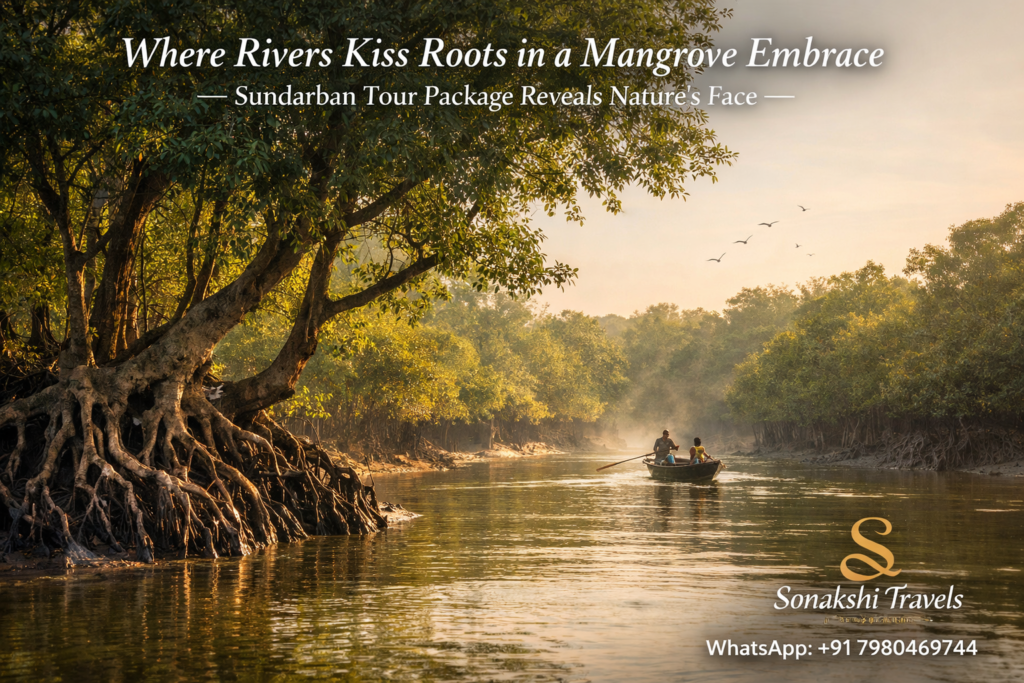
In the southern reaches of Bengal’s deltaic wilderness, land does not end abruptly; it dissolves into tide and silt. Rivers slow into branching veins, and mangrove roots rise from the mud like living architecture—structures shaped less by permanence than by repetition. Readers seeking a grounded ecological context often begin with Sundarban Travel resources that frame the region through its tidal logic rather than through surface scenery.
A carefully designed journey through this landscape is not a sightseeing exercise. A well-structured tour plan in the Sundarbans places travelers inside a working estuarine system where biology, tide, and time remain inseparable. Here, the river does not border the forest; it inhabits it. Roots do not simply hold soil in place; they negotiate continuously with salt, current, and sediment drift.
This article examines how immersion in the tidal forest reveals nature in its most unfiltered form—through predator and prey, through mangrove adaptation, through avian migration, through reptilian endurance, through the discipline of slow observation, and through eco-sensitive ethics. The emphasis remains singular: how the Sundarbans reshape perception when experienced as an ecosystem in motion.
1. The Amphibious Sovereignty of the Royal Bengal Tiger
Few ecosystems demand as much adaptive intelligence from an apex predator as the Sundarbans. The Royal Bengal Tiger here is not simply a forest dweller; it is amphibious in instinct and strategic in movement. Field observations and regional studies consistently suggest behavioral adjustments distinct from inland populations, particularly in navigating saline creeks, negotiating mudflats, and shifting territories shaped by tides rather than by fixed boundaries.
Swimming as Strategy
Unlike tigers in dry deciduous or grassland habitats, Sundarban tigers regularly swim between islands because water is not an obstacle in this geography; it is the geography. The river system compels territorial ranges to flex with currents and seasonal channels. Swimming becomes less a dramatic event than a practical method of movement—muscular control calibrated for brackish conditions, crossings executed with economy, and transitions timed against tidal flow.
For the traveler, this changes the psychology of observation. One does not follow long terrestrial corridors or read dusty tracks for hours. Instead, attention sharpens to disturbances that are small but meaningful—ripples that interrupt still water, brief movement between pneumatophores, or sudden alarm calls that fracture silence. The environment trains the mind toward patient, evidence-based noticing rather than toward expectation.
The Ecology of Elusiveness
Elusiveness in the Sundarbans is not romantic exaggeration; it is ecological logic. Dense mangrove thickets compress sightlines. Tides erase traces within hours. Human movement is largely restricted to waterways, producing a clear spatial asymmetry between observer and predator. That imbalance protects the tiger’s sovereignty, because it limits predictable encounter points and preserves a wide margin of concealment.
A guided wildlife-focused exploration that respects distance and prioritizes quiet passage accepts this asymmetry as a feature, not a limitation. The value lies not in certainty of a sighting, but in the heightened sensory state demanded by the terrain—an alertness that reveals how power and fragility coexist in a functioning wild system.
2. The Mangrove Labyrinth as Living Infrastructure
The mangrove forest of the Sundarbans is frequently described as vast, yet scale is only the first layer of its significance. More critical is the forest’s structural intelligence. Numerous mangrove species thrive here because their physiology is engineered for salinity, waterlogging, unstable sediment, and tidal immersion—conditions that would collapse most terrestrial plant systems without constant adaptation.
Pneumatophores and Oxygen Negotiation
Pneumatophores—vertical breathing roots that pierce mud like clustered stakes—are not visual curiosities. They are survival mechanisms. In oxygen-poor soil, these aerial roots act as respiratory conduits, enabling gas exchange above the surface. What looks eerie from a moving boat is, in functional terms, a sophisticated response to a habitat where the ground is regularly submerged and aeration is limited.
When a boat glides through narrow channels, the rising grid of pneumatophores creates a feeling of quiet tension, as though the forest is both open and guarded. They stand like living markers of negotiation between land and water. Over time, the traveler begins to notice that stability here is neither natural nor guaranteed; it is maintained by continuous biological work performed by root systems under stress.
Salinity, Silt, and Resilience
Mangroves regulate sediment deposition by slowing water flow, allowing silt to settle and gradually stabilizing emerging landforms. At the same time, several species manage salinity through filtration and excretion processes that prevent salt overload. These combined strategies allow the forest to hold its ground against tidal abrasion while remaining flexible enough to survive cyclical flooding and shifting channels.
Immersion in such a landscape through a private, low-noise river safari setting often makes the mechanics of resilience easier to perceive because the experience is slower and less interrupted. The forest does not resist the tide; it absorbs, redistributes, and reorganizes it. Observing this over hours, rather than moments, clarifies why the Sundarbans feel less like a static forest and more like a living infrastructure engineered by roots, salt, and time.
3. Avian Networks Across Tidal Skies
The Sundarbans support a wide range of birdlife, forming an avian network that integrates resident species with seasonal migrants. Intertidal mudflats, estuarine waters, and canopy layers create multiple feeding niches, each activated differently by tide, light, and microhabitat. The result is not merely diversity, but ecological layering—birds distributed according to function and opportunity.
Ecological Niches in Vertical Space
Bird distribution here is stratified. Waders patrol exposed flats when water recedes. Kingfishers occupy mid-level perches above creeks, reading surface disturbance with precise timing. Raptors circle high, using thermals above the canopy. Each vertical layer reflects specialization shaped by tidal cycles rather than by fixed terrain.
For the traveler, the early hours reveal silhouettes and movement patterns before color becomes vivid. Iridescent flashes from kingfishers, methodical groupings of storks in shallows, and sudden arcs of raptors above the treeline are not incidental moments; they signal nutrient flows sustained by estuarine productivity. The sky becomes an ecological map, translating what happens below the surface into visible behavior above it.
Migration as Connectivity
Seasonal migration links the Sundarbans to distant geographies. Birds arriving from northern India and Central Asia integrate temporarily into this deltaic system, using it as a feeding and resting ground. Their presence underscores a larger reality: the Sundarbans are not an isolated wilderness, but a node in wider ecological routes shaped by climate, food availability, and long-distance survival strategies.
Within a journey that prioritizes patient observation, birdwatching becomes more than identification. It becomes a lens through which ecological interdependence is understood. Each wingbeat carries a narrative of distance and return, and the traveler begins to sense how the delta participates in life cycles that extend far beyond its visible boundaries.
4. Reptilian Continuity in Brackish Realms
The aquatic undercurrents of the Sundarbans host species whose evolutionary lineage predates modern settlement patterns. Saltwater crocodiles, water monitors, and river dolphins represent continuity across deep time, but they also represent present-day ecological balance: predators and scavengers that shape food webs in waters where visibility is limited and navigation is complex.
Crocodiles and Territorial Geometry
Saltwater crocodiles inhabit mudbanks and tidal inlets, regulating territory through subtle spatial cues rather than through overt movement. Their thermoregulation—basking under filtered sunlight before sliding into opaque water—demonstrates physiological precision in a habitat where temperature shifts and salinity create constant metabolic demands.
Encountering such creatures from a boat changes perception of scale. The river ceases to feel like a passive channel and becomes inhabited depth—space occupied by bodies that belong fully to water and mud. Silence, in that moment, is not simply courtesy; it functions as a practical form of restraint that keeps observation aligned with ecological sensitivity.
Dolphins in Turbid Currents
The Ganges river dolphin, adapted to low-visibility waters, relies primarily on echolocation rather than on sight. Brief surfacing arcs interrupt the waterline and vanish again, leaving only small disturbances behind. These appearances reinforce an important idea about the Sundarbans: presence is not always designed to be seen.
A carefully paced journey that sustains quiet navigation allows such subtle phenomena to emerge without forcing them. The traveler learns to read absence as a form of information—an ecological cue that the landscape is alive even when it does not perform for the observer.
5. The Philosophy of the Boat Safari
In many wildlife destinations, movement is terrestrial and urgent. In the Sundarbans, movement is aquatic and deliberate. Boat safaris redefine pace because the tide dictates direction and timing. The engine’s hum becomes a background rhythm, and the river becomes the primary corridor of perception.
Silence as Medium
Sound behaves differently over water. Voices carry farther, and small disturbances transmit across open surfaces. Responsible navigation therefore privileges minimal intrusion. This operational discipline transforms the safari into a meditative exercise, not because it aims to create atmosphere, but because the ecosystem rewards quiet and penalizes disruption.
As sunlight diffuses across estuarine surfaces, reflections double the landscape. The forest appears inverted beneath the boat, and ripples fracture that mirrored world into shifting geometry. Such visual layering creates a contemplative state that aligns attention with the slow mechanics of the delta rather than with the traveler’s usual sense of time.
Human Presence at the Margins
Occasional glimpses of fishermen casting nets or honey collectors moving along embankments hint at a fragile coexistence between community and wilderness. These interactions are peripheral yet meaningful because they demonstrate how livelihoods adapt to ecological constraints without fully dominating them. The relationship is complex, shaped by risk, regulation, and local knowledge.
Within this framework, the safari does not accelerate experience; it sustains it. For travelers seeking a quieter, detail-rich approach to observation, even a short, tightly managed outing—such as the single-day river-and-forest immersion—can still communicate the delta’s slow intelligence when conducted with restraint and attention.
6. Eco-Sensitive Engagement and Ethical Travel
As a UNESCO World Heritage Site, the Sundarbans operate under conservation imperatives that limit intrusive tourism. Low-impact travel is not an optional ideal; it is the operational baseline required to prevent cumulative ecological stress in a habitat already shaped by salinity shifts, erosion, and human-wildlife boundaries.
Operational Discipline
Regulated boat routes, waste management protocols, and limits on shore access reduce pressure on fragile zones. Avoidance of plastic, minimal noise, and controlled visitation keep tourism observational rather than extractive. These measures are not merely “good practice”; they are conservation tools that protect breeding grounds, reduce disturbance, and maintain the ecosystem’s capacity to regenerate.
When structured responsibly, the journey becomes an extension of conservation ethics. It teaches through practice—showing that presence can be respectful, that curiosity can be disciplined, and that meaningful engagement does not require intrusion.
Psychological Recalibration
Eco-sensitive travel also produces psychological change. The absence of network signals, city noise, and constant scheduling recalibrates attention. Many travelers notice heightened sensitivity to sound, texture, and time because the forest’s rhythm replaces digital urgency. This is not a decorative “escape” narrative; it is a measurable shift in how the mind processes stimuli when distractions are removed.
The delta compels introspection precisely because it resists spectacle. It does not entertain the visitor; it requires the visitor to become more observant, more patient, and more accountable to the environment being entered.
7. Temporal Depth and the Feeling of Antiquity
The Sundarbans evoke temporal depth. Sediment layers accumulate invisibly, tides erase and redraw boundaries daily, and myths circulate alongside ecological realities. Yet the most compelling feature is not narrative—rather, it is process. The delta operates through cycles that make human timelines feel brief and secondary.
Immersion in this environment resembles passage through a threshold. The journey does not transport travelers backward in history; it positions them inside processes older than recorded narrative. Mangroves predate memory, reptiles embody endurance, and birds trace routes inherited across generations. The forest’s continuity is not symbolic; it is functional.
That perspective fosters humility. Human ambition contracts against tidal cycles that operate with indifferent consistency. What remains is a clearer sense of proportion—how small a visitor is, and how large the living system truly is when observed as a whole.
The Delta as Revelation
Every destination offers scenery. Few offer structural revelation. In the Sundarbans, revelation emerges through immersion in systems—predatory adaptation, botanical resilience, avian migration, reptilian persistence, aquatic philosophy, and ethical restraint. These are not separate experiences; they are expressions of one integrated ecology.
A thoughtfully paced experience reveals nature not as backdrop but as operating intelligence. Rivers do not merely touch roots; they shape existence through salinity and sediment. The forest does not simply shelter life; it engineers survival. Silence does not indicate emptiness; it holds layered presence—often sensed before it is seen.
To travel here is to witness how water and root, predator and prey, tide and silt converge into a functioning whole. The revelation lies in coherence rather than spectacle. In that coherence, nature’s face becomes visible—unfiltered, unsimplified, and enduring.