Updated: 1 March 2026
Whispers in the Wild—Understanding a Sundarban Visit
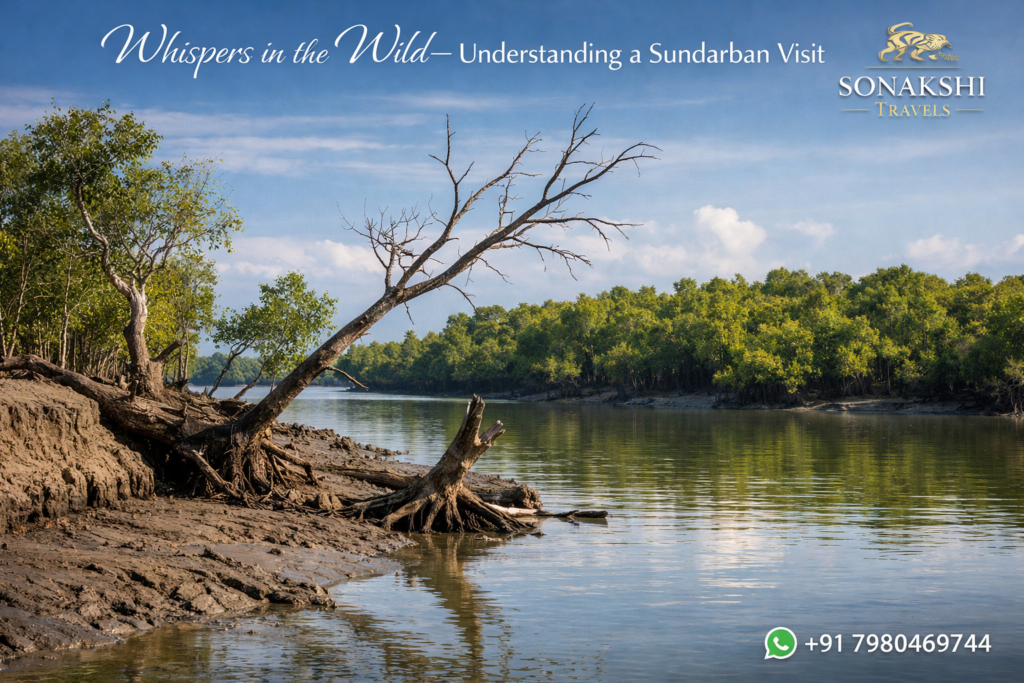
The idea of a Sundarban visit often begins with a fixed image: tangled mangrove roots, wide tidal rivers, and the silent possibility of a tiger moving somewhere beyond sight. Yet the experience itself is not defined by images. It is defined by immersion. This is a landscape where water replaces roads, where mud replaces pavement, and where movement depends on natural rhythm rather than human schedule. For readers who want a stable reference point before entering this setting, the regional overview on Sundarban Travel helps frame why the delta behaves differently from conventional nature destinations.
To understand what a Sundarban visit truly means, one must look beyond surface impressions. The forest does not perform for visitors. It does not guarantee sightings. It does not unfold on command. Instead, it requires attention, patience, and physical awareness. In return, it offers something rare: the experience of standing inside a working delta where river, soil, salt, and life interact every moment.
The Delta as a Living System
The Sundarban is not a static forest. It is part of the world’s largest tidal delta, shaped continuously by the combined flow of major rivers before they meet the sea. During a visit, this reality becomes visible in small but important ways. Riverbanks shift. Mudflats appear and disappear. Channels widen or narrow with the tide. The forest stands on soil that is soft, water-fed, and unstable.
This constant movement influences everything a visitor experiences. Boats do not glide over fixed water bodies; they move through tidal channels whose depth and direction change daily. The landscape is not arranged for comfort. It is arranged by nature’s own logic. Many first-time visitors find that reading a detailed field-oriented guide to the Sundarban tour clarifies why observation, not speed, is the most reliable way to understand the delta.
Researchers describe mangrove ecosystems as buffer systems. They absorb storm energy, filter sediment, and protect inland regions from erosion. During a Sundarban visit, these protective functions are not abstract ideas. The dense root systems visible along riverbanks act as living infrastructure, binding soil and slowing water. The forest’s complexity is ecological engineering at work.
The Psychology of Entering a Regulated Wilderness
Unlike open parks or hill destinations, the Sundarban operates under controlled access. Entry is monitored. Movement is guided. Boats follow designated channels. This structure is not a restriction; it is protection. The forest is a habitat first and a travel destination second.
For visitors, this regulated environment creates a distinct psychological shift. There is awareness that one is inside a protected territory. Human presence is temporary. Wildlife presence is permanent. This awareness encourages humility. Conversations soften. Movements become slower. Even silence acquires weight because it is not empty; it is full of cues.
Psychologists studying wilderness exposure note that environments where human dominance is minimal often create heightened sensory attention. In the Sundarban, this effect is amplified. The absence of urban noise allows small sounds to gain importance: a splash near the bank, a bird call in the canopy, the low hum of wind across mangrove leaves. Travelers who choose a well-structured Sundarban tour package often benefit from clearer guidance on pace and conduct, which supports deeper observation without turning the visit into a rigid checklist.
The Boat as the Central Experience
In most landscapes, walking defines exploration. In the Sundarban, floating defines it. The boat is not transport alone. It is the primary observation platform. From its deck, the visitor sees the forest from water level, which is the natural boundary between land and river.
This perspective shapes the entire experience. Mangrove trunks appear rooted directly in the tide. Salt-tolerant leaves reflect sunlight. Mudskippers move between water and soil. Crocodiles, when present, remain near the water’s edge. The visitor does not penetrate deep into land; instead, the forest reveals itself from the shoreline in fragments that must be patiently assembled.
The rhythm of the boat matters. Slow movement allows scanning of riverbanks. Sudden acceleration disturbs wildlife and reduces observation quality. Experienced guides understand that silence and steadiness increase the chance of meaningful encounters. During a Sundarban visit, time on the boat is not transit time. It is field time.
Wildlife Presence Without Guarantee
The Sundarban is globally associated with the Royal Bengal Tiger. Yet a responsible understanding of a visit must accept uncertainty. Wildlife here is not staged. Tigers move across wide territories. Deer, wild boar, reptiles, and birds appear unpredictably.
This unpredictability changes visitor expectation. The focus shifts from “spotting” to “signs.” Paw prints on soft mud. Alarm calls from deer. Sudden silence in a patch of forest. These indirect indicators form part of the experience. Ecologists emphasize that predator ecosystems rely on invisibility; survival depends on remaining unseen as much as on strength.
Birdlife often becomes more visible than larger mammals. Kingfishers, herons, egrets, and migratory species use tidal channels as feeding grounds. Observing these species requires patience rather than speed. A Sundarban visit rewards those who study edges—the meeting point of water and vegetation—because edges are where feeding, hiding, and movement patterns overlap.
Human Life Within the Forest Boundary
The Sundarban is not empty of people. Along its inhabited islands, communities live in close relationship with the river. Fishing, honey collection, and small-scale agriculture shape daily routines. During a visit, brief interactions with village settlements reveal a balance between dependence on natural resources and constant awareness of risk.
Living near a tidal forest requires adaptation. Embankments protect fields from saline water intrusion. Boats are essential tools rather than leisure objects. Cultural practices reflect reverence toward forest deities and protective symbols, not as decoration but as part of local risk culture. These elements are not staged performances; they are a living language through which people explain danger, luck, and survival.
For visitors, observing this coexistence adds depth to the experience. The forest is not isolated from human life; it shapes it. A Sundarban visit becomes an opportunity to witness how communities negotiate ecological uncertainty without romanticizing it, and without pretending it is simple.
Physical Preparedness and Environmental Reality
The Sundarban environment places specific demands on the body. Open river exposure means direct sunlight. Humidity can be high. Surfaces may be wet or slippery. Mosquito presence in marsh zones is natural. These are not minor details. They influence attention, comfort, and safety, and they shape how fully a visitor can stay present during observation.
These conditions are not inconveniences; they are environmental facts. Long sleeves reduce sun exposure and protect skin from minor scrapes. Secure footwear supports balance when stepping across uneven ground or boat surfaces. Mosquito repellent reduces discomfort and also lowers the chance of bites that can distract the mind from the landscape. For travelers with limited time who still want to experience these conditions in a controlled way, a Sundarban single-day visit plan can be useful because it concentrates essential field exposure while keeping practical arrangements straightforward.
Research in outdoor risk management emphasizes that preparedness improves judgment. When the body feels secure, attention becomes more precise. In a landscape like the Sundarban, this connection is clear: the more comfortable and protected you are, the more you notice—small movements on the bank, shifting light on water, and the subtle signs that suggest unseen life nearby.
Ecological Responsibility During a Visit
A Sundarban visit carries responsibility. Mangrove ecosystems are sensitive to disturbance. Plastic waste, loud noise, and careless movement can damage habitats. Even small actions accumulate impact over time because the forest edge is a narrow working zone where roots, juvenile fish, and feeding birds coexist.
Visitors must understand that this forest functions as a carbon sink, storm barrier, and biodiversity reserve. Conservation rules are not formalities; they are protective mechanisms. Maintaining silence, avoiding litter, and respecting boundaries directly support ecological stability. Responsible behavior also improves the quality of the visit because calm conditions allow more natural wildlife activity.
Environmental researchers repeatedly note that responsible tourism can support conservation when disturbance is minimized and local practices are respected. In the Sundarban, this balance is essential. The visit should leave no trace beyond memory and learning.
Emotional Transformation Through Stillness
Many visitors describe a subtle emotional shift during their time in the Sundarban. The absence of constant digital distraction creates mental space. The repetitive motion of water induces calm. Watching the tide rise and fall introduces a rhythm slower than urban life, and that rhythm can reset how the mind measures time.
This shift is not dramatic. It unfolds quietly. Standing on a boat deck, watching light spread across water, can produce reflection without effort. Listening to distant bird calls can restore attention that modern life often fragments. In this sense, a Sundarban visit becomes not only ecological exposure but also a disciplined form of stillness, where the mind learns to hold focus on small details.
Studies on nature exposure suggest that biodiverse landscapes can reduce stress indicators and improve sustained attention. The Sundarban adds an important nuance: the environment is both calming and alerting. The visitor experiences serenity through water rhythm, but also awareness through the presence of wild territory. This combination gives the place a distinctive psychological character.
Understanding Value Beyond Sightings
It is easy to measure a visit by visible highlights. In the Sundarban, such measurement is incomplete. The true value lies in immersion within a functioning ecosystem. The delta’s shifting channels, the mangrove roots breathing through mud, and the layered calls of birds form the core experience because they show how life persists under tidal pressure.
Even without dramatic wildlife encounters, the visit remains meaningful. It reveals how coastal forests survive saline conditions through specialized root and leaf structures. It demonstrates how communities adapt to tidal life without separating culture from environment. It illustrates how conservation and controlled access operate together, not as theory, but as daily practice in a sensitive habitat.
For travelers who want this learning to happen with minimal disturbance and maximum quiet, a carefully managed private and luxury Sundarban visit can support better observation because pace, noise levels, and attention are easier to control. When evaluated through this broader lens, a Sundarban visit becomes a learning journey rather than a checklist.
Conclusion: Entering the Whispers of the Wild
A Sundarban visit is not defined by spectacle. It is defined by attention. It asks the visitor to slow down, observe edges, and respect boundaries. The forest does not offer certainty, but it offers authenticity, and authenticity is what makes the experience valuable.
To stand in the Sundarban is to stand at the meeting point of river and root, salt and soil, predator and prey, human settlement and wild domain. The experience is layered—ecological, psychological, and cultural. It demands preparedness, patience, and humility, not as abstract virtues, but as practical tools for seeing clearly.
When approached with awareness, the visit becomes more than travel. It becomes participation in a living delta. The whispers in the wild are subtle. They are carried by tide, by wind through mangrove leaves, and by the quiet understanding that nature continues its work whether observed or not. To enter that space, even briefly, is to understand the Sundarban in its truest form.