Sundarban luxury tour of mindful escape – Travel that slows your thoughts
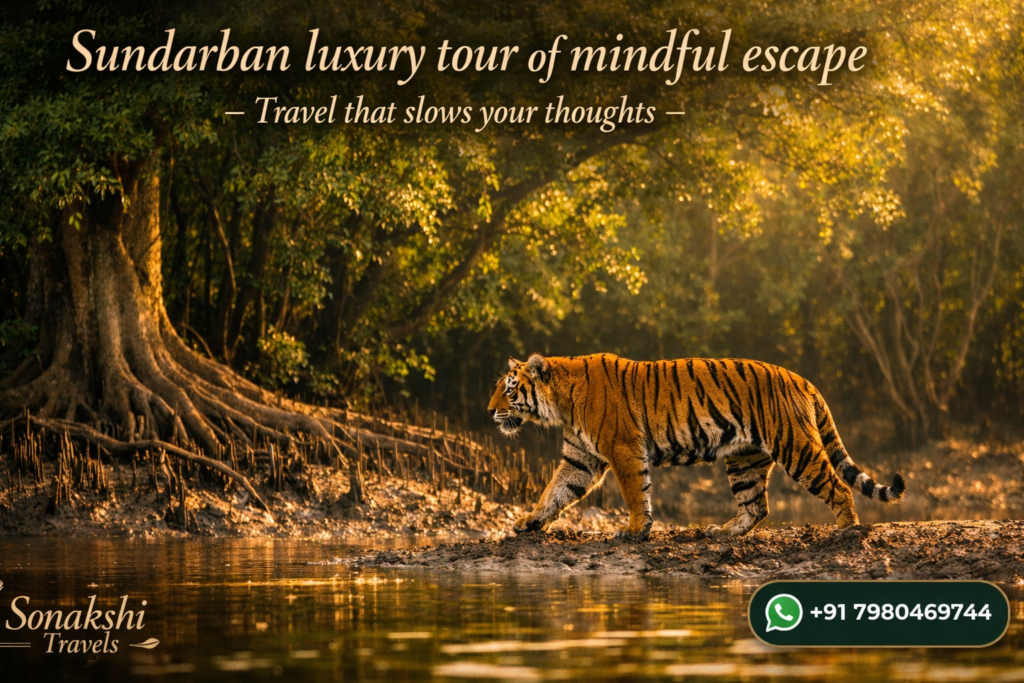
There are journeys that fill the mind with more images, more movement, and more noise. Then there are journeys that do something quieter and more important. They remove pressure from thought. They reduce the restless speed that modern life creates inside the head. A Sundarban luxury tour belongs to this second kind of journey. It does not force attention through spectacle alone. It works through rhythm, distance, silence, water, and pause. In the tidal world of the mangrove delta, the traveler is not pushed from one dramatic moment to another. Instead, the landscape slowly changes the quality of thought itself.
This is what makes the experience so unusual. Many destinations promise relaxation, yet they remain full of activity, instruction, and social demand. The mind travels there only to stay busy in a different setting. A mindful escape is something deeper. It is not simply comfort. It is a gradual return to inner quiet. In the Sundarban, this return happens through long waterlines, soft current, filtered light on the river, and the slow appearance of mangrove edges that never reveal themselves all at once. A carefully designed Sundarban travel experience can become a form of mental clearing, where thought becomes less crowded and awareness becomes more precise.
Why the landscape naturally calms the mind
The first reason the Sundarban slows the mind is structural. This is not a landscape built around sharp interruption. It is formed by flowing boundaries. River becomes creek, creek becomes channel, mudbank becomes forest edge, and forest edge disappears again into tide. Because the environment itself is always shifting in soft ways, the eye does not receive harsh visual commands. Instead of being captured by fixed monuments, it moves gently over surfaces, reflections, roots, leaves, shadows, and open sky. That movement matters. Research on restorative environments often shows that the mind recovers best when attention is held without strain. The Sundarban does this naturally.
On a refined Sundarban luxury tour package, the traveler often discovers that silence here is not empty. It is layered. There is the low sound of water touching the boat, the distant call of birds, the subtle friction of wind through mangrove leaves, and the occasional stillness between one sound and the next. Such sound patterns do not crowd the nervous system. They space it out. They allow thought to loosen. Many people only notice how tired their minds have become when they enter an environment that no longer demands constant reaction. The Sundarban creates that contrast with rare power.
This is also why the place feels larger than its visible form. A noisy destination explains itself immediately. A quiet destination asks for patience. The Sundarban does not reveal its meaning in one glance. It reveals itself through duration. That duration changes mental behavior. Travelers begin by looking outward, but after some time they begin listening inward. The outer stillness becomes a mirror for inner stillness. That is the beginning of mindful travel in its true sense.
Water as a medium of mental release
One of the deepest qualities of a luxury Sundarban river cruise is the psychological effect of movement over water. Land travel usually divides experience into arrivals and departures. Water travel is different. It creates continuity. There is no sharp break between one moment and the next. The body feels carried rather than pushed. The horizon opens without rushing. The mind, in response, becomes less defensive. It no longer prepares for the next sudden demand. It begins to rest inside transition itself.
This is especially meaningful in the Sundarban because the water here is not decorative. It is living structure. Tide shapes direction, depth, reflection, and mood. The traveler moves through a world where water is both path and presence. Watching current slide past the boat hour after hour can produce a rare kind of mental softness. Thoughts no longer arrive in hard lines. They become slower, more spacious, and sometimes more honest. What daily life hides under speed begins to appear in calmer form.
A high-quality Sundarban luxury travel experience is valuable not because it isolates the visitor from nature, but because it allows the visitor to encounter nature without friction. Comfort matters here because it removes the small irritations that break reflection. When the body is at ease, the mind can go deeper. One begins to notice small gradations in color on the river, subtle changes in the density of mangrove shade, and the different emotional tones of open channel and narrow creek. This is not passive seeing. It is attention becoming cleaner.
The role of silence in mindful escape
Silence is often misunderstood. Many people treat it as the absence of activity. In truth, silence is a condition that lets perception become more exact. In the Sundarban, silence is not lifeless. It is full of hidden movement. Crabs work below roots. Birds shift between branches. Mud remembers the tide. Water carries faint signs from unseen channels. The traveler senses life without having to be overwhelmed by it. That balance is one of the most calming aspects of the place.
A Sundarban luxury private tour shaped around mindful escape allows space for this silence to be felt fully. Instead of treating quiet moments as empty intervals between major events, the journey begins to recognize them as central. A bend in the river with no conversation, no urgency, and no performance can become the most meaningful part of the day. The mind, left unforced, starts organizing itself. Emotional noise decreases. Internal dialogue loses some of its aggression. Even memory behaves differently in such conditions. Thoughts become less scattered and more connected.
This is why some travelers return from the Sundarban with fewer stories of action but stronger memories of feeling. They remember how the air sat on the river just before dusk. They remember how the mangrove line seemed to hold both secrecy and calm. They remember a stretch of floating quiet in which time felt less mechanical. These are not small impressions. They are signs that the journey succeeded in slowing thought.
How the mangrove environment changes attention
The mangrove forest has its own behavioral language. It does not offer the easy openness of mountain valleys or the immediate grandeur of large waterfalls. Its beauty is more intelligent than obvious. Roots rise in strange patterns. Mudbanks curve like temporary borders. Foliage gathers in layered walls of green that appear still from far away but reveal constant subtle activity at closer attention. A luxury mangrove forest tour in this environment becomes powerful because it trains the mind to notice without chasing.
This matters in an age of overstimulation. Much of modern life rewards fast scanning, quick judgment, and short attention. The Sundarban asks for another mode. It rewards patience. It teaches the eye to remain with one frame long enough for detail to emerge. It teaches the ear to wait. It teaches the mind that meaning does not always arrive instantly. Such lessons are not abstract. They are embodied. After some time in the delta, travelers often feel their breathing become more even, their speech become less hurried, and their responses become less reactive.
That is one reason a well-planned Sundarban premium wildlife tour can feel inwardly different from ordinary sightseeing. Even when wildlife is not immediately visible, the atmosphere remains deeply engaging. The traveler is not merely waiting for an event. The traveler is learning a different rhythm of attention. The possibility of life hidden within the forest sharpens awareness without creating noise. This balance between alertness and calm is a rare mental state, and the Sundarban sustains it with remarkable consistency.
Luxury as emotional space, not excess
In the context of mindful escape, luxury should not be understood as display. It should be understood as freedom from disturbance. The finest part of a Sundarban luxury tour packages experience is not simply superior service or polished surroundings. It is the way thoughtful comfort protects the inner quality of the journey. When movement is smooth, surroundings are clean, and the pace is carefully held, the traveler remains mentally open. There is no need to defend oneself against inconvenience at every step. Attention stays where it should remain: on the living atmosphere of the delta.
This kind of luxury has an ethical dimension as well. It shows respect for the environment by encouraging slower, more observant travel rather than noisy consumption. It also shows respect for the traveler by allowing contemplation to become part of the experience. In such a setting, refinement is not a distraction from nature. It is a way of meeting nature with steadiness and care.
A good Sundarban luxury nature tour therefore feels calm in its design. It does not overfill the senses. It does not mistake activity for depth. It creates a frame in which water, light, silence, and forest can do their work on the mind. This is why the experience remains with people long after they leave. They may forget certain sequences of the journey, but they remember the quality of thought it produced. They remember feeling less divided inside themselves.
The psychology of slowness in a tidal world
Slowness in the Sundarban is not laziness. It is alignment. The delta itself operates through measured change. Tide enters, retreats, reshapes edges, and returns. Light moves over water in long gradients. The forest does not declare itself quickly. When travel enters this system respectfully, human thought begins to align with environmental rhythm. That alignment is one of the clearest sources of mental restoration.
On an exclusive Sundarban private tour, one may begin to understand that slowness is not the opposite of richness. In many cases, it is the condition that makes richness visible. When the boat glides through a quieter channel, every passing detail carries weight: the polished shine of wet mud, the careful geometry of exposed roots, the hovering stillness before a bird breaks the air, the way reflected light trembles under shade. These are small scenes, yet together they rebuild perception. The traveler no longer seeks constant climax. The traveler begins to value continuity, relation, and texture.
This psychological shift is deeply important for people whose daily lives are ruled by pressure, deadlines, and fragmented attention. The Sundarban does not solve life, but it changes the speed at which life is being processed. Sometimes that alone is transformative. A slower mind can feel more clearly, decide more honestly, and rest more fully. This is why mindful escape is not a superficial idea. It is a serious response to mental overload.
Mindfulness through observation, not instruction
Many modern wellness experiences tell people how to be calm. They offer methods, rules, and repeated commands to relax. The Sundarban works differently. It does not instruct. It invites. Its effect is indirect, and for that reason, often stronger. A Sundarban travel guide may help explain the ecology of mangroves, tides, birds, and animal behavior, but the deepest calm still comes from direct observation. The traveler sees how nothing in this landscape is hurried, yet nothing is lifeless. Everything is active in measured ways.
That lesson can be inwardly powerful. People often live as if speed proves value. The Sundarban quietly denies that idea. It shows that intensity can exist inside stillness, that life can be full without being loud, and that mystery can calm rather than disturb. These realizations do not arrive as slogans. They arrive as felt truth after enough time spent looking, listening, and floating through the tidal forest.
For this reason, a Sundarban exploration tour centered on mindful escape becomes more than scenic travel. It becomes a change in mental method. One stops trying to take possession of the place through endless photographs or constant interpretation. One begins instead to receive the place. That shift from control to receptivity is central to mindfulness, and the Sundarban supports it in natural ways.
Why the experience feels deeply personal
Although the delta is vast, the emotional experience of it often feels intimate. Part of this comes from enclosure. Mangrove lines narrow the field of vision just enough to create focus. Part comes from rhythm. Repeated movement on water produces a gentle inward turn. And part comes from uncertainty. Because the landscape never fully explains itself, each traveler must meet it with personal imagination and feeling. A Sundarban private tour or refined luxury journey often becomes memorable for precisely this reason: it leaves room for private thought.
One person may experience the river as release. Another may experience it as reflection. Another may feel the forest as humility, as if the human mind has finally entered a world that does not revolve around human speed. These differences are not signs of confusion. They are signs of depth. The place is large enough to hold many forms of inward response without losing its own character.
A truly meaningful luxury Sundarban safari is therefore not only about what is seen outside the boat. It is about what becomes visible inside the traveler. The journey slows thought, and in slowing thought, it clears space for subtler feelings. Some travelers feel gratitude more strongly. Some feel quiet sorrow surface and soften. Some feel simple relief. The delta does not produce identical emotions. It produces the conditions in which emotion can settle into clearer form.
The lasting value of a journey that slows the mind
The greatest strength of this experience is that it does not end when the journey ends. A true Sundarban tourism experience of mindful escape leaves behind a changed mental memory. Even after returning to ordinary life, travelers often remember the pace of the river, the measured silence of the mangroves, and the rare sensation of being mentally unforced. That memory can continue working quietly in the background. It reminds the mind that another rhythm is possible.
This is why the title matters so deeply. A mindful escape is not escape from reality. It is escape from unnecessary mental speed. It is travel that slows your thoughts not by reducing the world, but by refining the way you meet the world. The Sundarban does this with uncommon grace. Through water, silence, tidal motion, ecological subtlety, and emotional spaciousness, it offers a form of travel that feels both grounded and restorative.
In the end, a Sundarban luxury tour of mindful escape is valuable because it restores proportion. It reminds the traveler that not everything meaningful arrives in noise, that not every powerful journey depends on speed, and that the deepest luxury may simply be the chance to think more slowly in the presence of a living, breathing landscape. In the Sundarban, that chance is not accidental. It is written into the water, the forest, the silence, and the long patient rhythm of the tide.