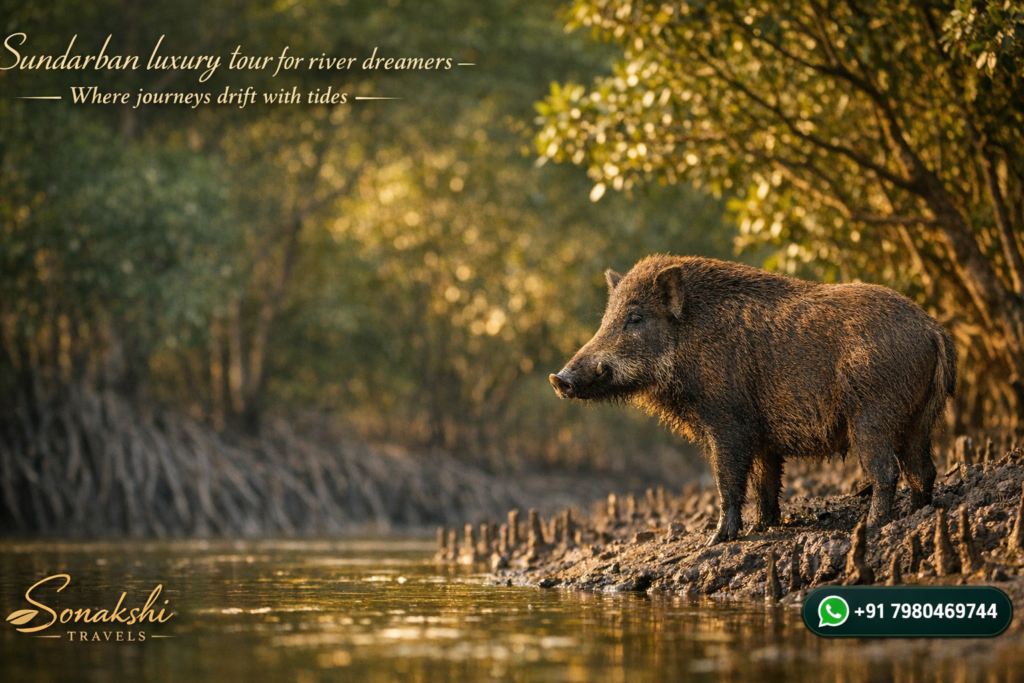
Sundarban luxury tour for river dreamers – Where journeys drift with tides
Some journeys move through monuments, roads, and fixed destinations. Some move through schedules that feel louder than the places themselves. A Sundarban luxury tour belongs to another kind of travel altogether. It is a journey shaped not by rigid lines but by water, current, silence, and drift. In the delta, movement does not feel imposed from outside. It feels drawn by the living rhythm of the river. For river dreamers, this creates a rare emotional experience. Travel becomes less about reaching and more about floating inside a landscape that is always in quiet motion.
This is why the idea of drifting with tides matters so deeply. In the Sundarban, water is not just background scenery. It is the force that gives the landscape its language. The banks change character with light. Reflections soften the edges of the forest. Mud, roots, leaves, and sky all appear to shift because the river is never fully still. A traveler who enters such a place with patience begins to understand that the experience is not built on speed. It is built on surrender to rhythm. That is what makes this form of Sundarban travel especially meaningful for those who are drawn to quiet water, long horizons, and slow beauty.
Why river dreamers respond to this landscape
There are people who feel naturally connected to rivers. They do not see water only as a route or a resource. They see it as mood, memory, and movement. Such travelers often feel a special attraction toward places where the day unfolds through flow rather than through crowd and noise. The Sundarban answers that emotional instinct with unusual depth. Its waterways do not behave like decorative channels around a destination. They are the destination. They carry atmosphere. They hold silence. They create suspense through what is revealed and what remains hidden beyond the next bend.
For this reason, a Sundarban tour can become deeply personal when understood through the image of river dreaming. The dreamer is not simply someone who enjoys scenic beauty. A river dreamer is someone who feels restored by gradual change. The traveler watches the water darken, brighten, widen, and narrow. The eye learns to notice the line where the mangrove shade touches the tide. The mind begins to slow down because the landscape itself does not rush. This slowing is not emptiness. It is attention becoming more refined.
Environmental researchers often describe estuarine systems as spaces of transition, where fresh water and salt water interact and where life adapts to shifting conditions. That scientific truth also helps explain the emotional power of the Sundarban. A place made by transition naturally resists hard stillness. Its identity lives in between. It is neither fully land nor fully sea. It is neither silence alone nor movement alone. For the traveler, this creates a strong impression of being inside a world that is alive through balance. The journey becomes memorable because it feels fluid at every level.
The river as a moving form of thought
In many landscapes, the mind looks outward and gathers images. In the Sundarban, the mind often begins to move with the scene itself. This is one of the most distinctive qualities of a river-centered journey. The traveler does not stand apart from motion. The traveler is carried inside it. The boat glides. The tide changes angle. Ripples break and disappear. The eyes follow the water, and thought becomes gentler. For people tired of mechanical pace, this matters greatly. The river does not demand constant interpretation. It allows thought to loosen and reform quietly.
That is why a refined Sundarban luxury travel experience can feel so different from ordinary comfort-based travel. Its luxury is not limited to soft seating, privacy, or service. Its deeper luxury lies in mental space. The river gives room for unhurried seeing. It removes the pressure to consume the place too quickly. A dreamer can sit with one stretch of water and find that it is never the same from one minute to the next. Light on current is already an event. The floating shadow of branches is already a change. The passage of another small boat in the distance is enough to alter the emotional tone of the scene.
Psychologically, this kind of travel creates a rare state of alert calm. The landscape is soothing, yet it is never empty. The traveler relaxes, but attention does not disappear. Instead, awareness becomes quieter and sharper at the same time. This is one reason water-based environments often remain in memory with unusual strength. The senses are engaged without being overloaded. The mind is occupied without becoming crowded. In the Sundarban, that condition reaches exceptional depth because the whole environment is built on shifting water and tidal timing.
How the tides shape the feeling of the journey
The title image of journeys drifting with tides is not only poetic. It is rooted in ecological reality. The Sundarban is a tidal forest. Its daily life is shaped by rise and fall, exposure and submergence, nearness and withdrawal. This gives the journey a structure that feels more organic than planned. Even when the traveler does not study the hydrology in technical terms, the body senses that the place is being continually rearranged by water. Banks appear softer at one hour and more defined at another. Reflections lengthen, fragment, or vanish. Channels seem open, then secretive. The feeling of travel changes with them.
For river dreamers, this tidal character creates fascination because it makes movement feel collaborative. The traveler does not move against the place. The traveler moves with it. This produces an unusual humility. One begins to understand that the journey is not being forced into the landscape. It is being received by it. In that sense, a luxury Sundarban river cruise is most powerful when it preserves this sense of participation in natural rhythm rather than trying to overpower it.
The tides also influence the emotional tempo of observation. When the river is broad and reflective, the mood feels open and meditative. When the current narrows between darker mangrove edges, the same journey can feel inward, hidden, and almost secretive. Nothing dramatic needs to happen for the atmosphere to deepen. Water alone is enough. This is one of the great lessons of the delta: scale and meaning can change without noise. The dreamer learns to read mood through current, color, and edge.
The poetry of mangrove edges and open water
One reason the Sundarban speaks so strongly to imaginative travelers is the contrast between enclosure and openness. At one moment, the river feels wide, exposed to sky, and full of breath. At another, the banks draw inward, and the mangroves seem to gather close in layered green silence. This alternation gives the landscape its poetic structure. The traveler is never held in a single visual mode for too long. Instead, the eye moves between release and concentration, distance and intimacy.
For a river dreamer, these transitions matter more than spectacle. The value of the journey lies not in one grand image but in a chain of subtle visual experiences. The slight lean of branches over water. The pale shimmer along a muddy edge. The roots gripping unstable soil. The faint movement of leaves in humid air. The long mirror of sky carried on a slow current. Such details are easy to ignore in faster forms of travel, but in a high-quality luxury Sundarban cruise, they become central. The place reveals itself through gradation.
This slow revelation has deep ecological meaning as well. Mangrove systems survive through adaptation to unstable conditions. Root structures, salinity tolerance, sediment patterns, and tidal circulation all shape what the traveler sees. The beauty of the landscape is therefore not separate from its biological intelligence. What looks graceful is often also functional. What appears delicate is often a sign of resilience. To drift through such a place is to move through visible evidence of life adjusting itself continuously to water.
Silence, sound, and the intelligence of slow travel
People often describe silent landscapes as empty, but the Sundarban teaches a more accurate idea of silence. Here, silence is not the absence of sound. It is the absence of unnecessary human noise. In that quieter field, smaller sounds gain meaning. Water touching the side of a boat. A distant bird call carried across open air. Leaves responding to a mild wind. The low, steady sound of movement through current. These are not interruptions. They are part of the journey’s structure.
This is why a thoughtful Sundarban luxury nature tour appeals so strongly to those who value slow travel. Slowness here is not laziness or delay. It is a method of perception. When movement is gentle, hearing improves. When the mind is less crowded, the traveler begins to distinguish between different textures of sound. Some parts of the river feel hushed and suspended. Others feel softly alive. This fine listening changes the entire emotional quality of the journey.
Research in environmental psychology has repeatedly suggested that low-noise natural settings support mental restoration by reducing cognitive fatigue. The Sundarban offers a powerful example of that principle, but in a form shaped by water. The river absorbs harshness. It spreads sound differently from land. It creates distance without making the traveler feel isolated. This combination helps explain why drifting through a tidal landscape can feel both calming and mentally clarifying.
Luxury as space, stillness, and emotional refinement
When people hear the word luxury, they often imagine excess. Yet in a place like the Sundarban, true refinement appears through restraint. The finest quality of the experience is not loud decoration but quiet alignment with the landscape. Comfort matters, certainly. Privacy matters. Ease matters. But the greatest luxury is the ability to encounter the river without disturbance. To sit in peace. To watch a changing channel without being hurried. To let the eye travel across water without interruption. This is the kind of richness that suits river dreamers.
That is why the idea of a Sundarban luxury tour package becomes most meaningful when understood as carefully held space. The traveler receives not merely services but conditions for deeper attention. The journey is allowed to breathe. The river remains the main presence. The comfort around it should support the experience, not compete with it. In the best form of this journey, luxury is quiet enough to disappear into atmosphere while still shaping the traveler’s ease and receptivity.
This emotional refinement also affects memory. Loud experiences often remain as fragments. Quiet, deeply felt journeys tend to remain as atmosphere. The traveler may remember a certain curve of water at dusk, the patient drift of the boat, the feeling of being suspended between banks, the way light rested on the tide. These memories endure because they are not merely visual. They are total states of mind.
Why drifting feels more meaningful than rushing
Modern travel often trains people to measure value through quantity. More stops, more views, more completed activities. Yet a river landscape such as the Sundarban asks for another standard. Here, depth matters more than count. One long passage through tidal water can contain more meaning than many hurried transitions elsewhere. Drifting is not the opposite of meaningful travel. In this setting, drifting is the very form through which meaning appears.
A Sundarban private tour especially suits this philosophy because it allows the traveler to remain close to the emotional cadence of the river. The journey does not need to feel public, compressed, or externally paced. It can remain intimate. The dreamer can stay with a mood until it unfolds. That privacy gives dignity to silence. It allows the river to be encountered not as background entertainment but as living presence.
The phrase “journeys drift with tides” also carries an inner meaning. Many travelers arrive carrying mental noise from urban life, work pressure, digital overload, and constant decision-making. The river offers a different model of movement. It does not eliminate direction, but it softens control. It reminds the traveler that not every meaningful experience needs to be driven aggressively forward. Sometimes depth comes from learning how to move with conditions rather than against them.
For those who dream in water and horizon
Not every traveler seeks the same kind of beauty. Some are drawn to height, stone, architecture, or event. River dreamers are different. They are often drawn to reflections, margins, changing light, and the subtle emotion of open flow. For such people, the Sundarban offers rare fulfillment. It does not present beauty as a fixed picture. It presents beauty as a living sequence. The river is always carrying the scene into another form.
This is what makes a carefully shaped Sundarban premium tour package so powerful when the central desire is not display but immersion. The traveler is not asked to conquer the place. The traveler is invited to enter its pulse. Water teaches patience. Tides teach flexibility. Mangrove edges teach attention to detail. Silence teaches the value of restraint. Taken together, these elements create a journey that feels less like consumption and more like listening.
For those who have always felt moved by ferries, estuaries, calm currents, river songs, and the melancholy beauty of drifting water, this landscape can feel almost intimate from the first sight. Yet its intimacy grows deeper with time because the delta does not reveal itself all at once. It opens gradually, as all meaningful water landscapes do. A river dreamer recognizes this instinctively. The beauty lies not only in what is seen, but in how slowly and gently it is given.
Conclusion: a journey carried by living water
To understand the title “Sundarban luxury tour for river dreamers – Where journeys drift with tides,” one must understand that the heart of the experience is neither speed nor spectacle. It is relationship with movement. The river carries light, silence, reflection, and mood. The tides shape the emotional architecture of the day. The mangroves stand not as a static backdrop but as responsive edges to flowing life. The traveler who enters this world with patience receives more than scenery. The traveler receives a gentler way of seeing.
In that sense, the journey remains faithful to the deepest desire of river dreamers. It allows travel to become fluid, attentive, and inwardly spacious. It offers beauty without noise, luxury without heaviness, and motion without agitation. The delta does not simply transport the traveler through geography. It teaches the traveler how to drift with intelligence, humility, and wonder. That is why this kind of Sundarban luxury wildlife safari stays in memory not as a checklist of moments, but as a continuous feeling of being carried by living water.