Updated Date: 20 February 2026
Champagne under Starlit Mangroves—Your Sundarban Luxury Tour Package Begins
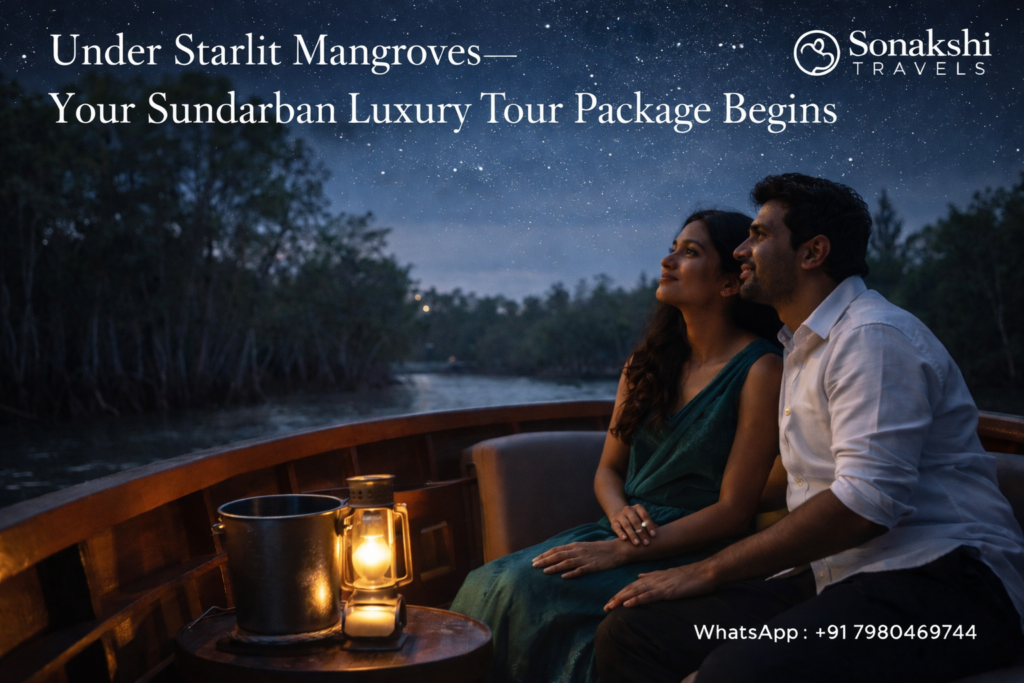
Luxury, at its most disciplined, is not defined by abundance; it is defined by intention. A Sundarban luxury experience begins not with spectacle, but with calibration—of pace, of perception, of presence—so that the first meaningful detail is allowed to register. For readers seeking a grounded perspective on how such journeys are designed and curated, the broader information architecture of SundarbanTravel.com provides essential context without distracting from the core experience described here.
The opening gesture may be simple: a glass raised beneath a darkening sky, the river surface mirroring constellations, mangroves holding their silhouettes without drama. Yet within that gesture lies a deliberate shift from ordinary movement to attentive immersion. This journey is structured around privacy, sensory depth, and ecological intimacy. It is designed for those who understand that exclusivity in a fragile delta ecosystem is not about insulating oneself from nature, but about entering it with restraint, respect, and operational care.
Redefining Luxury in a Living Delta
Conventional hospitality often equates refinement with architectural display. In contrast, a luxury format in the delta reframes sophistication through spatial restraint and ecological alignment. The ceiling is open sky; the corridor is a tidal channel; illumination is lunar and tidal rather than uniform and electric. This is one reason many travellers begin their orientation through an overview of the region’s on-water experience on the Sundarban tour page, which clarifies how the landscape itself becomes the primary “interior.”
This distinction matters because the Sundarbans function as an intertidal system with constantly shifting boundaries. Operating within such an environment requires calibrated movement, limited acoustic disruption, and infrastructural sensitivity. A private luxury format reduces pressure by limiting group density and enabling controlled navigation through creeks and river passages, rather than compressing multiple parties into the same observational windows.
The outcome is an experience that feels expansive without becoming intrusive. Luxury becomes the discipline of reducing friction—between guest and guide, between vessel and water, between expectation and reality—so the environment can remain the dominant presence.
Privacy as Ecological and Psychological Value
In high-density group travel, ecological immersion competes with human noise, queueing, and social pacing. A carefully designed private format mitigates that dynamic by limiting participation to a dedicated group, keeping the acoustic field intact. The soundscape—wind through pneumatophores, distant bird calls, the subtle break of tidal current—remains perceptible in the foreground rather than being pushed into the background by conversation and movement.
Research on restorative environments suggests that natural settings can reduce cognitive fatigue when attention is not repeatedly interrupted by competing stimuli. Privacy, therefore, is not merely a comfort choice; it is a mechanism for deeper recalibration. Without crowd dynamics, the mind settles more easily into sustained observation, which is the condition under which this landscape reveals its finer textures.
The Ritual of the First Evening
The symbolic beginning of the journey is often marked by a quiet ceremony: champagne opened beneath a sky that is gradually dimming rather than abruptly dark. The ritual is understated. It does not attempt to dominate the forest’s atmosphere; it acknowledges it, and then steps back.
The timing is deliberate. Twilight in a mangrove ecosystem carries transitional acoustics. Diurnal species recede, nocturnal movements begin, and water currents subtly change with tidal progression. Raising a glass during this threshold hour creates a conscious pause between human tempo and ecological rhythm—an early signal that the journey will be shaped by the delta’s timing rather than a traveller’s impatience.
Sensory Layering
Luxury here is not sensory overload; it is sensory clarity. The experience engages all five senses without forcing any one of them into dominance:
- The visual field: moonlight diffused across tidal water.
- The auditory field: a low-frequency chorus of insects and distant fauna.
- The olfactory field: brackish air carrying silt, salt, and mangrove resin.
- The tactile field: softened deck wood beneath bare feet.
- The gustatory field: a measured sip, effervescent and cool.
These layers converge without hierarchy. Environmental psychologists describe a related state as “soft fascination,” in which attention is held gently rather than grabbed aggressively. In practice, this produces the mental conditions for introspection and emotional clarity—one reason the first evening often remains the most vividly recalled segment of the entire experience.
Architecture of the Vessel
The boat at the center of this experience is not conceived merely as transport. It functions as an adaptive floating habitat engineered to balance comfort with ecological compliance. Many travellers prefer to understand this format through a dedicated overview of the operator-led private framework, such as the guidance offered on the private luxury tour page, because the vessel’s design choices are inseparable from the quality of immersion.
Spatial Design
Cabins are proportioned to maintain airflow and privacy without overbuilding. Air-conditioning, where present, is calibrated for efficiency rather than brute force, and attached baths are designed with water conservation in mind—an operational ethic that matters in a landscape where freshwater and salinity exist in delicate relation.
The upper deck serves as both observation platform and contemplative space. Its open design supports 360-degree viewing, reducing the need for constant movement and allowing guests to remain in one place while the landscape changes around them. Reading lounges and seating arrangements are positioned to reduce glare and maintain unobstructed sightlines, so attention stays outward rather than being pulled inward by discomfort.
Material Integrity
Interior finishes commonly integrate bamboo, treated wood, and natural textiles. These materials are selected not only for aesthetic warmth, but also for thermal moderation and reduced chemical off-gassing. In a humid mangrove environment, material integrity directly affects comfort, air quality, and the subtle sense of calm that distinguishes refined hospitality from superficial luxury.
Operationally, engine calibration prioritises low vibration output. Reduced vibration translates into quieter navigation and more stable viewing conditions, supporting both ecological sensitivity and guest wellbeing. When motion feels steady and sound remains low, observation becomes easier and less fatiguing.
Guided Presence Rather than Guided Performance
A defining feature of a refined, private-format journey is the interpretive approach of the naturalist guide. Interpretation here is not theatrical narration; it is contextual explanation delivered with restraint. For travellers evaluating how guidance shapes immersion, the broader planning perspective described under a well-structured Sundarban tour package overview can be useful, because it clarifies the difference between itinerary narration and ecological interpretation.
The mangrove ecosystem is biologically intricate. Root structures act as stabilisers and filtration systems. Salinity gradients influence species distribution. Tidal flux shapes feeding patterns and movement corridors. A skilled guide translates these processes in situ, allowing observation to evolve into understanding. The guest does not merely “see” the landscape; they learn how it works, and why restraint is essential to experiencing it.
Bonbibi and Cultural Memory
When local narratives such as Bonbibi are introduced, they are best framed as cultural ecology: communities articulating ethics, risk, and reverence in a living landscape that can be both sustaining and dangerous. In a luxury framework, this matters because it prevents romanticisation. The story becomes interpretive context rather than entertainment, deepening engagement without sensationalism.
Wildlife Encounters in a Private Format
The possibility of observing species such as the Royal Bengal Tiger or the estuarine crocodile is never staged. In a well-run luxury setting, anticipation is balanced with ethical restraint. The objective is not to extract a sighting, but to enter wildlife space in a manner that keeps animal behaviour unaltered.
Private navigation permits extended stillness in suitable zones. Rather than competing with multiple vessels for position, the boat can hold at respectful distance, allowing observation to occur without crowd pressure. This increases the likelihood of authentic encounters while reducing stress on wildlife, which is both an ethical requirement and a practical advantage for those who value realism over spectacle.
Avian Micro-Moments
Often, the most enduring moments involve subtler fauna: a kingfisher’s plunge, a brahminy kite tracing circles above tidal flats, the synchronized movement of mudskippers along exposed banks. These micro-moments become visible only when noise and haste are absent. Private pacing allows time for attention to refine itself, which is why small observations frequently feel more significant than headline sightings.
Culinary Expression on Water
Dining aboard a luxury-format vessel is structured around freshness and locality, with preparation planned in measured quantities to reduce waste and preserve quality. Culinary experience is not presented as performance; it is part of a coherent rhythm designed to support comfort and attentiveness rather than to distract from the landscape.
Deckside Evenings
Candle-lit dinners on the deck serve both atmospheric and practical functions. Low lighting preserves night vision and avoids unnecessary insect attraction; it also allows the sky to remain visible rather than washed out by bright fixtures. In this context, illumination is treated as a design variable, not an afterthought.
Organic fish preparations and regional Bengali cuisine are typically presented with an emphasis on flavour integrity and digestive ease. Heavy gastronomy may impress in an urban dining room, but in humid environments it can interfere with rest and alertness. The more refined approach is quietly functional: satisfying, well-balanced meals that sustain comfort without dominating the evening.
Silence as Premium Commodity
Modern urban environments are saturated with high-frequency noise, interruptions, and persistent alertness. The Sundarbans offer a contrasting acoustic architecture. In a private luxury setting, silence is not accidental; it is curated through route choices, anchoring decisions, and disciplined onboard behaviour.
Anchoring locations are selected to balance safety, ecological guidelines, and acoustic depth. When engines cease, the delta resumes audible dominance. Fireflies punctuate darkness, water laps gently against hull timber, and the absence of mechanical hum becomes tangible. In a well-calibrated experience, silence is treated as an asset to protect rather than an emptiness to fill.
Neurophysiological Response
Studies on nature-based immersion indicate reductions in cortisol and improvements in parasympathetic activation after exposure to biodiverse, low-noise environments. A private luxury format can amplify these benefits by reducing social friction and scheduling pressure. When the body is no longer bracing for interruptions, attention becomes steadier, and the landscape feels less like scenery and more like a living field of presence.
Operational Precision and Ethical Framework
Behind visible elegance lies logistical rigour. Permits, tidal calculations, crew coordination, and safety compliance must be executed precisely, because in an intertidal ecosystem errors are magnified. Seamlessness for the guest is not luck; it is the outcome of disciplined planning and experienced operations.
Safety briefings are delivered succinctly, and emergency equipment is integrated unobtrusively rather than displayed as theatre. Crew members are trained not only in navigation, but also in ecological awareness and guest confidentiality. For travellers who want this level of privacy to remain uncompromised even during short-format travel, a similarly controlled design is sometimes explored through an overnight Sundarban plan that retains the core operational logic while compressing time.
Transformation through Immersion
The culmination of this experience is not measured in photographs or checklists. It manifests as altered perception: a sharpened ability to notice, a steadier emotional register, a quieter internal tempo. Guests often describe returning with heightened sensory awareness—not because the tour “adds” something, but because it removes constant interference.
The champagne beneath starlit mangroves, though symbolically prominent, is secondary to the shift it represents. It marks a boundary between habitual acceleration and deliberate stillness. The forest does not perform; it persists. In that persistence, many travellers encounter a quieter dimension of themselves—one that is typically crowded out by urban speed and social demands.
Conclusion: A Beginning, Not an Escape
Your Sundarban luxury experience may begin with a toast, but it does not end with it. The journey establishes a template for how travel can be conducted with privacy, ecological restraint, interpretive depth, and quiet competence. The most persuasive feature is not indulgence, but coherence: every element supports attention rather than dispersing it.
In the measured clink of glass beneath mangrove constellations lies an invitation to engage wilderness without domination, to seek comfort without excess, and to let silence speak without interruption. Luxury here is not an assertion; it is alignment—between human presence and a landscape that is alive, complex, and worthy of restraint.
And in that alignment, something enduring begins.